
I’ve been a fully paid TradingView subscriber for eight years and use it daily. My verdict: it is my top all-round charting recommendation for traders who want to analyze stocks, ETFs, forex, and cryptocurrencies in one place.
TradingView earns a AAA 4.75 in my independent 58-point testing framework. Its strongest qualities are fast, flexible charts, powerful screening, and a community that makes the platform far more useful than a collection of standard indicators.
I personally use Premium, and have also implemented my MOSES ETF strategy in TradingView. Those are practical reasons I continue paying, but not reasons every trader needs the same subscription.
The drawbacks matter. Real-time exchange data can cost extra, custom strategy development has a learning curve, and support is a weaker area in my assessment.
Verdict
My testing shows TradingView is best for international stock, FX, and cryptocurrency traders. It’s the ultimate all-rounder with a global community, heatmaps, broker integration, pattern recognition, backtesting, and screening.
Additionally, TradingView offers excellent backtesting capabilities and a thriving trading community, making it a great choice for international traders.
My recommendation: Start free. Pay when you can identify a specific feature or limit that is holding back your analysis.
TradingView Review Results & Ratings
TradingView is the world’s premier trading platform, trusted by over 20 million active traders. It offers a seamless blend of powerful charting tools, advanced screening features, and in-depth analysis, covering a wide range of assets, including stocks, indices, ETFs, and cryptocurrencies.
| Test | Tier | Score | Average |
|---|---|---|---|
| Composite Lab Performance Score | AAA | 4.75 | 4.21 |
| Pricing Index: $ per Day | AA | $1.97 | $2.74 |
| Value Score (VP) | AA | 4.37 | 2.82 |
| Speed & Ease of Use | AAA | 5.00 | 4.50 |
| Chart Analysis Depth Index | AAA | 5.00 | 3.17 |
| Chart Pattern Depth & Accuracy | B | 3.98 | 2.73 |
| Scanning Performance | AAA | 4.83 | 3.38 |
| Backtesting Performance | A | 4.19 | 3.38 |
| Trading Bot & Auto-Trading Reliability | B | 3.50 | 2.50 |
| AI & Algo Index | A | 4.00 | 2.00 |
| Alert Speed | AA | 4.67 | 3.67 |
| Trade Signal Quality | C | 2.50 | 0.00 |
| Broker Connectivity & Ecosystem Depth | AAA | 5.00 | 1.55 |
| Portfolio Tool Performance | B | 3.60 | 2.80 |
| Financial News Speed & Depth | B | 3.00 | 2.30 |
| Community Utility Index (CUI) | AAA | 5.00 | 3.25 |
| Support Infrastructure & SLA Audit | B | 3.25 | 3.75 |
Tested using benchmarking system v3.
See the 2026 v3 58-point TradingView test and benchmarks.
Pros
✔ 20 million users sharing ideas
✔ AAA Speed & ease of use
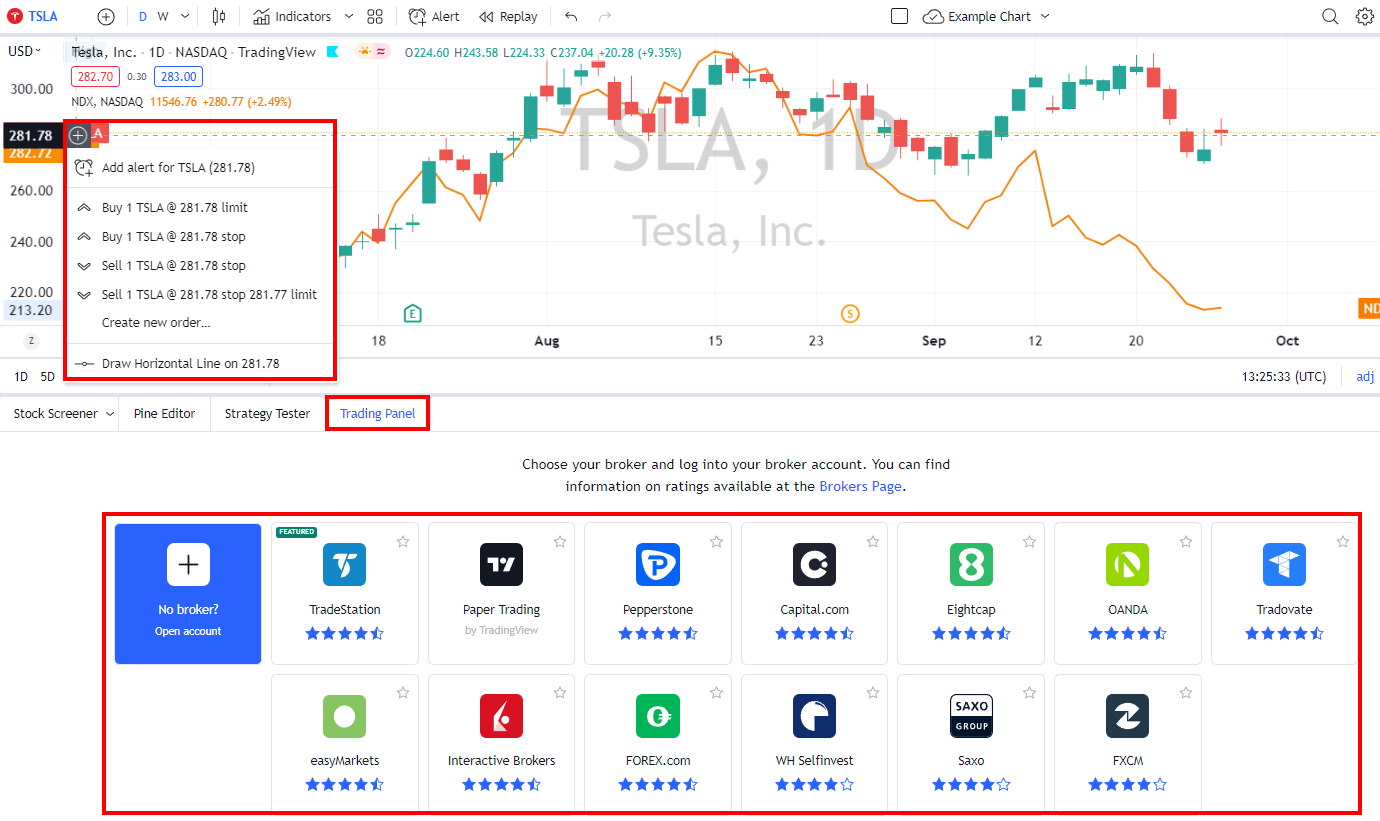
✔ Trading from charts
✔ Powerful screening and technical analysis
✔ All stock exchanges globally
✔ AAA Broker connectivity and asset coverage
✔ 100,000+ user-generated strategies
✔ Free and low-cost plans
✔ Flexible backtesting with Pine Script
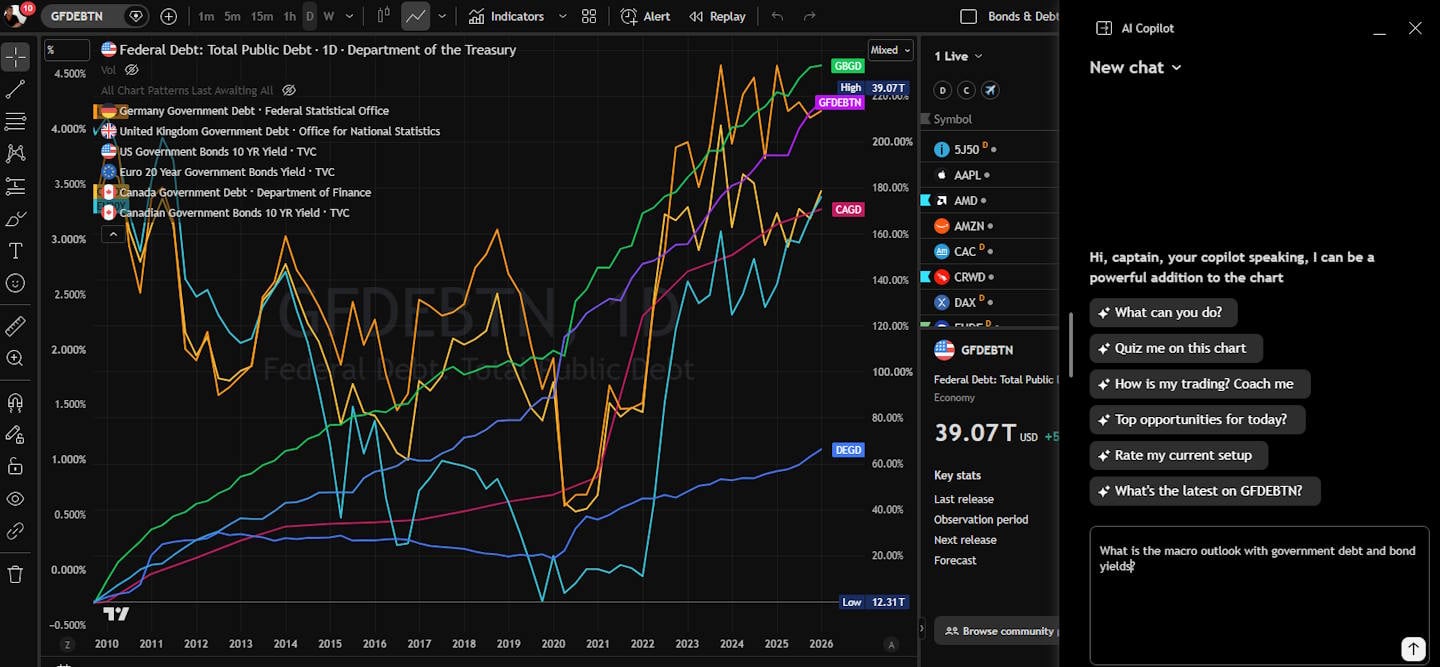
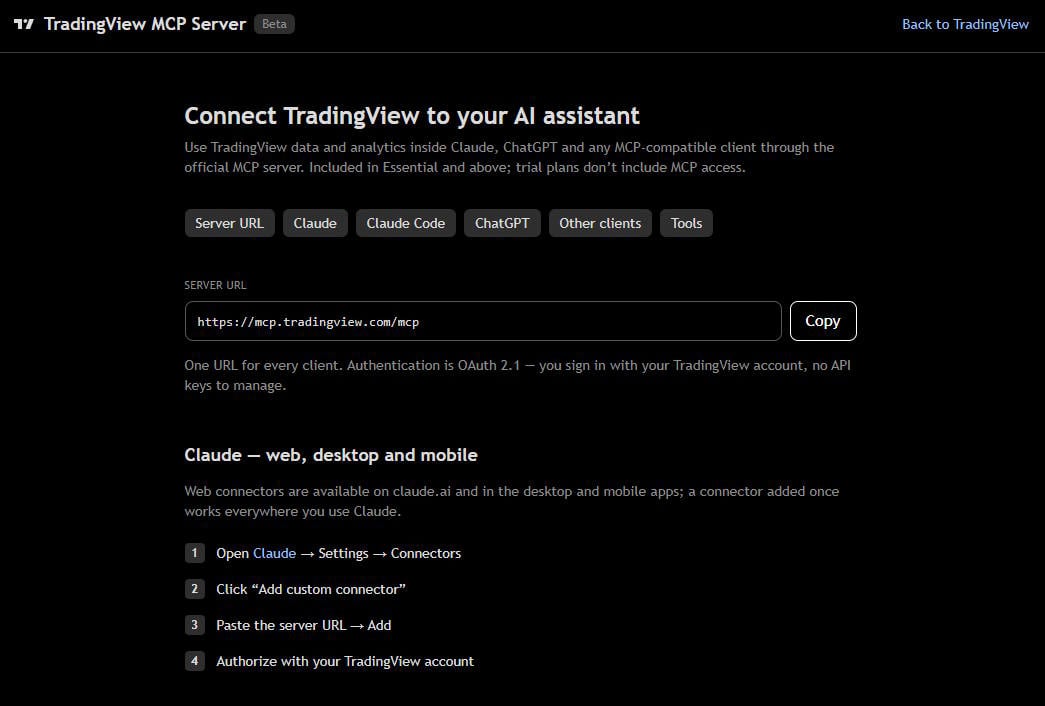
✔ New ChatBot & AI MCP Servers
Cons
✘ Not ideal for value or dividend investors
✘ Coding skills required for backtesting and custom indicators
✘ Average portfolio tools

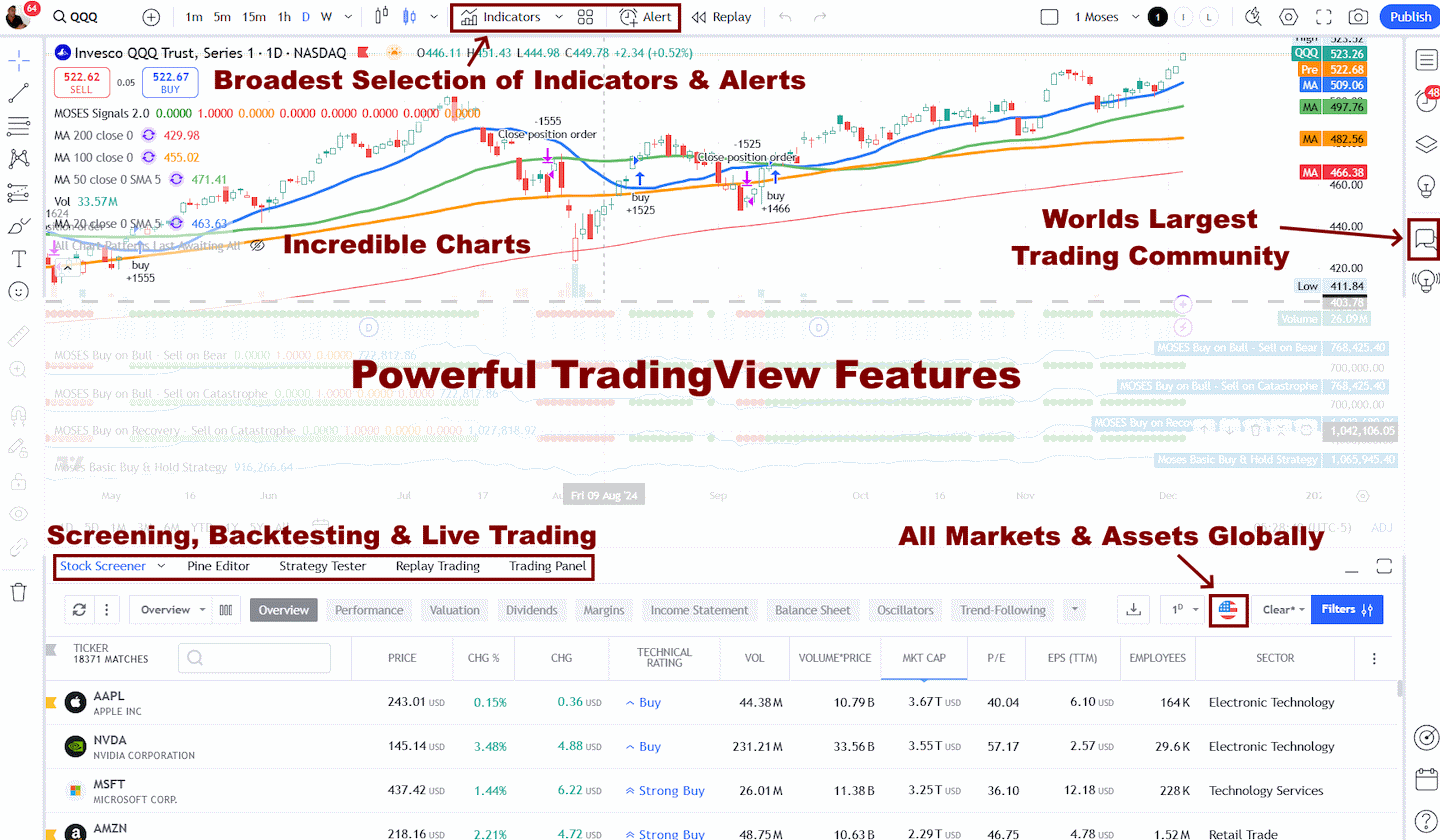
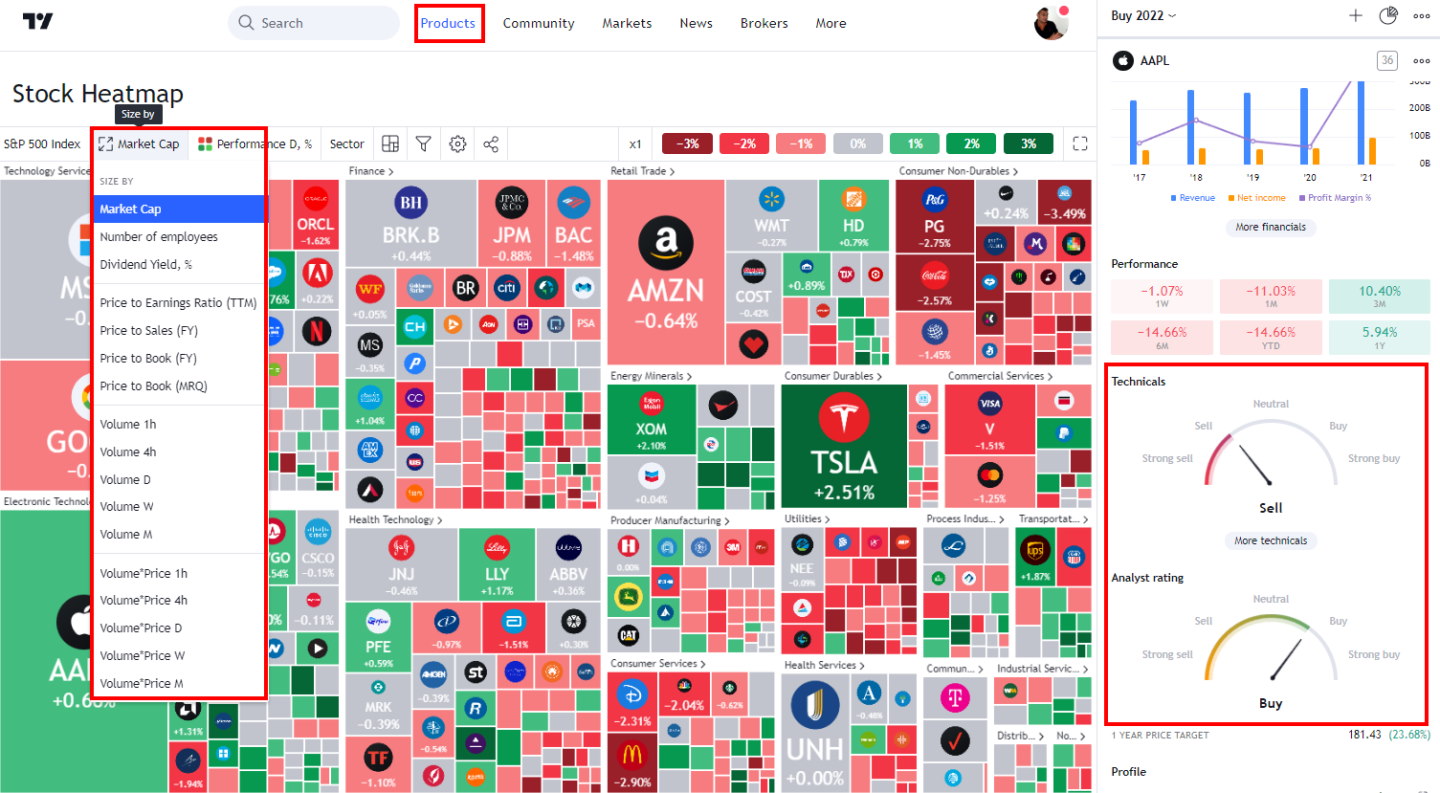
TradingView provides best-in-class technical analysis tools to analyze financial markets. It offers heatmaps, super charts, indicators, strategy development tools, and backtesting capabilities.
Its vibrant community of traders shares ideas, strategies, and custom indicators, making it an invaluable resource for learning and collaboration.
TradingView at a glance
| Question | My answer |
|---|---|
| What is it? | A charting, market analysis, and trading interface platform with screening, alerts, and community scripts. |
| Who is it best for? | Technical traders analyzing multiple markets, particularly active stock, ETF, forex, and crypto traders. |
| Is it free? | Yes. Basic is free, with restrictions; paid subscriptions expand access and capacity. |
| Which plan do I use? | Premium, with automated pattern recognition a particular attraction. |
| What do I like most? | Charting depth, ease of use, screening and the script-sharing ecosystem. |
| What should you check before paying? | Your required features, exchange-data costs, broker compatibility and renewal terms. |
Screenshot Highlights

Key Features
| ⚡ TradingView Features | Charts, News, Watchlists, Screening, Chart Pattern & Candlestick Recognition, Full Broker Integration |
| 🏆 Unique Features | Trading, Backtesting, Community, Global Stock, FX & Crypto Markets, Webhook Bot Integration |
| 🎯 Best for | Stock, FX & Crypto Traders |
| ♲ Subscription | Monthly, Yearly |
| 💰 Price | $0 | $15 | $35 | $70 See Pricing Guide |
| 🆓 Free | ✔ |
| 💻 OS | Web Browser|PC|IOS|Android |
| 🎮 Trial | Yes, Free 30-Day Premium |
| ✂ Discount | -17% on yearly plan + $15 Discount |
| 🌎 Region | Global |
My Video Review
What I Like & What To Watch Out For
1. Chart speed and deep analysis
TradingView earns 5.00 for speed and ease of use in my testing. My benchmark recorded a chart-loading time of 1.55 seconds with 200 price bars and two indicators. That supports my experience as a daily user: the platform makes it easy to move from an idea to a chart and start investigating.
What I appreciate most is the balance between accessibility and depth. Beginners can start with a straightforward chart, while experienced traders can build more detailed layouts. Performance will vary with your device, connection, and workspace, but TradingView’s interface remains one of its strongest selling points.
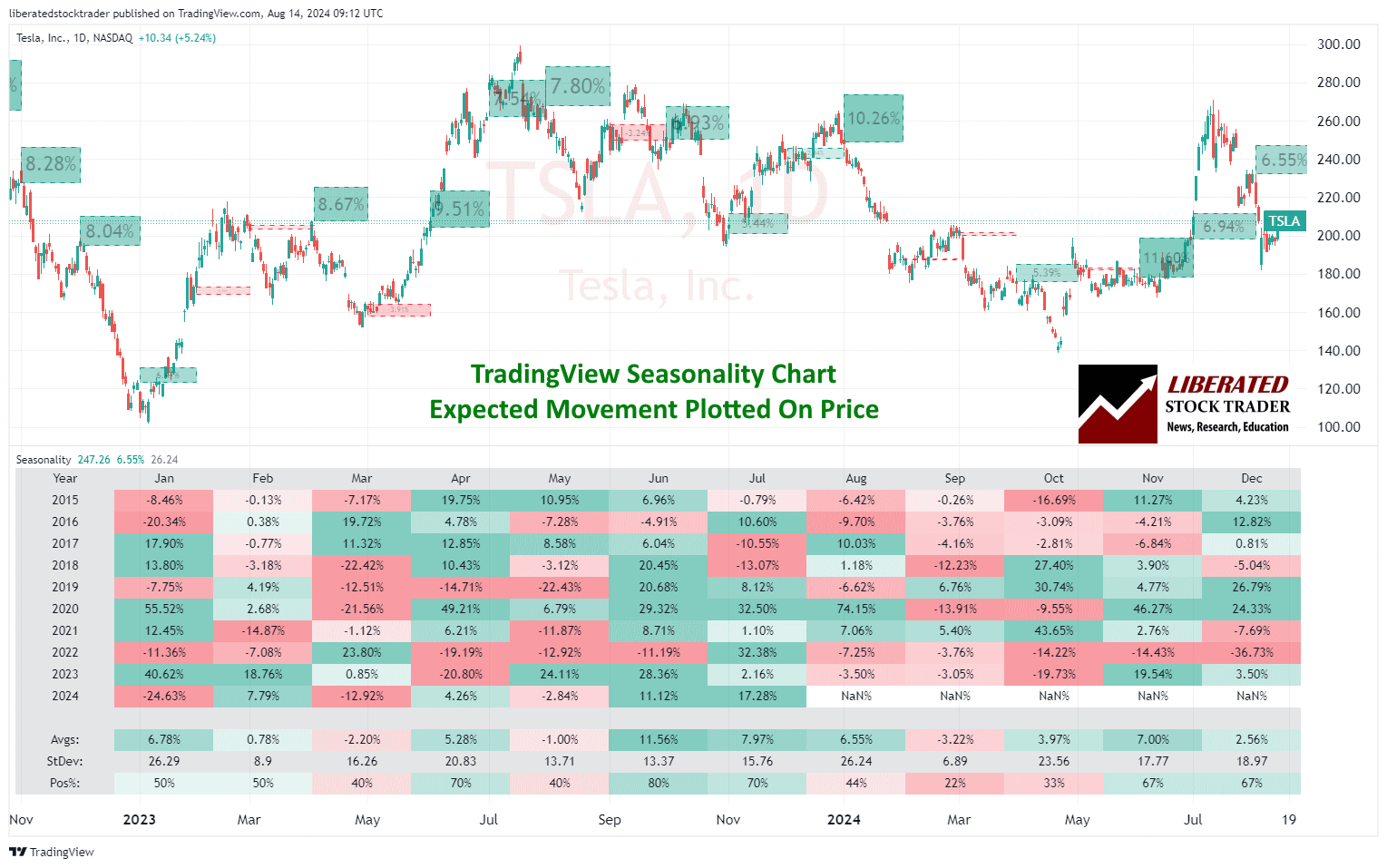
Charting is the main reason I recommend TradingView. It combines substantial analytical depth with an interface that doesn’t make every routine task feel like software administration.
TradingView receives 5.00 for chart analysis depth. Its combination of chart types, technical indicators, drawing tools, and custom scripting gives me considerable flexibility when investigating a market. I can examine the broader trend, study a potential entry, and compare timeframes within the same environment.
Automated Stock Indicator Ratings
Most people do not want to learn in-depth how each indicator works. This innovation allows you to save time by getting an instant readout of which indicators are bullish, bearish, or neutral.
The stock indicator ratings are well implemented, as they include two critical technical analysis indicators: price-based moving averages and price- and volume-based oscillators. Based on my observations, the TradingView buy and sell indicators are a good measure of sentiment and are featured in my Fear & Greed Index Dashboard.
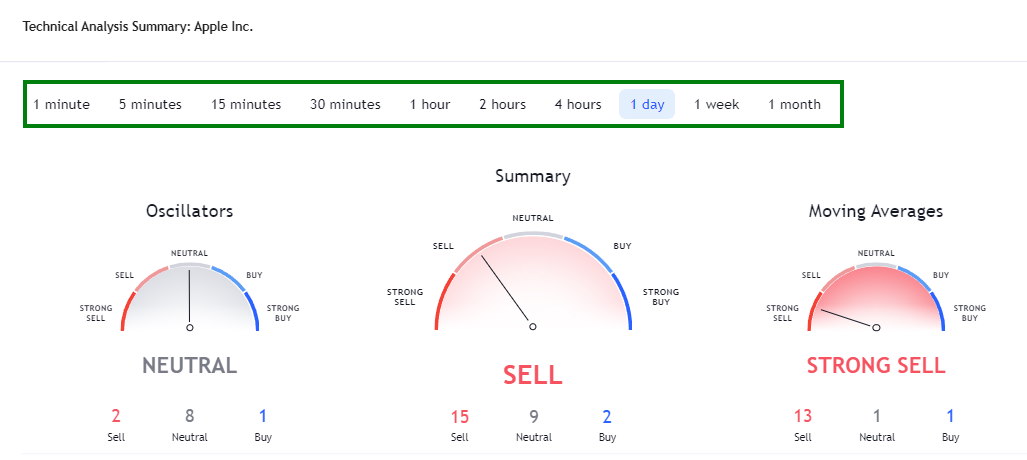
When viewing a chart, click “Technicals” to see three gauges. The left gauge shows the oscillating indicators, such as Relative Strength, Stochastics, and the Average Directional Index. On the right, you have a selection of Moving Averages, Simple, Exponential, and even Ichimoku Cloud.
Each indicator is averaged out to give an overall Buy, Sell, or Neutral Rating, making it an excellent implementation of automated technical analysis designed with the user in mind.
| Technical Charting | Rank | Chart Types | Indicators |
| TradingView | #1 | 17 | 160 |
The advantage is how these tools work together. I can keep a chart simple or develop a more specialized setup as my research requires. My advice is to add tools with a clear purpose: more indicators do not automatically produce better analysis.
2. Automated pattern recognition is genuinely useful
TradingView earns 3.98 for chart-pattern depth and accuracy. Automated chart-pattern recognition is one of my favorite Premium features. I particularly like the pattern explanations and projected price targets: they help turn a chart pattern into something you can investigate.
This is also an area where I want to be precise about what the software does. Detecting a pattern is not the same as identifying a profitable trade. A projected target is not a forecast you can rely on without further analysis.
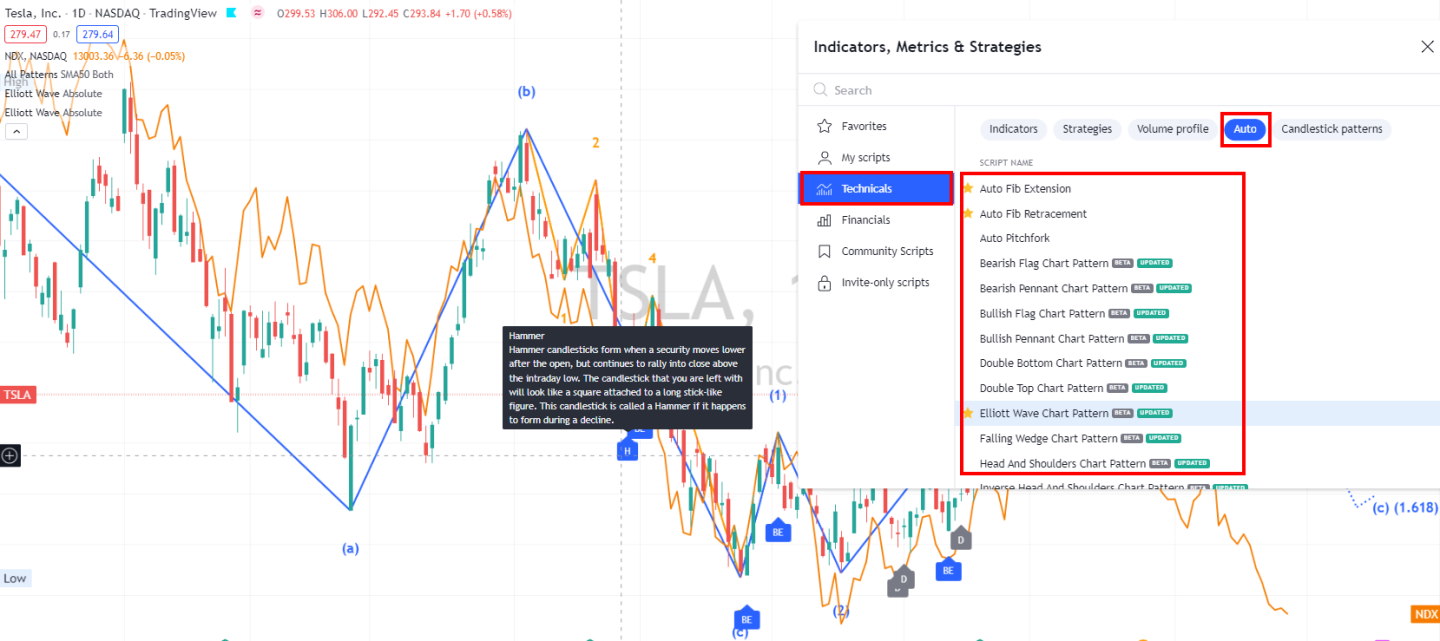
TradingView offers automated candlestick recognition for 48 patterns. The Candlestick pattern recognition works globally on stocks, ETFs, Forex, and cryptocurrencies.
In the image below, you can see that pattern recognition is intelligently implemented. The Bearish Engulfing (BE) pattern (highlighted in red below with a downward-pointing arrow) indicates that this candle is a bearish signal. You can also observe that the Doji (D) patterns are grey and pointing upwards, indicating a possible change in price direction.
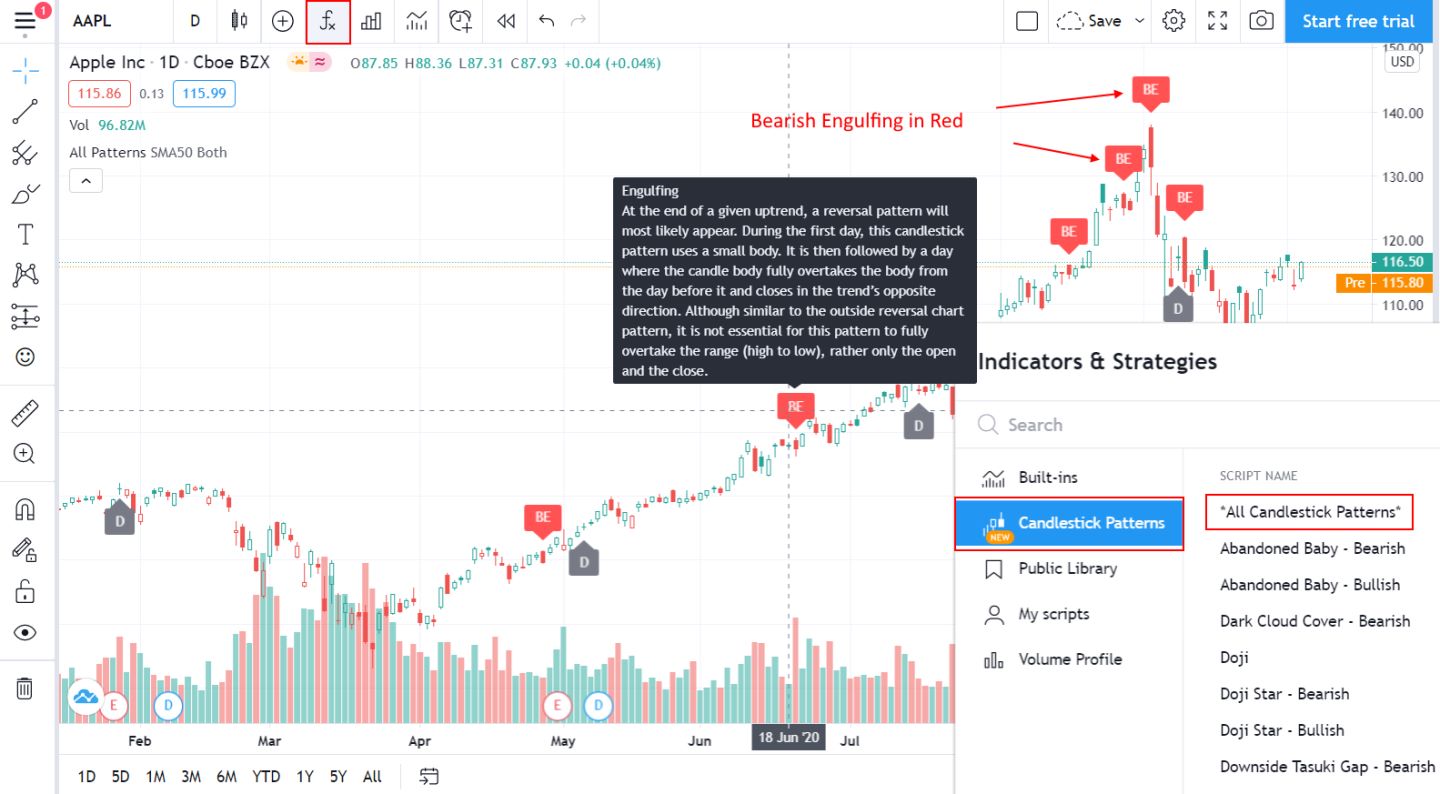
Finally, I like that you can hover your mouse over the pattern to get a full, detailed explanation of its meaning.
| Pattern Recognition Software | TradingView |
|---|---|
| # Candle Patterns Recognized | 40 |
| # Chart Patterns Recognized | 10 |
| Trendline Recognition | ✔ |
| Backtesting Patterns? | ✔ |
Table: TradingView Pattern Recognition. See the In-depth Best Pattern Recognition Software Review
3. Screening connects market research to charts
TradingView scores 4.83 for scanning performance. Its screening tools help narrow a large market into a manageable shortlist using technical and fundamental criteria. This is particularly useful when I want to move beyond familiar watchlist names and investigate instruments that meet a defined set of conditions.
Testing the TradingView stock screener shows it excels at screening for technical indicators. It provides real-time scanning and filtering on 172 metrics, including 42 financial filters. TradingView’s stock screener also includes a useful scan for technical buy and sell ratings.
TradingView’s screening watchlists have fundamental data separated into Performance, Valuation, Dividends, Margin, Income Statement, and Balance Sheet. TradingView stands out for its charting of economic indicators, such as comparing the civilian unemployment rate with growth in company profits. You can set the screening watchlist and filters to refresh every minute.
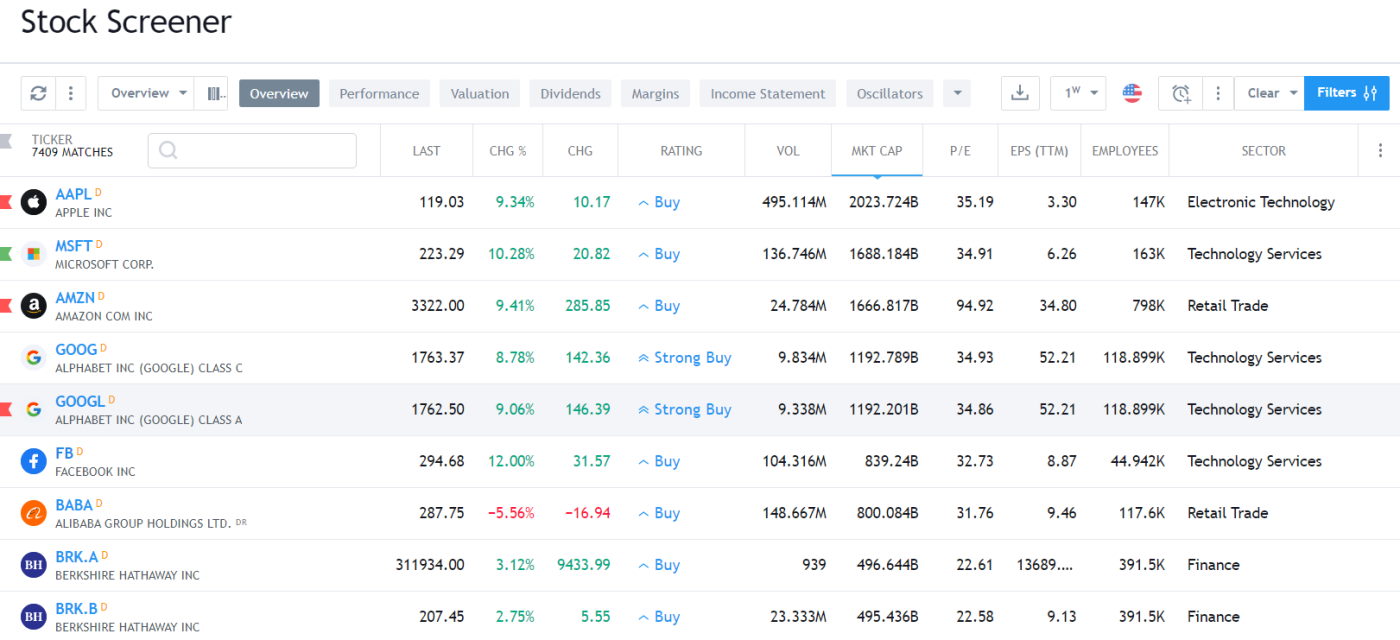
Another great thing about the screener implementation is that it is highly customizable; you can configure the columns and filters exactly how you like. As you can see above, I have updated the overview screen to include the number of employees, P/E, and TTM EPS.
The connection between screening and chart analysis is a major strength. Once a candidate appears, I can examine its price structure and decide whether it deserves further research. A screening match is a starting point, though: it does not establish investment quality or an attractive trade on its own.
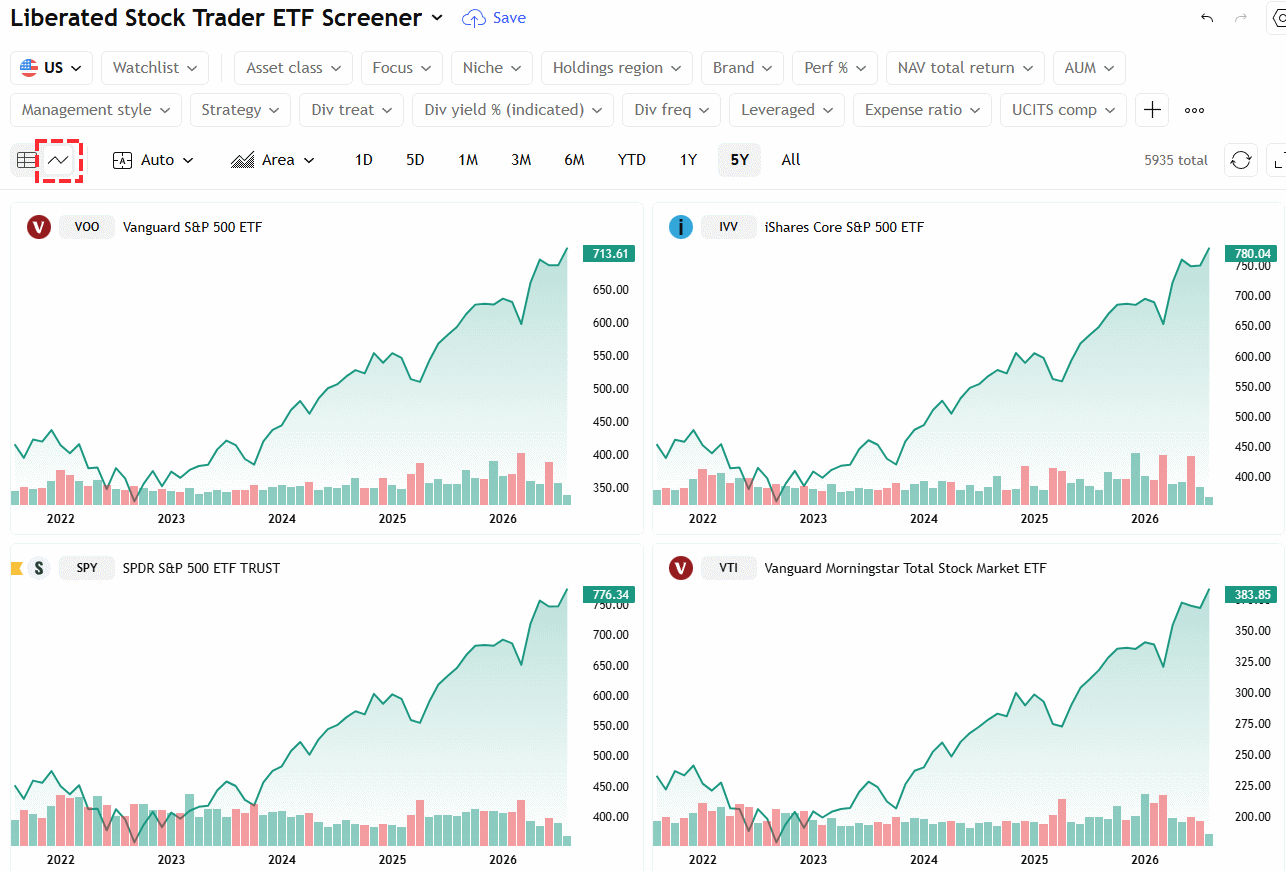
TradingView’s Forex screener shows the major and minor pairs by default, and you can add exotic FX pairs. You can also filter on rising and falling FX pairs and set alerts directly from the screener.
TradingView’s ability to provide crypto screening is unique. The cryptocurrency rating system lets you select cryptos rated “strong sell” for short trades and “strong buy” for long trades, saving you a lot of time.
4. Pine Script & Backtesting flexibility
TradingView receives 4.19 for backtesting performance. I have implemented my MOSES ETF strategy on TradingView, which has given me a practical appreciation of its flexibility. Pine Script and the Strategy Tester let users translate trading rules into a strategy and investigate how those rules behaved historically.
TradingView has an active community of developers and sellers of stock analysis systems. With the premium-level service, you can create and sell your own. The community also offers many indicators and systems for free.
I like that you have results in a few clicks [strategy tester -> Add Strategy]. You can also tweak the strategy parameters, as shown below, and observe the results.
I have even implemented my MOSES ETF Trading strategy into TradingView (see image below); I am no developer, but the Pine Script language is so natural that anyone can do it.
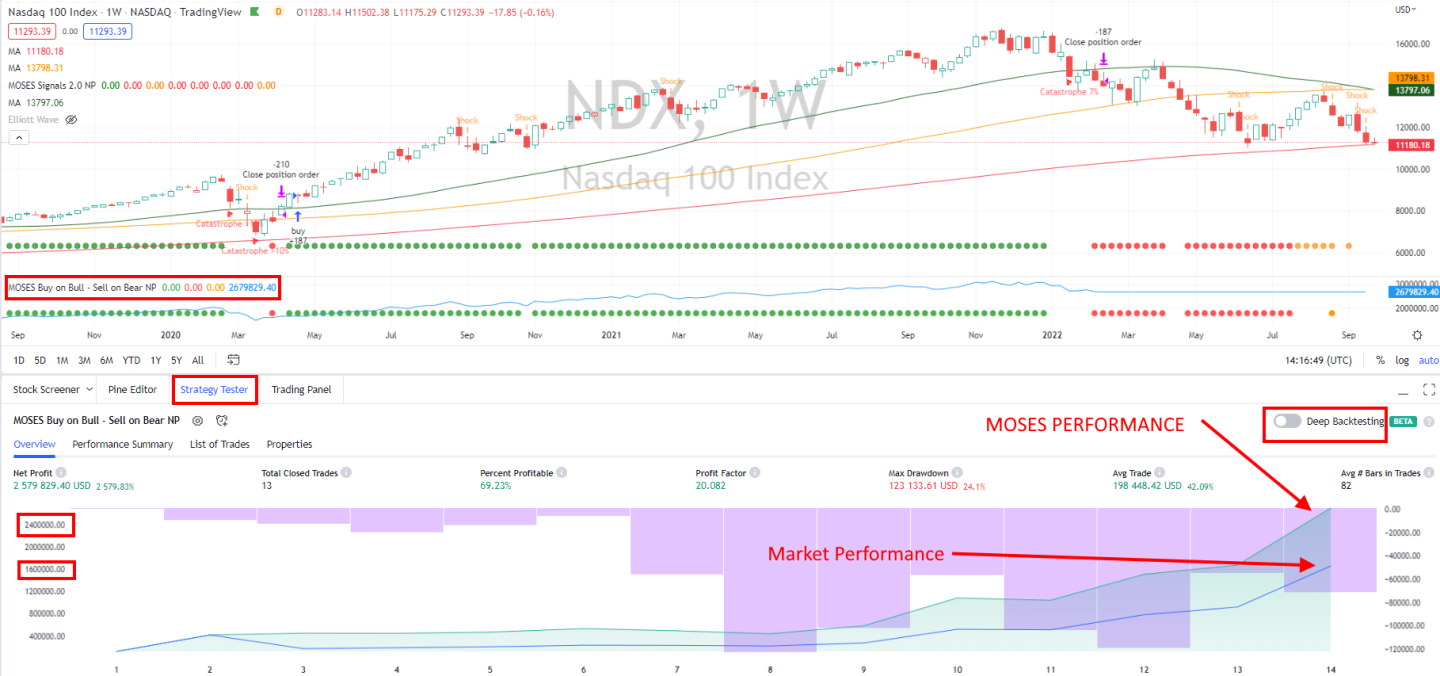
TradingView’s backtesting reports show net profit, drawdown, buy-and-hold return, percentage of profitable trades, and the number of trades.
TradingView also offers market replay functionality, allowing you to play back the timeline. It shows the chart scrolling and the trades executed; all buy and sell orders are drawn on the chart and highlighted.
Pine Script lets users build custom indicators and strategies. TradingView’s Strategy Tester can then simulate strategy behavior on historical data. However, simulations depend on the script, data, and execution assumptions; TradingView documents the role of its broker emulator and settings such as commission and slippage.
The main challenge is understanding both the code and the assumptions behind the results. Custom strategies may require programming knowledge, while costs, execution assumptions, and the chosen test period can materially affect a backtest. I value TradingView as a research tool, but historical performance should be examined carefully before informing live decisions.
You can use existing community scripts without becoming a programmer. But if you want a strategy tailored closely to your own rules, expect to learn some Pine Script or obtain coding help. My implementation should not be mistaken for proof that every strategy is easy to build—or profitable.
5. The community adds depth, provided you stay selective
TradingView’s community is a significant part of its appeal. TradingView earns 5.00 for community utility. Shared charts, explanations, and custom scripts extend its value well beyond the built-in tools. I particularly appreciate the opportunity to explore how other traders approach a market and discover ideas that can inform further research.
Selectivity is essential. A popular author or widely used indicator does not automatically provide reliable trading guidance. I treat community contributions as material to investigate: understand the reasoning, examine the limitations, and test relevant claims before incorporating someone else’s work into your own approach.
Check out my published ideas on TradingView and follow me for regular market and stock analysis ideas and commentary.
Join me and 20 million traders on TradingView for free. It's a great place to chart, scan, trade, and get my latest trading ideas and analysis.
My preference is to treat that material as research input. An interesting script deserves investigation; a popular idea does not deserve an automatic trade.
Look for a clear explanation of what a script calculates, how it behaves as new data arrives, and where its limitations lie. Be especially cautious about claims built around perfect-looking historical signals.
The platform’s usefulness comes partly from letting you explore other people’s work. Responsibility for understanding that work remains with you.
6. Alerts help turn analysis into a repeatable process
TradingView earns 4.67 for alert speed in my testing. Alerts help make analysis repeatable by notifying you when a condition warrants attention. Their practical benefit is reducing the need to keep checking a chart while waiting for something specific to happen.
The quality of an alert depends on the condition you define and how you respond. I would use a notification to revisit a setup and assess the current context before acting. If alerts feed an external automation system, that connection needs separate testing; an alert-speed rating does not measure end-to-end trade execution.
7. Deep broker and exchange integration matters
TradingView earns 4.67 for alert speed in my testing. Alerts help make analysis repeatable by notifying you when a condition warrants attention. Their practical benefit is reducing the need to keep checking a chart while waiting for something specific to happen.
The quality of an alert depends on the condition you define and how you respond. I would use a notification to revisit a setup and assess the current context before acting. If alerts feed an external automation system, that connection needs separate testing; an alert-speed rating does not measure end-to-end trade execution.
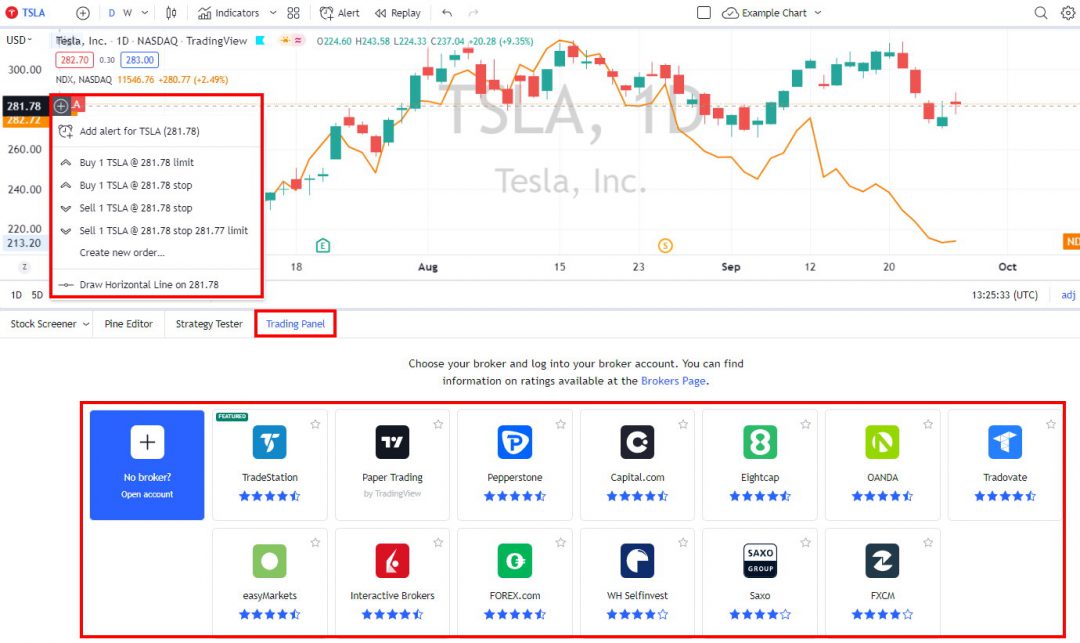
TradingView pulls data from 13 American, 9 European, and 30 Asian exchanges. It also covers all major cryptocurrency exchanges, foreign exchange, and commodity futures markets.
With TradingView, you can trade stocks and indices globally, as well as major and minor foreign currencies. Additionally, one can trade energy, metals, agricultural futures, and all major cryptocurrencies.
- Stocks – 90% of the world’s stock markets are covered.
- Forex (FX) Currencies – All the Major, Minor, and Exotic currencies covered
- Futures – Energy, Metals, Agriculture, Indices, and even Interest Rates
- Cryptocurrencies – 26, including Bitcoin, Ripple, Ethereum, Bitcoin Cash
- Bonds – 30+ Government Bond Types
Real-time exchange data can be an additional expense
A TradingView subscription and exchange market data are different purchases. Some real-time exchange feeds require an additional subscription. Before paying, check the precise symbol, exchange and data status you need; don’t assume a paid charting plan includes every real-time feed. TradingView explains these distinctions in its market-data purchasing guide.
This matters especially if your analysis depends on intraday prices or volume. The right question is not simply “Does TradingView have live data?” It is “Does my account have the feed I need for this instrument?”
Support is not a reason I recommend the platform
My support-infrastructure assessment rating 3.29 is less favorable than my assessment of the charts. If fast access to help is critical to your workflow, investigate the available support route before committing to a subscription.
Customer reviews also raise support and billing concerns. Those reports deserve attention, but they are individual accounts rather than controlled tests or proof that every customer will have the same experience.
I would record the trial end date, check the renewal amount, understand cancellation terms and keep confirmation of any subscription change. A product can have excellent analytical tools and still disappoint someone dealing with a billing problem.
Charting depth does not make it a complete portfolio-research system
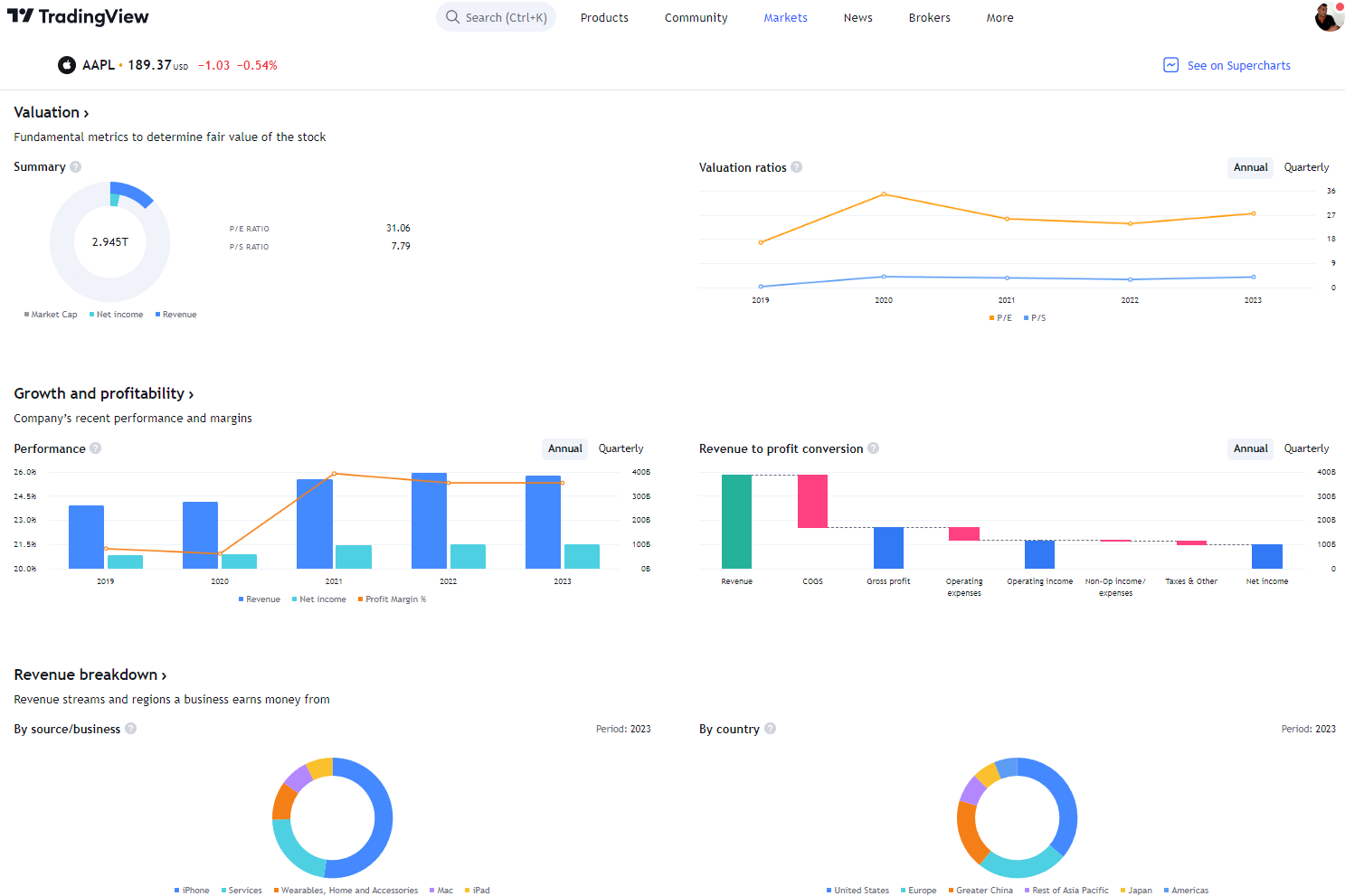
TradingView is strongest in my assessment when the chart is central to the decision. I am less enthusiastic about it as the main tool for someone whose priorities are portfolio construction, dividend research, or detailed fundamental comparisons.
That does not mean it lacks financial information. It means you should choose software around your principal task. An excellent charting platform can still be the wrong first purchase for a long-term investor who rarely studies charts.
Broker integration needs checking at the account level
TradingView can connect to supported brokers, but the charting platform and brokerage account remain different services. The broker handles your account and execution; instrument availability and trading functions depend on the connection.
Don’t choose a broker simply because its logo appears in a compatible-broker list. Check your region, account type, instruments and required order functions. If a feature is essential to your trading, verify it directly with the broker before relying on the integration.
You can also use TradingView for analysis without making it your trade-entry interface.
Is TradingView trustworthy? Why customer reviews differ
I regard TradingView as a legitimate and useful analytical platform, and my eight years as a paid user underpin that opinion. That is not a guarantee of uninterrupted service, investment outcomes, or every interaction with customer support.
It helps to separate three questions:
- Are the charts and research tools useful? In my experience, yes. That is the core of my recommendation.
- Is billing fair and transparent? Yes, in my 8 years of using and interacting with TradingView, they have never let me down.
- Should you trust a trading idea published by another user? Only after assessing it independently, take every idea with a pinch of salt.
My recommendation rests on my own experience and testing, with the stated limitations—not on dismissing dissatisfied customers or treating an average external review as a technical benchmark.
Is TradingView free, and when is a paid plan worth it?
TradingView’s free Basic plan is a sensible starting point. At the time of checking, it provides one chart per tab and two indicators per chart. Paid plans expand limits and feature access; consult the official plan comparison for current entitlements.
The decision should start with what you need to do:
| Your situation | My recommendation |
|---|---|
| Learning to read charts or checking a small watchlist | Start with Basic and learn the workflow before paying. |
| Repeatedly running into chart, indicator, or alert limits | Identify the lowest paid plan that removes those particular restrictions. |
| Wanting the automated pattern tools I discuss here | Check current access to Premium features and try the tools before committing. |
| Requiring specialist capacity or advanced features | Compare the exact entitlement you need; don’t buy the highest tier by default. |
The premium plan is worth it to me because I use features that matter for my analysis. That does not make it the best value for a beginner who needs a clean chart and a couple of indicators.
For current subscription costs, monthly versus annual billing, plan comparisons and available offers, see my dedicated TradingView pricing and plans guide. Include any exchange data charges in your total budget.
Who I recommend TradingView for—and who should look elsewhere
I recommend it most strongly for: technical traders who want flexible charting across markets, screeners to support their research, and the option to build or adapt indicators and strategies. It suits a trader who wants to investigate opportunities rather than receive a list of trades.
I would be more cautious if your priority is advanced portfolio research, an entirely no-code strategy-development workflow, dedicated execution functionality, or rapid human support. Define the requirement first, then compare tools against it.
There isn’t one universal “better than TradingView” answer. A tool that is better at your most important task can be a better purchase even if it offers fewer features overall. Use my trading tools finder to compare platforms by the job you need them to do.
My final verdict
After eight years as a paid user, I continue to recommend TradingView for its charts, screening, flexibility and community. My overall test rating is 4.75.
The strongest reason to buy it is that its tools improve your research workflow. The weakest reason is the hope that more indicators or a more expensive plan will make trading decisions for you.
Start free, work out what you genuinely need, and upgrade only when you can explain the benefit. If you are ready to compare subscriptions, my TradingView pricing guide is the next step.
FAQ
Is TradingView good for beginners?
Yes, particularly for learning charts and technical analysis. Start with the free plan, a small watchlist, and a simple chart. Avoid paying for extra complexity before you understand how it improves your decisions.
Is TradingView Premium worth it?
It is for me, particularly because I value automated chart-pattern recognition. For someone using only basic charting, it may be unnecessary. Match the subscription to the features you will actually use.
Can you trade directly through TradingView?
You can place trades through supported broker connections. Compatibility and available functions vary, so verify your particular account and instruments. TradingView is not a substitute for evaluating the broker holding your trading account.
Does TradingView provide profitable trading signals?
Indicators, pattern detections and community ideas are analytical inputs, not promises of profit. You still need to understand the method, evaluate its limitations, and manage risk. A good-looking backtest does not establish future performance.
Is TradingView better than MetaTrader?
Yes, TradingView is better than MT4 and MT5 for stock, crypto, and ETF traders because it offers a huge social trading community, better charts, more indicators, and global market scanning. For currency trading, MetaTrader offers better algorithmic trading.
Can you use TradingView in Europe or Asia?
Yes, TradingView is available to use in Europe. In fact, TradingView covers 52 exchanges worldwide so that it can be used in the Americas, Europe, and Asia. TradingView is also very popular in India.
26/09/2026 – Update to TradingView AI Rating with ChatBot (Copilot) & Addition of AI MCP Server.

Hi Ron, thanks for the question, Yes, candlestick pattern recognition is available for free in the free version. Go to: Indicators -> Technicals -> Patterns and scroll down the list to get to Candlestick Patterns.
Barry
I have the free version of Trading View and could not find some of the things you discussed in your video; for example, the technical analysis stock screener, and candle stick patterns. Is that because you are using the Pro version? Where can I go to learn more about how Trading View works. I currently use Thinkorswim for charting and trading.
Thanks,
Ron
Hi Mike, I just tested it for you.
Can the screener scene for OTC only? YES
And scan OTC for intraday real time biggest gainers? YES
Does it have full Level 2 depth for OTC? NO
Barry
Can the screener scene for OTC only?
And scan OTC for intraday real time biggest gainers?
Does it have full Level 2 depth for OTC?
Hi drftr,
I think with Pine Script you can create any signals you like, it is extremely flexible. The signals will change with the chart timeframe, but also you can hard code them. Finally, I do not think you can connect to external signals.
Barry
Looks interesting… Is it possible to combine external signals from file in charts and/or PineScript for backtesting? Or is there a menu where you can enter additional data so without the need to hack the scripts on a daily or weekly base?
Hi Alvin, thanks for the question. It really depends on the exchange and the data. Some exchanges like BATS in the USA give real-time data for free, some will charge. It depends on country and exchange. If the data is freely available tradingview will not have to charge extra.
what is the time delay on these charts
Customer service even for premium accounts is terrible – very slow response times, very poor responses once they are finally received – strongly advise to consider this – if you have no queries great but when you do – prepare to get no support.
tradingview is absolutely great, so much social and great charrts thx. I signed up for premium, just what i was lookin for