
Firstrade remains one of the best-value U.S. online brokers for self-directed investors, especially options traders. It offers $0 stock trades, $0 ETF trades, $0 mutual fund trades, $0 options commissions, and, most importantly, $0 options contract fees. That makes it cheaper than Fidelity, Charles Schwab, and E*TRADE for investors who regularly trade options contracts.
Firstrade Review Ratings
| Category | Rating | Verdict |
|---|---|---|
| Trades & Commissions | 5.00 | Excellent: $0 stocks, ETFs, options, mutual funds, and options contract fees. |
| Options Trading Costs | 5.00 | One of the strongest pricing structures available for retail options traders. |
| Trading Platform | 4.10 | Good for self-directed investors, but not best-in-class for advanced traders. |
| Research & News | 4.40 | Strong free research tools, including Morningstar, Trading Central, Zacks, Briefing.com, and Benzinga. |
| Account Types | 4.50 | Good selection of brokerage, retirement, custodial, ESA, and trust accounts. |
| International Access | 4.10 | Useful for eligible non-U.S. investors, but supported countries are limited. |
| Margin & Cash Management | 3.10 | Margin rates are acceptable, but the yield on idle cash is weak. |
| Customer Support | 2.50 | Weakest area: external customer feedback is poor. |
| Regulation & Protection | 5.00 | FINRA/SIPC member with SIPC and excess insurance protection. |
| Overall Rating | 4.30 | Excellent value broker, but not the best overall broker for service or advanced tools. |
Bottom line: Firstrade is one of the best low-cost brokers for options traders and cost-conscious investors. It is not my top recommendation for investors who need premium service, advanced trading software, full-service planning, or high interest on idle cash.
The honest conclusion is that Firstrade is not the best overall broker for every investor. It is excellent on price, good for basic self-directed investing, useful for eligible international clients, and surprisingly strong on free research. However, the cash sweep rate is low, and the platform is not as advanced as Interactive Brokers, thinkorswim, or TradingView for active traders who need institutional-grade tools.
Firstrade Review Summary
Firstrade’s strongest advantage is simple: cost. Most major U.S. brokers now offer $0 online stock and ETF trades, so Firstrade is no longer unique there. The real difference is options. Fidelity, Schwab, and E*TRADE generally charge $0.65 per options contract, while Firstrade charges $0 per contract. For investors trading multi-contract strategies, covered calls, cash-secured puts, spreads, or frequent options trades, the savings can be meaningful.
Firstrade also offers more than just cheap trades. It provides free research, a usable web platform, mobile trading, advanced options chains, overnight trading, retirement accounts, and access to stocks, ETFs, options, mutual funds, fixed income, and CDs.
However, the trade-off is real. Firstrade is not the broker I would choose for investors who need excellent phone support, deep retirement planning tools, superior portfolio analytics, professional charting, or high interest on uninvested cash. It is a low-cost self-directed brokerage, not a full-service wealth platform.
Who Is Firstrade Best For?
| Investor Type | Firstrade Fit | Why |
|---|---|---|
| Options traders | Excellent | $0 options contract fees are Firstrade’s biggest advantage. |
| Cost-conscious ETF investors | Good | $0 ETF trades are useful, but now common across major brokers. |
| Mutual fund investors | Good | Firstrade offers $0 online mutual fund trades. |
| Beginner investors | Good / Mixed | Low costs help, but customer support concerns matter. |
| International investors | Good, if eligible | Firstrade supports selected non-U.S. countries. |
| Retirement investors | Good | Traditional IRA, Roth IRA, Rollover IRA, SEP IRA, SIMPLE IRA, and minor IRAs are available. |
| Advanced traders | Mixed | Costs are low, but the tools are not as robust as those at Interactive Brokers or thinkorswim. |
| Investors needing strong service | Weak | External reviews show recurring customer-service complaints. |
| Cash-heavy investors | Weak | Firstrade’s listed cash credit and FDIC sweep rates are low. |
Pros
- $0 options contract fees, which are rare among major retail brokers.
- $0 stock and ETF trades, matching the leading U.S. broker standard.
- $0 mutual fund trades, including load, no-load, and no-transaction-fee funds.
- No account minimum, making it accessible for new investors.
- No inactivity fee, useful for occasional investors.
- Good research package, including Morningstar, Trading Central, Zacks, Briefing.com, Benzinga, and Firstrade’s own research tools.
- Good IRA selection, including Traditional, Roth, Rollover, SEP, SIMPLE, and minor IRAs.
- International account availability for selected countries.
- Overnight trading on eligible stocks and ETFs.
- SIPC and excess insurance protection through Firstrade and its clearing arrangement.
Cons
- Customer-service reputation is weak, based on Trustpilot and BBB signals.
- Not the best advanced trading platform for day traders, pro options traders, or technical analysts.
- Low cash interest compared with high-yield brokerage cash alternatives.
- Margin rates are not industry-leading; Interactive Brokers is usually stronger for margin-heavy traders.
- International availability is limited, and not all countries are supported.
- No futures, forex, crypto spot trading, or CFDs.
- No robo-advisor or full-service financial planning.
What Is Firstrade?
Firstrade Securities is a U.S.-based online discount broker founded in 1985 and headquartered in New York. It serves self-directed investors who want low-cost access to U.S. stocks, ETFs, options, mutual funds, bonds, CDs, and retirement accounts.
Firstrade is best understood as a value broker. It is designed for investors who are comfortable making their own decisions online. It does not provide personalized financial, tax, legal, or investment advice, and it should not be treated as a managed investment service.
The company’s current positioning is clear: simple pricing, $0 commissions, $0 options contract fees, mobile and web platforms, research tools, and access to a broad range of standard investment products.
Firstrade Key Features
| Feature | Firstrade 2026 |
|---|---|
| Online stock trades | $0 |
| Online ETF trades | $0 |
| Online options trades | $0 commission + $0 contract fee |
| Options exercise / assignment | $0 |
| Online mutual fund trades | $0 |
| Account minimum | $0 |
| Inactivity fee | $0 |
| Extended-hours trading | Available |
| Overnight trading | Available on more than 2,300 eligible stocks and ETFs |
| Research | Morningstar, Trading Central, Zacks, Briefing.com, Benzinga, Market Buzz, Strategy Builder |
| Mobile app | iOS and Android |
| Margin rates | 8.00% to 12.00%, depending on debit balance |
| Cash credit / FDIC sweep rate | 0.15% listed by Firstrade |
| Regulation | FINRA/SIPC member |
| Best use case | Low-cost options trading and self-directed investing |
Firstrade Fees and Commissions
Firstrade’s pricing is the main reason to consider the broker. It charges $0 for online stock trades, ETF trades, mutual fund trades, options trades, options contract fees, and options exercise or assignment. Regulatory and exchange fees may still apply, but Firstrade’s own trading commissions are extremely low.
| Product / Service | Firstrade Fee |
|---|---|
| Online stocks | $0 |
| Online ETFs | $0 |
| Online mutual funds | $0 |
| Online options commission | $0 |
| Options contract fee | $0 |
| Options exercise / assignment | $0 |
| Broker-assisted stock / ETF trade | $19.95 |
| Broker-assisted options trade | $19.95 + $0.50 per contract |
| Mutual fund short-term redemption fee | $19.95 if held less than 90 days |
| Primary market CDs | $30 |
| Bonds | Net yield basis |
The key point is that Firstrade is not just cheap for stock investors. It is especially cheap for options investors because it removes the per-contract fee that most competing brokers still charge.
Firstrade vs. Fidelity, Schwab, E*TRADE, and Interactive Brokers
Firstrade is strongest when compared on options costs. Fidelity, Schwab, and E*TRADE all offer $0 online U.S. stock and ETF commissions, so Firstrade does not beat them meaningfully on basic equity trades. The advantage appears when options contracts are involved.
| Broker | Online Stock / ETF Trades | Options Base Commission | Options Contract Fee | Best For |
|---|---|---|---|---|
| Firstrade | $0 | $0 | $0 | Low-cost options and self-directed investing |
| Fidelity | $0 | $0 | $0.65 | Long-term investors, research, retirement, service |
| Charles Schwab | $0 | $0 | $0.65 | Full-service brokerage, planning, banking, support |
| E*TRADE | $0 | $0 | $0.65, or $0.50 with 30+ trades per quarter | Active traders and Morgan Stanley ecosystem users |
| Interactive Brokers | $0 for IBKR Lite U.S. stocks/ETFs | Varies | Typically $0.15 to $0.65 tiered, or $0.65 fixed | Advanced traders, margin users, global markets |
For a simple example, 100 options contracts cost $0 in Firstrade contract fees. At $0.65 per contract, the same trade costs $65 at Fidelity or Schwab before considering exchange and regulatory fees. That matters for options traders, especially those using spreads or multi-leg strategies.
However, cost is not everything. Fidelity and Schwab are stronger all-around brokers for customer support, retirement planning, cash management, educational content, and long-term wealth-building tools. Interactive Brokers is stronger for professional traders, low margin rates, global markets, and advanced order routing.
Options Trading: Firstrade’s Biggest Advantage
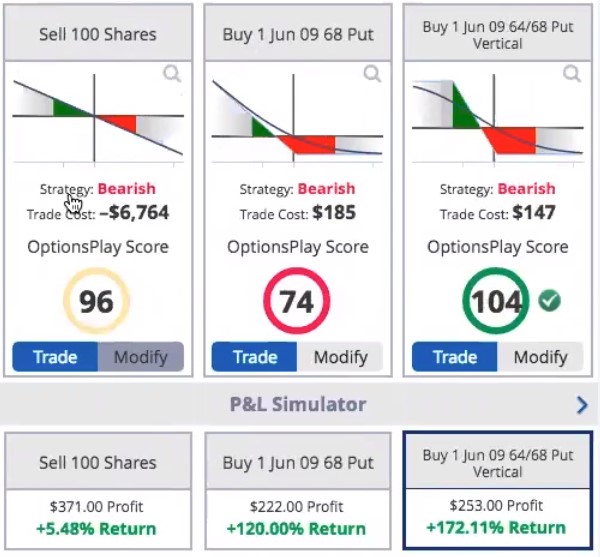
Firstrade’s most compelling feature is options pricing. If you trade options regularly, $0 contract fees are a real advantage. This can reduce friction for income strategies such as covered calls and cash-secured puts, and it can make multi-leg strategies cheaper to test and manage.
Firstrade supports simple and advanced options trading workflows through its web and mobile platforms. Its mobile app supports calls, puts, spreads, straddles, condors, butterflies, options baskets, redesigned options chains, and risk/reward profiles.
That said, options are not suitable for every investor. Low fees do not remove risk. Options can expire worthless, spreads can behave unexpectedly, and margin-enabled strategies can amplify losses. Firstrade is an attractive platform for cost-conscious options traders, but the investor still needs a disciplined strategy and risk controls.
ETF and Mutual Fund Investing
Firstrade is also useful for ETF and mutual fund investors. The platform offers $0 ETF trades and $0 online mutual fund trades. Firstrade currently promotes access to more than 11,000 mutual funds, giving long-term investors broad fund choice without transaction commissions.
The main caution is short-term trading in mutual funds. Firstrade applies a $19.95 short-term redemption fee if mutual fund shares are held for less than 90 days. That means Firstrade is better for long-term fund investors than for short-term mutual fund switching.
| Fund Feature | Firstrade | Verdict |
|---|---|---|
| ETF trades | $0 | Good, but standard among major brokers. |
| Mutual fund trades | $0 online | Strong value for fund investors. |
| Short-term redemption fee | $19.95 under 90 days | Important for active fund traders. |
| Research support | Morningstar and other tools | Useful for fund selection. |
For investors focused on ETF research and portfolio construction, you may also want to compare Firstrade with dedicated analysis tools such as Stock Rover or broader charting platforms such as TradingView.
Fixed Income and CDs
Firstrade offers fixed-income products, including Treasury bills, Treasury notes, Treasury bonds, municipal bonds, agency bonds, zeros, strips, and CDs. Most bond transactions are priced on a net-yield basis, meaning the markup or markdown is built into the yield rather than shown as a simple commission.
| Fixed Income Product | Firstrade Pricing |
|---|---|
| Treasury bills, notes, and bonds | Net yield basis |
| Municipal bonds | Net yield basis |
| Agency bonds | Net yield basis |
| Zeros and strips | Net yield basis |
| Primary market CDs | $30 |
| Secondary market CDs | Net yield basis |
This is adequate for investors who occasionally buy bonds or CDs, but Firstrade is not the most transparent fixed-income broker. Investors who build serious bond ladders may prefer platforms with more detailed fixed-income analytics and clearer spread disclosure.
Margin Rates and Cash Interest
Firstrade’s margin rates are acceptable but not market-leading. As of Firstrade’s current published schedule, margin rates range from 12.00% for smaller debit balances down to 8.00% for balances of $1 million or more. The listed base rate is 11.00%.
| Margin Debit Balance | Firstrade Effective Margin Rate |
|---|---|
| $0 – $24,999 | 12.00% |
| $25,000 – $49,999 | 11.75% |
| $50,000 – $99,999 | 11.25% |
| $100,000 – $249,999 | 10.75% |
| $250,000 – $499,999 | 10.50% |
| $500,000 – $999,999 | 8.60% |
| $1,000,000+ | 8.00% |
Margin users should compare Firstrade directly with Interactive Brokers. Firstrade may be cheaper than some traditional retail brokers at certain balance tiers, but Interactive Brokers is often stronger for serious margin traders.
Cash management is a weaker area. Firstrade lists its credit interest and FDIC-insured deposit rates at 0.15%. That is not attractive if you plan to hold large idle cash balances. Treasury bills, money market funds, or a broker with stronger cash sweep yields may better serve investors with significant cash.
Trading Platform and User Experience
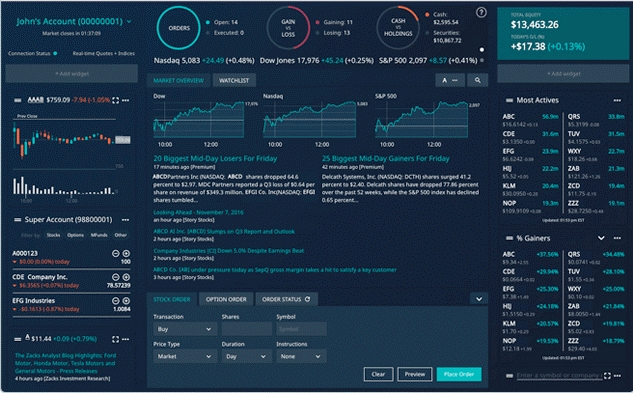
Firstrade’s platform is clean, usable, and sufficient for most self-directed investors. It is not a premium professional trading workstation, but it covers the essentials: watchlists, order entry, account balances, portfolio views, research, charting, options chains, and event data.
The web platform is suitable for long-term investors, ETF buyers, mutual fund investors, and basic options traders. Firstrade Navigator, shown earlier, gives a more dashboard-style trading experience with watchlists, charts, order entry, account details, and news.
For casual investors, the platform is good. For active traders who rely on advanced chart scripting, rapid order routing, backtesting, alerts, scanners, or professional execution, it is not the strongest choice. In that case, compare alternatives such as TradingView, TC2000, or Interactive Brokers.
Mobile App
Firstrade’s mobile app has improved substantially and is one of the platform’s more important parts. Current features include a consolidated portfolio dashboard, real-time gains and losses, buying power, cash and margin balances, watchlists, fast trade access, redesigned options chains, advanced options strategies, options basket trading, and risk/reward profiles.
The app also supports Face ID and fingerprint login, quick order edits, funding shortcuts, event/news research, and advanced charting in landscape mode. That makes the app stronger than many older perceptions of Firstrade suggest.
| Mobile Feature | Available? |
|---|---|
| Stock and ETF trading | Yes |
| Options trading | Yes |
| Advanced options chains | Yes |
| Risk/reward profile | Yes |
| Watchlists | Yes |
| Portfolio dashboard | Yes |
| Biometric login | Yes |
| Account funding | Yes |
| Advanced professional charting | Limited |
Research, News, and Screening
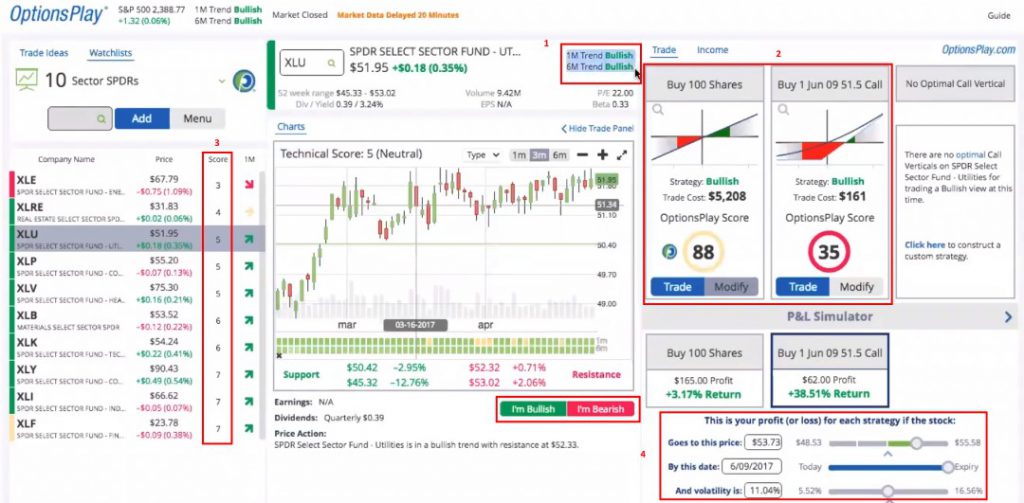
Firstrade offers a better research package than many investors expect from a no-commission broker. It includes premium research and tools from providers such as Morningstar, Trading Central, Zacks, Briefing.com, Benzinga, and OptionsPlay-related services.
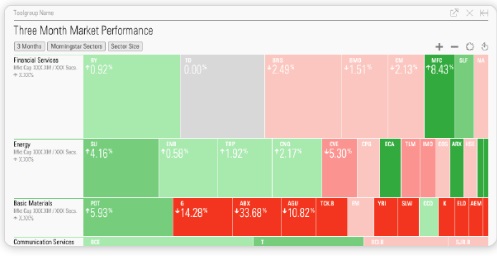
The research suite includes analyst reports, Morningstar ratings, Technical Insight, Market Buzz and News, Sectors & Industries tools, Strategy Builder, video commentary, an earnings and dividend calendar, ratings-change tracking, IPO events, and economic calendars.
| Research Tool | Primary Use |
|---|---|
| Morningstar reports and ratings | Long-term stock and fund research |
| Trading Central Technical Insight | Trend, pattern, and technical-event analysis |
| Market Buzz and News | AI-enhanced news, sentiment, and confidence data |
| Strategy Builder | Screening using fundamental, technical, and quantitative criteria |
| Sectors & Industries | Industry and sector performance analysis |
| Economic and event calendar | Earnings, dividends, IPOs, ratings, and macro events |
This research package adds real value. It does not replace a specialist stock screener such as Stock Rover, but it is more than enough for many retail investors who want free research included with their brokerage account.
Overnight and Extended-Hours Trading
Firstrade now offers extended-hours and overnight trading. Its current overnight trading documentation states that it runs from 8 p.m. to 4 a.m. ET, Sunday evening through Friday morning, and that more than 2,300 stocks and ETFs are supported.
This is useful for investors reacting to earnings, international market moves, or overnight news. However, overnight trading is not risk-free. Firstrade’s rules state that only limit orders are supported, that short selling and fractional trading are not supported, and that unfilled orders are canceled at 4 a.m. ET.
Overnight and extended-hours trading usually involves wider spreads, lower liquidity, more volatile price moves, and less predictable execution. It is useful, but not a beginner-friendly reason to choose a broker on its own.
International Accounts
Firstrade remains useful for selected international investors who want access to U.S. markets. However, international availability is limited and must be checked before applying. Firstrade’s help center says international clients may only open an individual investment account, not a joint account.
Firstrade’s currently listed supported international regions include Austria, Belgium, China, Czech Republic, Denmark, Finland, France, Germany, Hong Kong, India, Ireland, Israel, Italy, Japan, South Korea, Macau, Malaysia, Mexico, New Zealand, Norway, Poland, Portugal, Singapore, Spain, Sweden, Taiwan, and the United Kingdom.
This matters because older versions of this article listed some countries that are no longer shown in Firstrade’s current help-center list. If you live outside the U.S., verify eligibility directly before opening an account.
Account Types
Firstrade offers a broad selection of accounts for U.S. investors. It supports standard brokerage accounts, custodial accounts, education accounts, trusts, and several IRA types.
| Account Type | Available at Firstrade? | Notes |
|---|---|---|
| Individual brokerage | Yes | Standard account for one investor. |
| Joint brokerage | Yes | WROS and tenants in common. |
| Custodial account | Yes | For minors. |
| Coverdell ESA | Yes | Education savings account. |
| Trust account | Yes | Firstrade accepts trust accounts. |
| Traditional IRA | Yes | Tax-advantaged retirement account. |
| Roth IRA | Yes | After-tax retirement account. |
| IRA / Roth IRA for minors | Yes | For eligible minors with earned income. |
| Rollover IRA | Yes | For rolling over employer retirement plans. |
| SEP IRA | Yes | For self-employed individuals and small businesses. |
| SIMPLE IRA | Yes | Small-business retirement account. |
| International account | Yes, limited | Individual investment account only. |
Portfolio Management
Firstrade provides basic portfolio tracking, but it is not a full portfolio-management platform. You can view holdings, balances, gains and losses, watchlists, order history, cash, margin balances, and account activity. That is enough for simple brokerage management.
It is not ideal for advanced portfolio analytics, tax optimization, future dividend forecasting, income planning, automated rebalancing, or sophisticated asset allocation modeling. If portfolio analytics are a priority, a tool such as Stock Rover will be much stronger.
| Portfolio Feature | Firstrade Verdict |
|---|---|
| Portfolio balances | Good |
| Positions and gains/losses | Good |
| Watchlists | Good |
| Research integration | Good |
| Dividend forecasting | Limited |
| Tax optimization | Limited |
| Automated rebalancing | No |
| Robo-advisor management | No |
Customer Support: Firstrade’s Weakest Area
Customer support is the main reason I do not rate Firstrade as the best broker overall. Firstrade’s official support page lists help-center access, email support, phone support, and office hours. That is fine on paper, but external customer feedback is poor.
Trustpilot shows Firstrade with a weak customer rating from a small review sample, with many recent complaints focused on withdrawals, platform issues, account restrictions, and service responsiveness. BBB lists Firstrade Securities as not BBB-accredited, with a B+ rating and complaints filed against the business.
This does not mean every customer has a bad experience. Some investors are satisfied with Firstrade, especially when they rarely need support. But it does mean the article should not describe Firstrade as having excellent customer satisfaction. The more accurate verdict is that low fees are excellent, but customer service confidence is below that of the leading full-service brokers.
Regulation and Account Protection
Regulation and account protection are not the main concerns with Firstrade. Firstrade Securities Inc. is a member of FINRA and SIPC. SIPC protects securities customers up to $500,000, including $250,000 in cash awaiting reinvestment.
Firstrade also states that its clearing firm, Apex Clearing Corporation, has purchased excess insurance through London Underwriters, with Lloyd’s of London syndicates as lead underwriters. Firstrade states that this excess policy protects up to an aggregate of $150 million, with a combined return limit of $37.5 million per customer, including cash of up to $900,000.
This protection does not cover market losses. If your stocks, ETFs, options, or bonds fall in value, insurance does not reimburse you. Account protection is designed for brokerage failure and missing customer assets, not bad investments.
Is Firstrade Safe?
Firstrade is a regulated U.S. discount broker and a FINRA/SIPC member. From a regulatory and account-protection perspective, it is a legitimate brokerage platform. The concerns are not about whether Firstrade is a real broker; the concerns are about service quality, support responsiveness, withdrawal complaints from some users, and whether the platform is sophisticated enough for your needs.
If your priority is low-cost options trading and you are comfortable as a self-directed investor, Firstrade can make sense. If your priority is white-glove service, high cash yield, in-depth planning, or advanced execution tools, there are better choices.
Best Firstrade Alternatives
| Alternative | Better For | Why Choose It Instead? |
|---|---|---|
| Fidelity | Long-term investors and retirement accounts | Strong research, service, retirement tools, and cash management. |
| Charles Schwab | Full-service brokerage and planning | Excellent platform breadth, support, education, and banking integration. |
| Interactive Brokers | Advanced traders and margin users | Global markets, professional tools, low margin rates, and advanced execution. |
| E*TRADE | Active traders and Morgan Stanley users | Stronger platform ecosystem and good options tools, but higher contract fees. |
| TradingView | Charting and technical analysis | Better charts, indicators, alerts, and global market visualization. |
| Stock Rover | Stock research and portfolio analytics | Better fundamental screening, ratings, and portfolio analysis. |
Final Verdict: Is Firstrade Worth It?
Firstrade is worth considering if your priority is low-cost self-directed investing. It remains one of the best brokers for options traders because $0 options contract fees are a real, measurable advantage. It is also attractive for ETF investors, mutual fund investors, and eligible international clients who want access to U.S. markets without high trading costs.
But Firstrade should not be presented as the best broker for everyone. It is not the best choice for investors who need premium customer service, advanced trading technology, high cash interest, automated portfolio management, or deep retirement planning support.
My honest rating is 4.3 out of 5. Firstrade earns top marks for pricing, strong marks for research and account access, and weaker marks for service reputation and advanced platform depth.
The right conclusion is clear: Firstrade is one of the best low-cost brokers for options traders and self-directed investors, but it is not the best overall broker for every investor.
FAQ
Is Firstrade a good broker?
Yes, Firstrade is a good broker for cost-conscious self-directed investors, especially options traders. Its $0 options contract fees are a major advantage. However, it is not the best broker for customer support, full-service planning, or advanced trading tools.
Is Firstrade better than Fidelity?
Firstrade is better than Fidelity for options contract fees because Firstrade charges $0 per contract while Fidelity generally charges $0.65. Fidelity is better for overall service, retirement planning, cash management, research depth, and long-term investors who want a more complete brokerage experience.
Is Firstrade better than Charles Schwab?
Firstrade is cheaper for options traders because it charges $0 per contract, while Schwab generally charges $0.65 per contract. Schwab is better for full-service investing, customer support, banking integration, education, and broader platform depth.
Does Firstrade really charge $0 for options contracts?
Yes. Firstrade lists $0 options commissions and $0 options contract fees. Regulatory and exchange fees may still apply, but Firstrade’s own options contract fee is $0.
Is Firstrade good for beginners?
Firstrade can be good for beginners who want low costs and simple self-directed investing. However, beginners who need strong educational support, hand-holding, or reliable customer service may prefer Fidelity or Schwab.
Does Firstrade support international investors?
Yes, Firstrade supports selected international investors, but eligibility is limited by country. International clients may only open individual investment accounts, not joint accounts.
Is Firstrade safe?
Firstrade is a regulated U.S. broker and a member of FINRA and SIPC. SIPC and excess insurance protection apply to eligible assets, but this protection does not cover normal market losses.
