
I have been using Stock Rover for eight years, so this is not just a review; it is an in-depth look at its features and functionalities. I will also showcase Stock Rover’s immense potential by highlighting my four favorite strategies that I have implemented using the platform.
Verdict
According to testing, Stock Rover is the number-one choice for US investors who want to conduct their own deep fundamental research. Its main attraction is the connection between financials, stock selection, and portfolio management. I can investigate why a company passes a screen, compare it with alternatives, and assess the effect of holding it alongside other investments.
Stock Rover comes with a few limitations. It can connect to every major brokerage for portfolio analysis and reporting, but it does not execute trades. Also, this is an investing tool, not a trading tool; it does not offer real-time data or detailed technical charts.
Stock Rover Review Results & Ratings
My testing shows Stock Rover is best for long-term dividend, value, and growth investors. Its exceptional features are in-depth screening, a 20-year financial database, research reports, and broker-integrated portfolio management.
Stock Rover is an industry-leading platform that enables the development of intricate dividend, value, and growth investing strategies.
| Test | Tier | Score | Average |
|---|---|---|---|
| Lab Test Composite Score | AA | 4.37 | 4.19 |
| Pricing Index | AAA | $0.77 | $2.74 |
| Value Score (VP) | B | 3.63 | 2.82 |
| Speed & Ease of Use | AAA | 5.00 | 4.50 |
| Chart Analysis Depth Index | AA | 4.50 | 3.50 |
| Chart Pattern Depth & Accuracy | N/A | N/A | 2.73 |
| Scanning Performance | AAA | 5.00 | 4.50 |
| Backtesting Performance | A | 4.00 | 4.00 |
| Trading Bot & Auto-Trading Reliability | C | 2.50 | 1.50 |
| AI & Algo Index | C | 2.50 | 2.00 |
| Alert Speed | C | 2.67 | 1.50 |
| Trade Signal Quality | C | 2.50 | 0.00 |
| Broker Connectivity & Ecosystem Depth | C | 2.25 | 4.50 |
| Portfolio Tool Performance | AAA | 4.80 | 2.80 |
| Financial News Speed & Depth | C | 2.00 | 2.30 |
| Community Utility Index (CUI) | C | 2.75 | 4.00 |
| Support Infrastructure & SLA Audit | B | 3.50 | 3.50 |
How we test: Benchmarking system v3.
See the 2026 v3 58-point Stock Rover lab test and benchmarks.
Pros
✔ 800+ Financial Screening Metrics
✔ Potent Stock Scoring Systems
✔ Unique 20-Year Historical Financial Data
✔ Warren Buffett Value Screeners & Portfolios
✔ All Important Financial Ratios
✔ Real-time Research Reports
✔ Portfolio Management & Rebalancing
✔ Broker Integration
✔ Winner: Best Value Investing Screener
Cons
✘ No Social Community
✘ Not for Traders
✘ No Cryptocurrency or Forex Data
✘ US Markets Only

Over 8 years, I have developed highly valuable strategies using its unique fair value, discounted cash flow, and margin-of-safety data. Its extensive growth-investing data, such as performance relative to the S&P 500 and industry growth and earnings rankings, make Stock Rover the best choice for serious investors.
Key Features
| ⚡ Stock Rover Features? | Charts, News, Watchlists, Broker Integration |
| 🏆 Exceptional Features? | Financial Screening, Portfolio Mgt & Rebalancing, 20-Year Financial Database |
| 🎯 Best for | Growth, Dividend & Value Investors |
| ♲ Subscription | Monthly, Yearly |
| 🆓 Free | ✔ |
| 💰 Price | $0 | $29 | $49 |
| 💻 OS | Web Browser |
| 🎮 Trial | 14-Day |
| ✂ Discount Code | -25% During Premium Trial Period |
| 🌎 Region | USA |
My Stock Rover Video Review
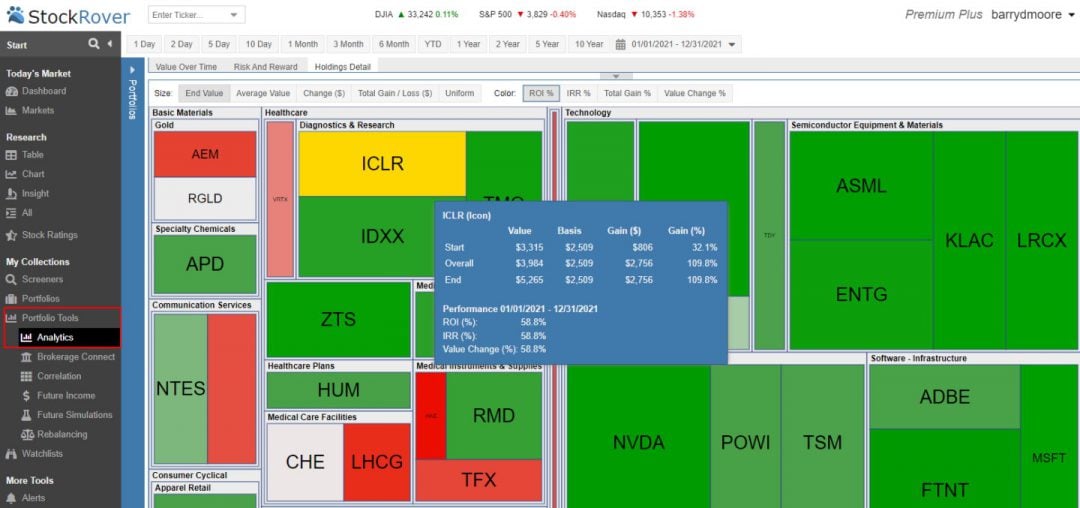
Screenshot Highlights
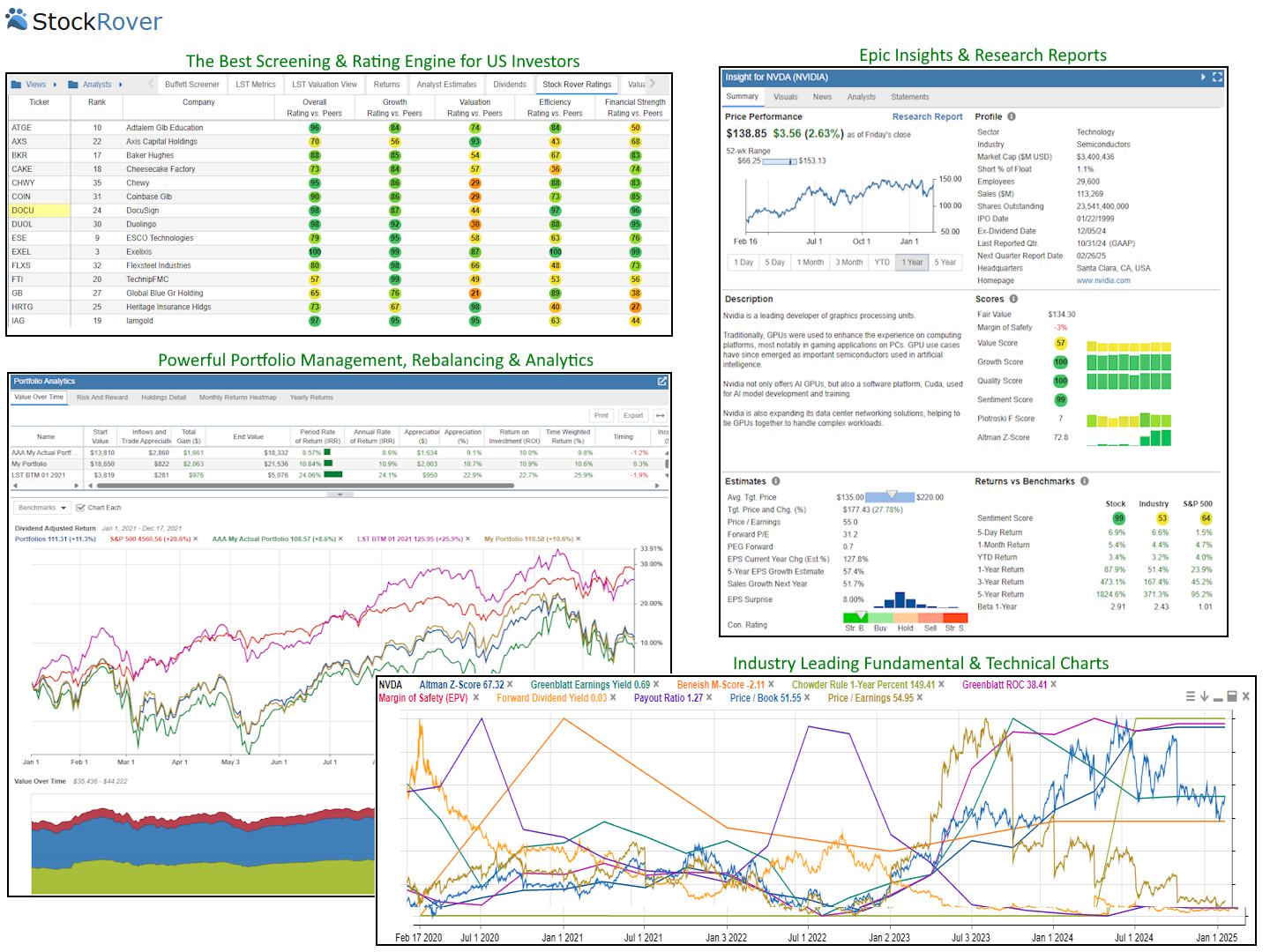
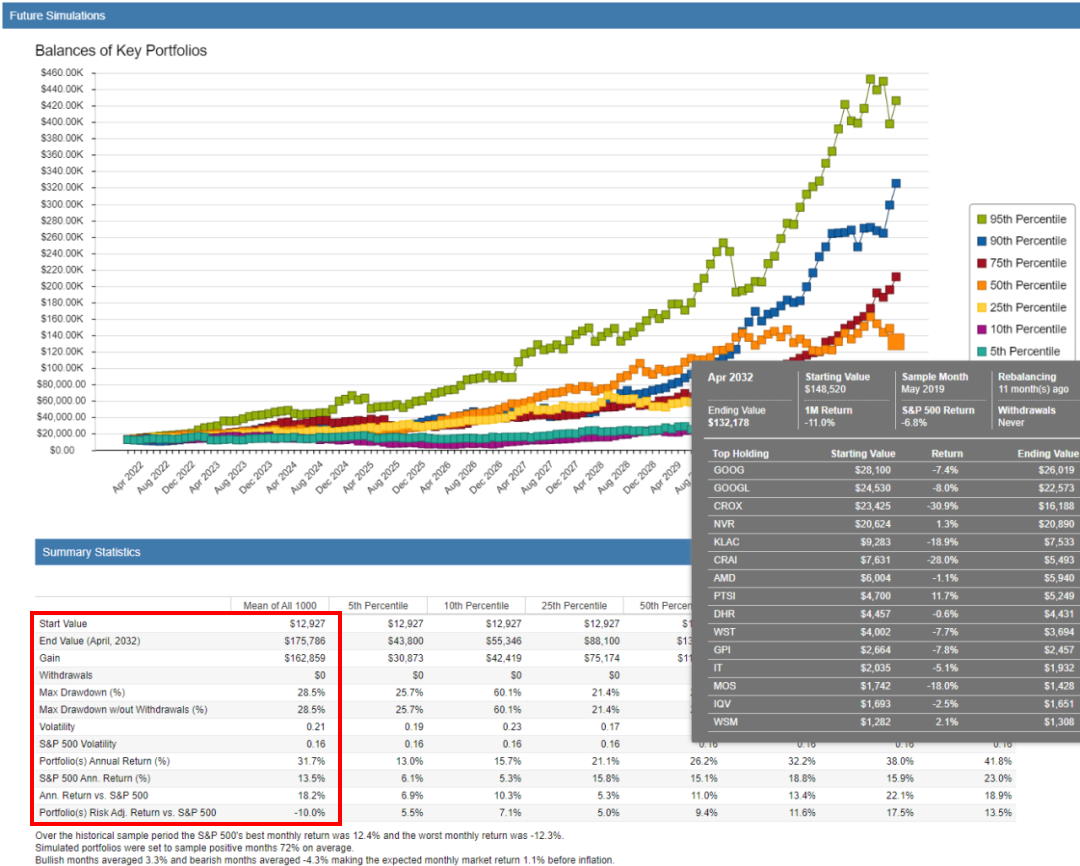
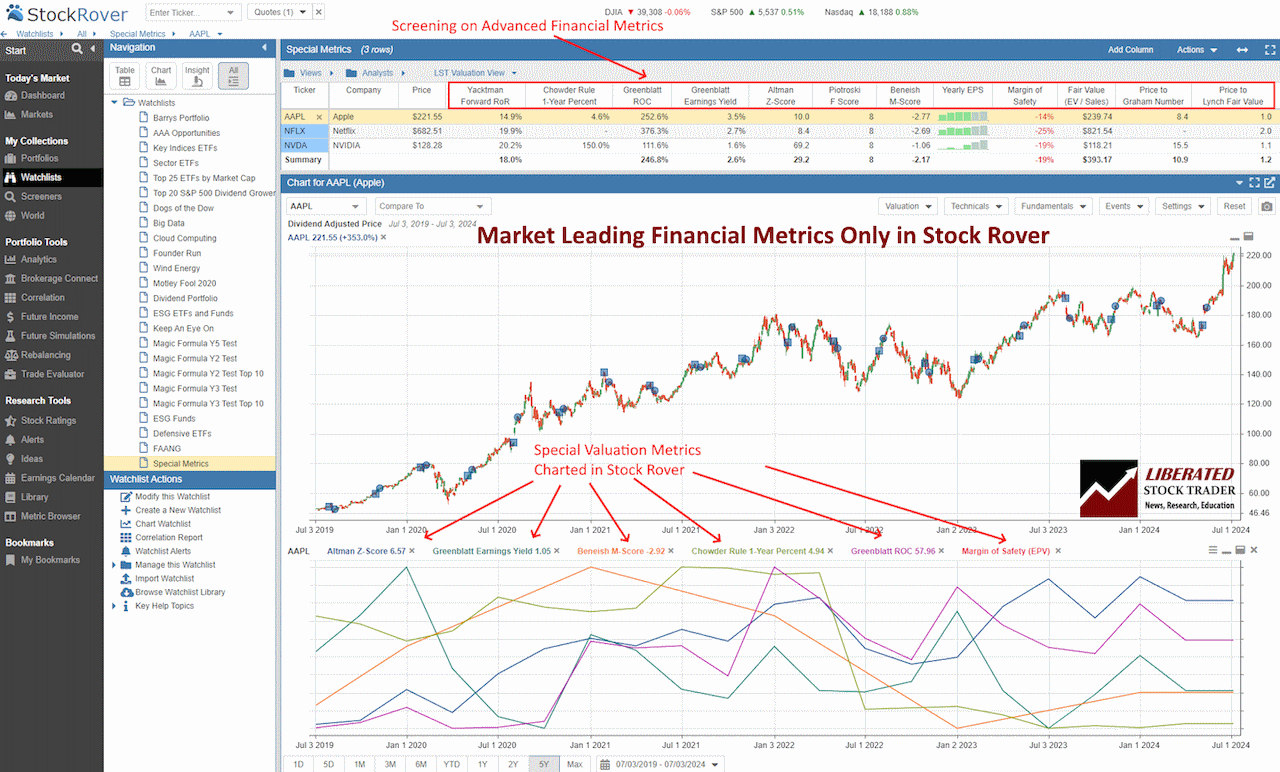
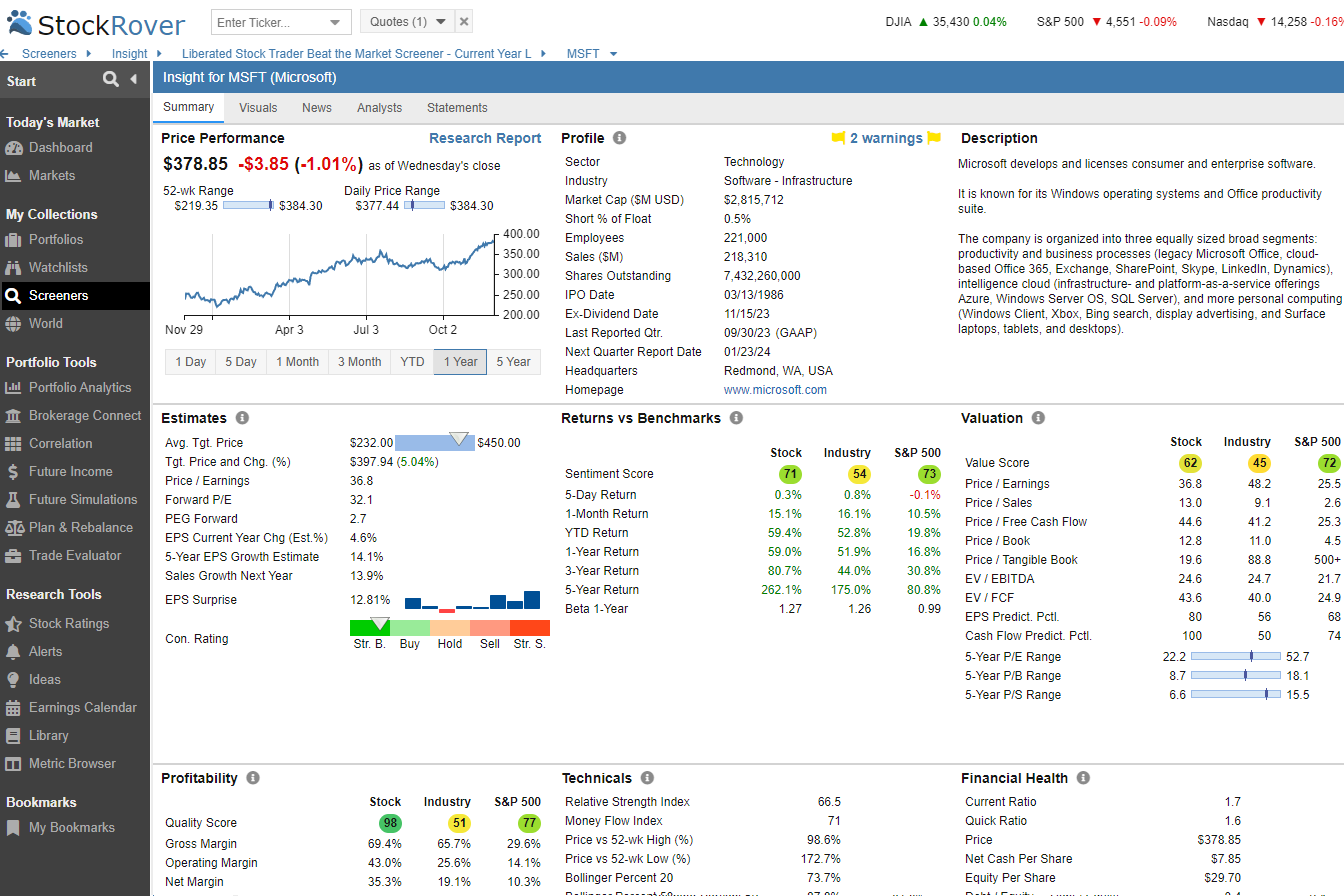
Who Is Stock Rover Best For?
I would shortlist Stock Rover if your investment decisions depend on company fundamentals and portfolio discipline. It is particularly useful when you want to consistently compare several businesses, investigate valuation assumptions, or understand concentration across your holdings.
| Your main requirement | My assessment |
|---|---|
| Research growth, value, or dividend stocks | A strong fit for research, discovery, and portfolio management |
| Compare financial strength and valuation | One of the main reasons I use it |
| Monitor allocation, correlation, and portfolio income | A compelling part of the platform |
| Follow a few prices and headlines | Explore the free account before paying |
| Trade intraday patterns or automate orders | Not suitable |
Pricing
You can have Stock Rover for free; however, the real power is unleashed with the Premium services.
Stock Rover’s Free plan includes ad-free screening for 8,500 stocks and 7,000 ETFs, portfolio analysis, and stock market news. The Free plan is OK for investors who use simple screening strategies and want to manage multiple stock portfolios in one place.
Stock Rover Premium & Premium Plus cost $29/mo and $49/mo, respectively, when paid annually. I recommend Premium Plus for all experienced growth, income, and value investors because it unlocks unlimited fair-value and margin-of-safety ratings, stock ratings, investor warnings, 700 metrics, and 20 years of historical data for screening.
Ultimate and Ultimate Pro cost $79/mo and $149/mo, respectively, when paid annually. These plans extend the services to include Options analysis, Insider metrics, and multiple client portfolio management tools for advisors. A 2-year subscription reduces the price of all plans by 40%, representing a significant saving. See our full Stock Rover Pricing & Discounts Guide for further information.
What I Like & What To Watch Out For
Excellent Growth, Value & Dividend Screening
Published screening rating: 5.00. My starting point is the approach explained in my guide to choosing and using a stock screener: decide what kind of investment you want before selecting filters. Growth, value, and dividend strategies ask different questions. Stock Rover answers all those questions thanks to its extensive 20-year financial database. As promised, here are my 4 favorite strategies using Stock Rover.
1. My Beat the Market Growth Strategy on Stock Rover
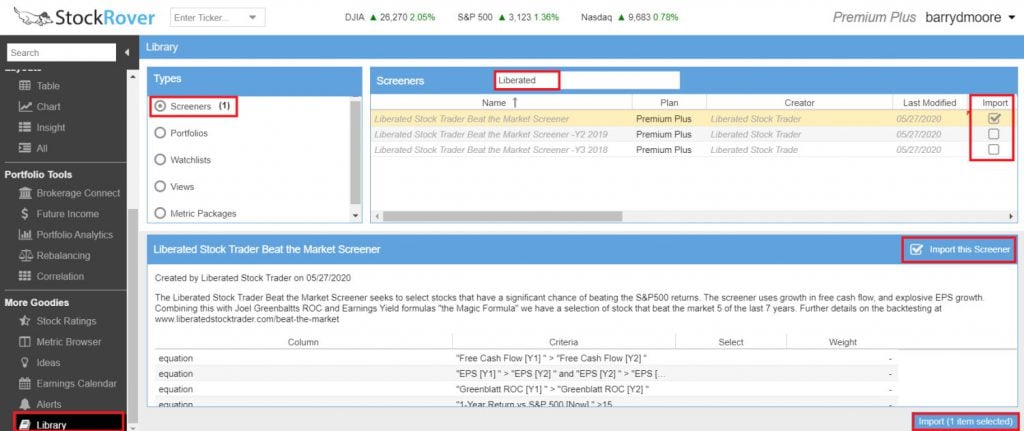
For a growth screen, I want evidence of earnings and sales expansion. For value research, I want to investigate business quality alongside valuation. I implemented my Beat the Market System (BTM) on Stock Rover, which you can access with a Premium Plus subscription.
For dividend research, current yield should be considered alongside dividend growth and payout sustainability. Mixing these requirements indiscriminately can produce an empty screen—or a list whose investment logic is difficult to explain.
Ranked screening is particularly useful once that logic is defined. Instead of treating every qualifying company as equally attractive, I can prioritize which candidates to investigate. The practical benefit is a more focused research list. I still need to examine accounting changes, competitive pressures, and the reasons a stock appears unusually cheap or fast-growing.
2. CAN SLIM Growth Strategy: Screening for Profitable Growth
In my CAN SLIM screener walkthrough, I demonstrate how to import a library screen and examine criteria covering current and long-term earnings, proximity to a price high, and institutional ownership. That illustrates how Stock Rover helps turn a broad growth-investing idea into a set of measurable requirements.
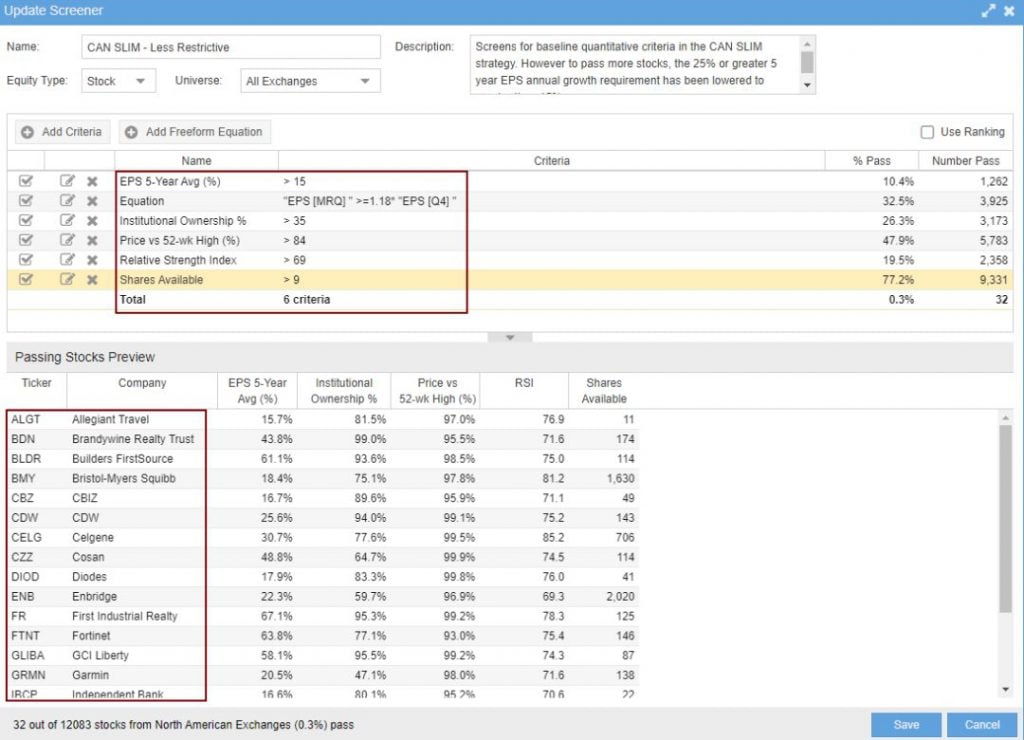
I also retain an important criticism from that article: new management is not automatically good news. A leadership change needs a business explanation, just as a new product needs evidence of demand. A screen can help locate growth candidates, but it cannot complete that qualitative assessment for me. The wider market direction also requires a separate decision.
My walkthrough is an adaptation of CAN SLIM. Its filters should not be presented as a complete mechanical reproduction of O’Neil’s method, and an RSI momentum reading is not the same measure as a stock’s relative-strength ranking against other shares. This distinction matters when interpreting the results. The software helps with selection; the strategy still needs clearly defined entry, exit, and risk rules.
3. A Graham Defensive: Testing Financial Resilience and Valuation
My Graham-style defensive stock guide takes a different approach. Its Stock Rover screen combines company size, financial condition, earnings history, dividend growth, and valuation measures, including price relative to the Graham Number. The article includes an importable screen and a worked results table, so readers can see how the idea becomes a practical research task.
I like being able to inspect why a company qualifies. For example, the guide uses a current ratio threshold of 1.8 and a P/E ceiling of 20 as adaptations of stricter criteria. Those are choices in my implementation, not universal safety rules or Graham’s original thresholds. Altering them changes both the number and character of the candidates.
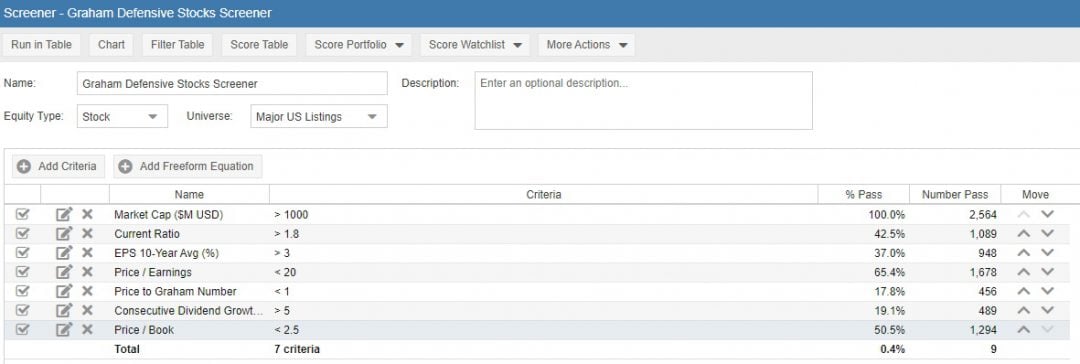
There is another useful distinction: passing a Graham-style financial screen does not make a company part of a traditionally defensive sector. A cyclical business may pass financial and valuation filters while remaining sensitive to the economy. That is why I examine the business behind the numbers rather than describe every result as protected against a downturn.
4. My Buffetology Value Screening Strategy on Stock Rover
My Buffett stock screener needs to filter on investment criteria such as earnings per share (EPS) growth, consistent return on equity (ROE), high return on invested capital (ROIC), and low debt, as measured by the solvency ratio. Finally, the screener needs to calculate the margin of safety and fair value and use a discounted cash flow (DCF) analysis. All this can be done with Stock Rover.
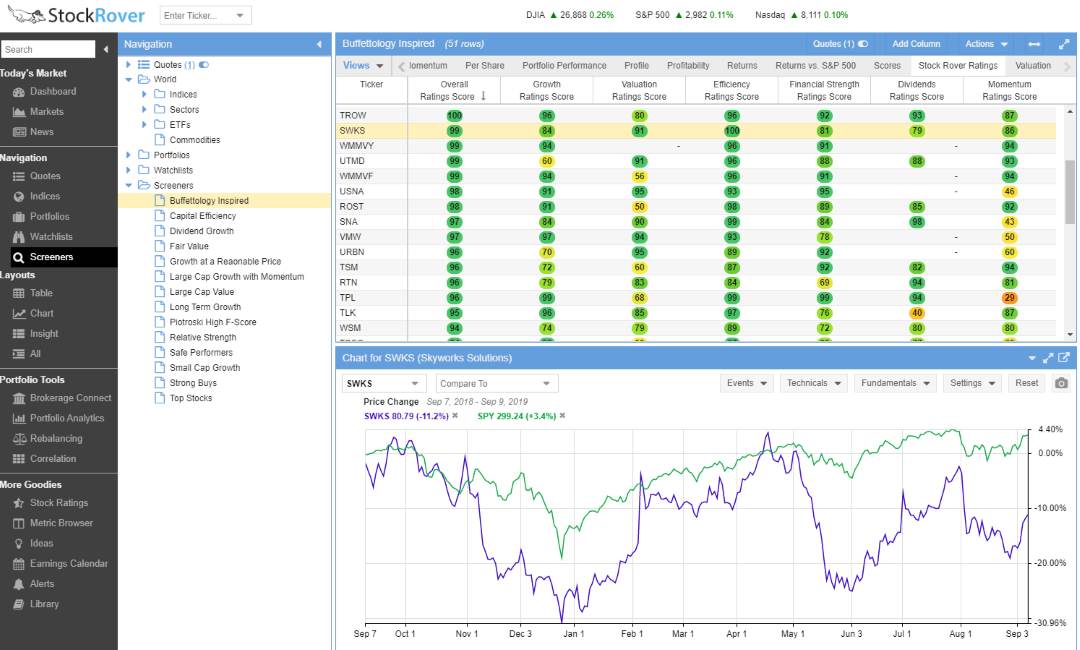
Unique to Stock Rover is the ability to screen stocks on their performance relative to the S&P 500. You could develop a strategy to select stocks based on their historical performance versus the benchmark.
Building your Stock Rover screener is easy: select Create Screener, give it a name, select the equity type, choose your universe of large, medium, or small-cap stocks, and then add your criteria. No programming skills are required.
Watchlists have fundamentals broken into Analyst Estimates, Valuation, Dividends, Margin, Profitability, Overall Score, and Stock Rover Ratings. You can even set the watchlist and filters to refresh every single minute if you wish.
In a screening and research tool, the critical magic ingredient is the database, and boy, is it enormous. There are over 800 selectable metrics, and 228 of them contain 10 years of historical data. Historical data can be selected as Trailing Twelve Months (TTM) or as historical calendar-year data.
My favorite Stock Rover ratios and calculations are:
- Margin of Safety / Fair Value
- Greenblatt Earnings Yield and ROC
- Return vs. S&P500
- Piotroski and Altman-Z scores
- The Stock Rover Growth and Value Scores.
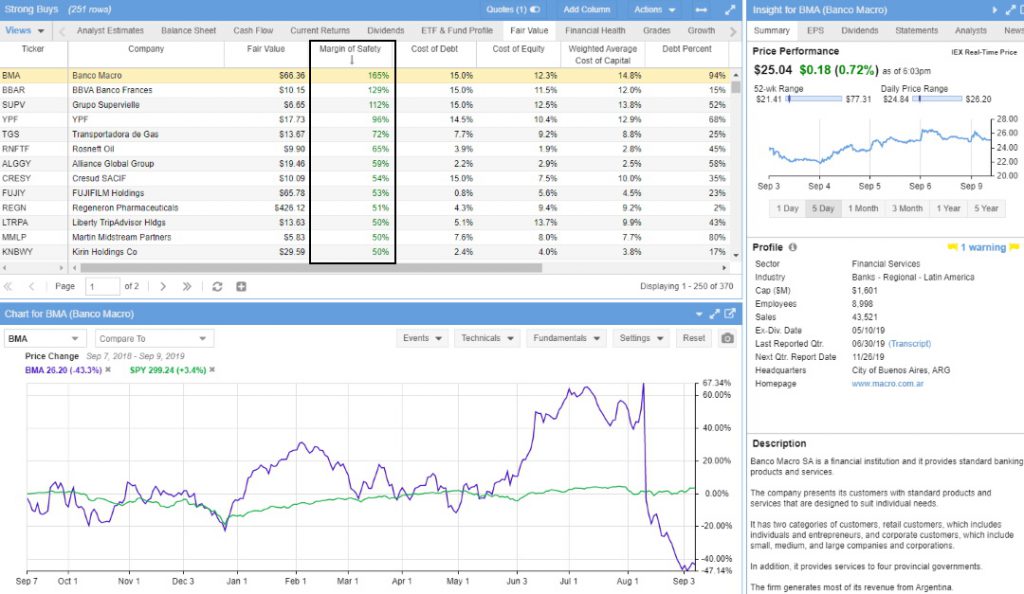
Financial Charting and Margin of Safety
Published chart-analysis rating: 4.50. I particularly value connecting a company’s fundamentals to its share price. Financial and valuation charts help me assess whether changes in market value are accompanied by stronger earnings, profitability, or other business metrics. They provide a numerical screen context that a single snapshot cannot.
This follows the approach in my value-investing strategy workbook: distinguish the price of a share from an estimate of the business’s worth. In a simple example, an estimated intrinsic value of $50 and a purchase price of $25 yield a 50% margin of safety, calculated as the difference divided by the estimated value. That arithmetic is useful, but the quality of the valuation estimate remains the critical assumption.
Stock Rover’s fair-value and margin-of-safety tools help me organize this research. I can investigate whether an apparent discount is accompanied by sound finances or whether declining business quality explains it. A low multiple alone is insufficient; I want to understand cash generation, debt levels, and the durability of earnings before deciding whether a stock offers value.
When it comes to stock charts, Stock Rover differs from all the other software vendors on the market. Whereas MetaStock and TradingView focus on hundreds of technical analysis (price/volume) indicators, Stock Rover focuses on charting the fundamental financial strength indicators.
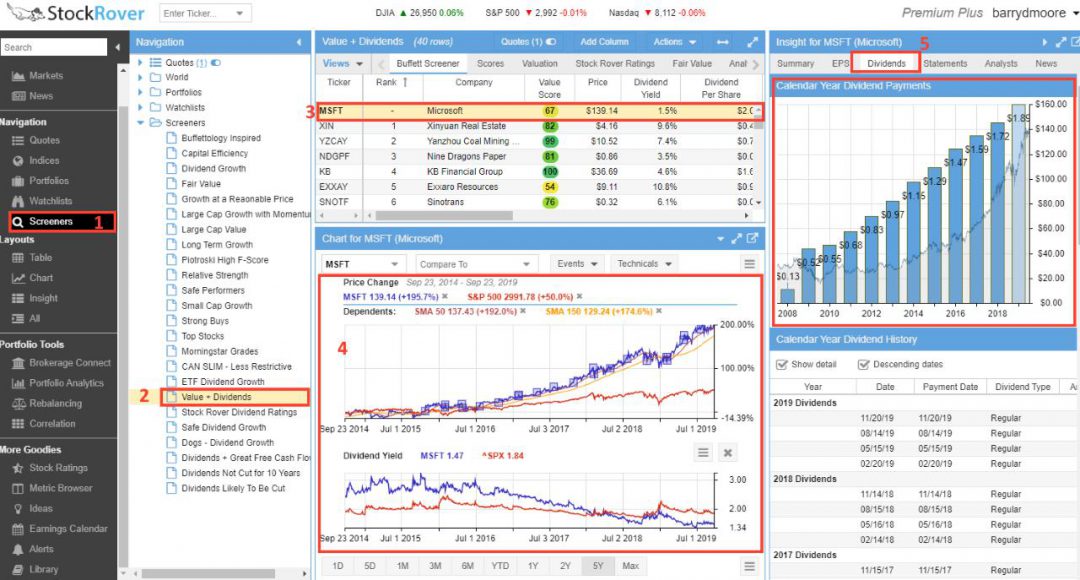
Stock Rover excels at fundamental charting with over 240 financial and 16 technical analysis indicators. It is not the best technical analysis or frequent trading service, but it is the complete package for fundamental income, growth, and value investors. Currently, Stock Rover does not allow you to draw trendlines or annotate charts, but this functionality is coming soon.
Stock Rating Signals – Quantitative Metrics at your Fingertips
Stock Rover provides a rating engine that meticulously ranks stocks based on key metrics such as growth, valuation, financial strength, dividends, and momentum. These ratings enable you to develop strategies to identify stocks with strong financials, cash flow, and efficiency, greatly simplifying the process.
I particularly like the roll-up view for all the scores and ratings. In the screenshot below, I have imported the Warren Buffett portfolio, which includes his top 25 holdings. I have also selected the “Stock Rover Ratings” tab, which rolls up all analyses into a simple-to-view ranking system, saving tremendous time and effort while providing a wealth of insight.
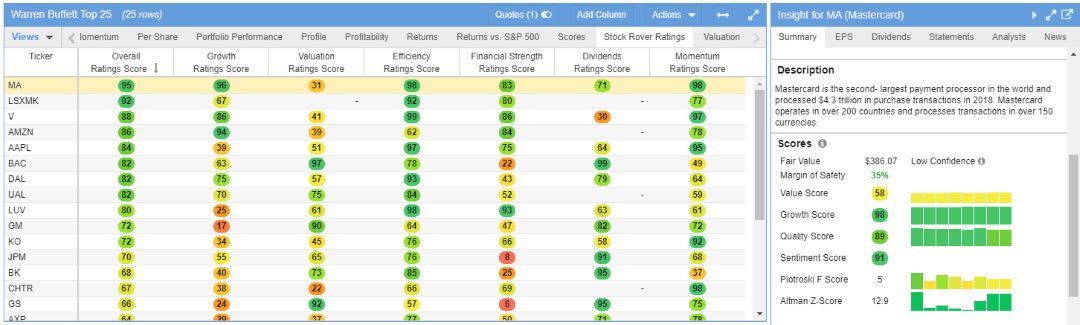
In the screenshot above, Stock Rover scores stocks on growth, valuation, efficiency, financial strength, dividends, and momentum. It also has overall ratings that place stocks in the top 20% of all stocks, making it easy to find good investments.
Always Up-to-Date Research Reports
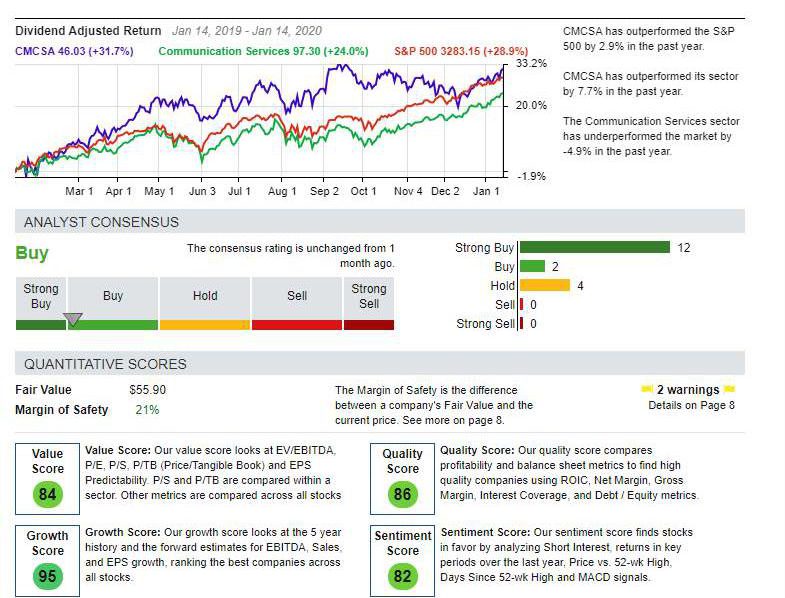
The Stock Rover Research Reports enable you to generate a professional, readable PDF report on any particular stock’s current and historical performance. The reports are unique as they are real-time research reports. They are generated using the latest data, highlighting a company’s competitive and market positions, as well as historical and potential dividend and value returns. The image below shows the dividend-adjusted commentary on Microsoft.
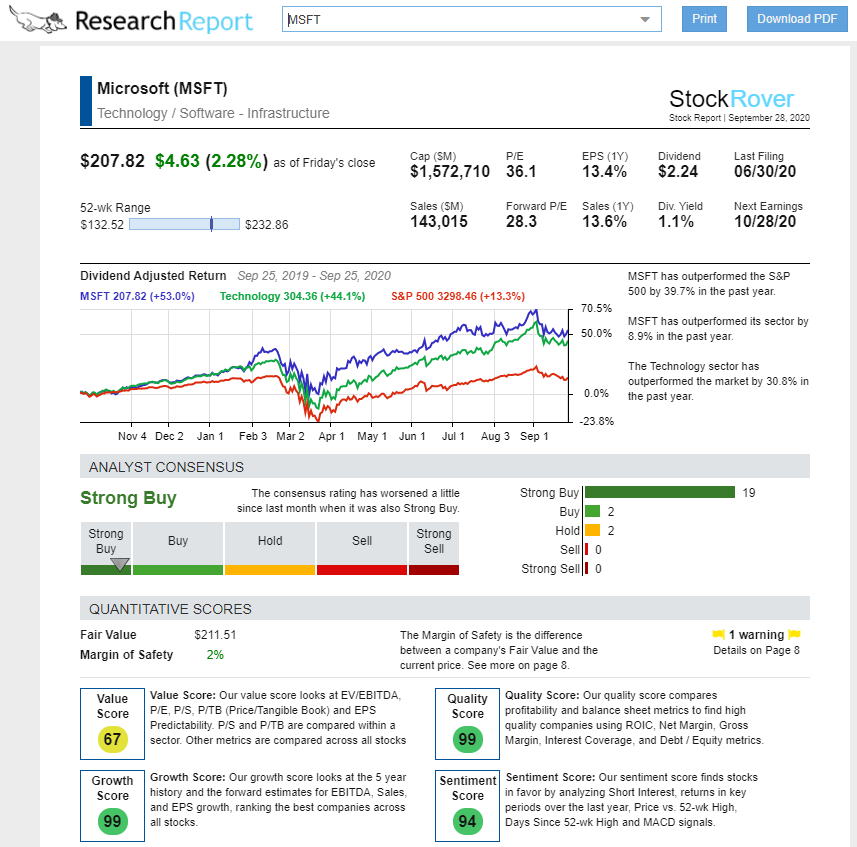
The best thing about Stock Rover’s Research Reports is they are Real-time, so the information is always up-to-date.
The Research Reports provide a genuinely comprehensive summary of any of the 8,5000+ stocks on the US and Canadian exchanges. Research reports can be viewed in a browser and exported as PDFs for portability and sharing.
I am very visual, and I like that a large portion of the data is thoughtfully presented in charts and visually appealing tables. The integrated Research Reports functionality takes the visualization to the next level. With visual representations of data, you can absorb and understand large amounts of information exceptionally quickly, saving you time and effort. With Stock Rover, reading a company’s quarterly financial reports is a thing of the past.
Near Perfect Turn-key Portfolio Management
Published portfolio-tool rating: 4.80. My seven-step portfolio-management guide uses Stock Rover to demonstrate what happens after selecting investments. The process includes ongoing research, performance analysis, rebalancing, correlation analysis, income planning, tax review, and simulations. This is a major reason I see Stock Rover as more than a screener.
Ongoing research connects the purchase decision with the decision to keep holding. In the guide, I discuss how to check whether a company still meets the original selection criteria and use a Microsoft research report as an example. That is a historical demonstration, rather than a statement about my current holdings. The useful question is whether the business still supports the thesis that justified its selection.
Rebalancing: Making Position Drift Visible
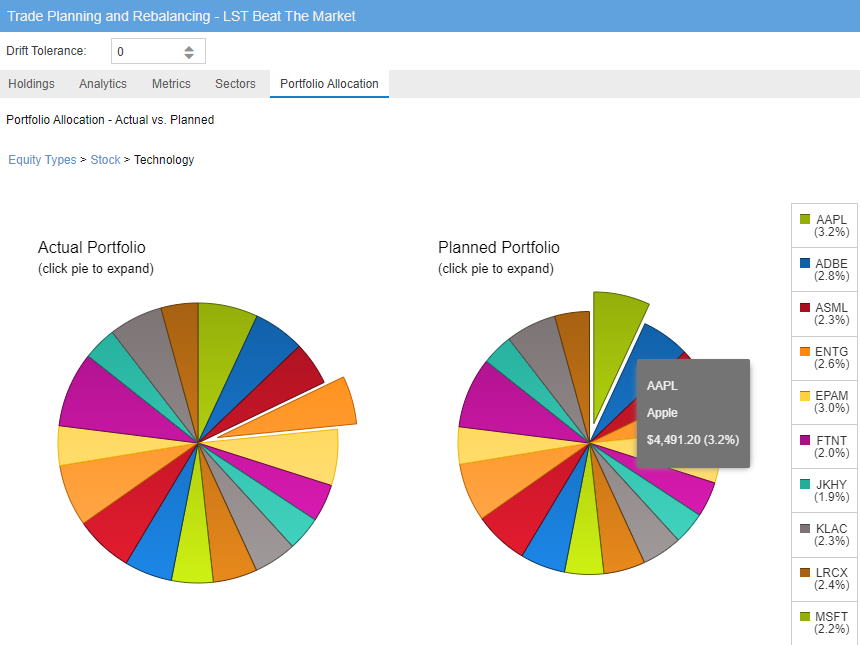
One demonstration examines a target allocation of 5% per stock. If a holding grows to 10%, its contribution to portfolio risk has changed even if my opinion of the company has not. The rebalancing report helps translate that drift into potential adjustments, making it easier to evaluate the difference between actual and intended weights.

I like that specificity. It turns a vague concern about concentration into a decision I can examine. However, a target weight is part of the example, not a rule that every investor should adopt. Any adjustment still needs to account for the strategy, transaction costs, and tax consequences; a suggested adjustment is not an executed trade.
Correlation: Checking Whether Holdings Behave Alike
My guide also demonstrates a correlation report for the LST Beat the Market system, filtered to highlight relationships above 0.7. That is useful evidence of how I use the platform: I want to identify holdings whose historical movements are closely related, even when their company names or industries differ.
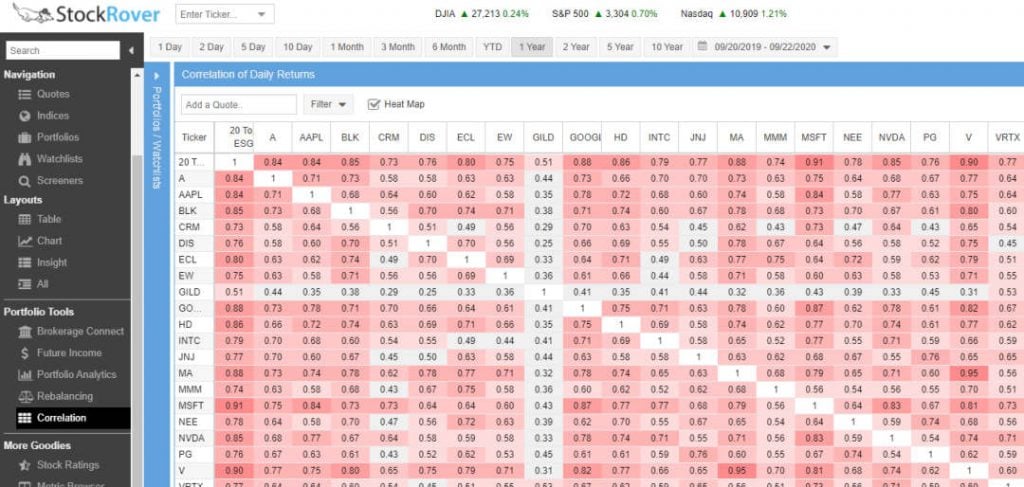
I treat 0.7 as an investigation threshold in that example, not a universal boundary between safe and unsafe portfolios. Correlations depend on the observation period and can change over time. The report helps me determine whether I am holding multiple versions of the same exposure; it cannot guarantee that diversification will protect me in the next market decline.
Income and Simulation: Planning Beyond Today’s Balance
The future-income tools address another practical question: when a portfolio might generate cash and how much. I find that useful when comparing an income objective with the holdings intended to support it. Dividend changes can alter the outcome, so the projection needs periodic review.
Monte Carlo simulations explore a range of possible future results under stated assumptions. I would examine the range and sensitivity to those assumptions, rather than focus on a single attractive ending balance. Together, these tools make portfolio planning more informative while leaving the investment and implementation decisions to me.
Forward-Looking Dividend Income Analysis
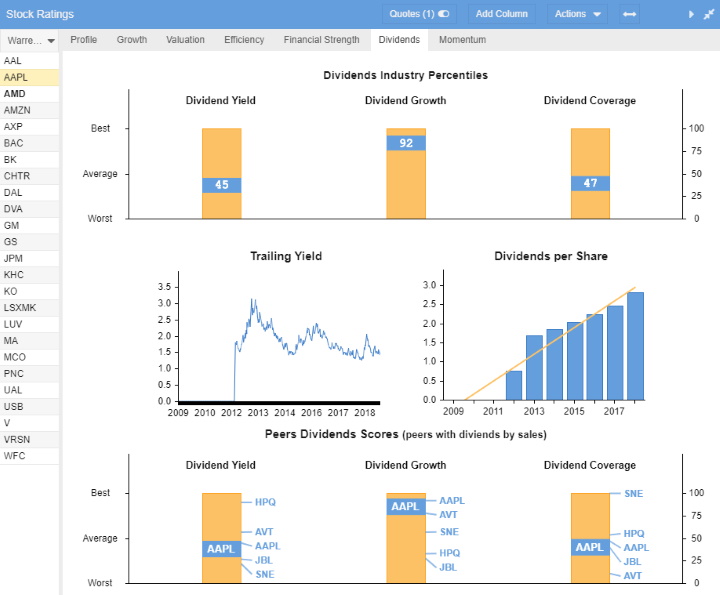
Stock Rover provides dividend analysis to visualize a stock’s dividend yield, growth, and coverage versus its competitors. It analyzes any portfolio or watchlist to predict future dividend income based on current and projected dividends, making it ideal for income investors.
As all smart investors know, you need to accrue your dividends to have a chance at excellent market-beating returns. Stock Rover provides intelligent analysis to enable you to do just that.
A Fast Research Workflow
Published speed-and-ease-of-use rating: 5.00. I like having watchlists, screens, financial tables, and portfolio information within one browser-based environment. Once I know the views and metrics I need, repeating a research task becomes more convenient. I can compare candidates using a consistent framework instead of rebuilding the same analysis each time.
There is still a learning commitment. A quick screen does not make the financial concepts behind it any simpler, and a dense table can overwhelm someone who has not yet decided what they are looking for. I would begin with one watchlist, one saved screen, and one portfolio view, then expand as those become familiar. That gives the information a clear purpose.
Browser and mobile access are useful, but I prefer a larger screen for detailed comparisons. During a trial, I would test the actual devices and tasks I expect to use, including modifying criteria, comparing results, and reviewing holdings. The important benefit is a smoother, repeatable workflow, rather than an isolated claim about how quickly a single operation completes.
Research Depth That Can Justify Premium Plus
Published Value Score: 3.63. I value the combination of screening, valuation, research reports, and portfolio tools. This is the lab’s broader Value Score, rather than a standalone rating of the subscription price. For an investor who regularly uses several of these capabilities, bringing them together can make the service worthwhile.
Premium Plus remains my preferred starting point for serious individual-stock research. It includes ranked and historical screening, fair-value tools, and stock research reports. The current plan provides 10 years of fundamentals and 20 years of historical prices; those are separate limits. Its listed price is $70 per month or $588 annually, which is equivalent to $49 per month when paid upfront.
I would not recommend the same subscription to everyone. Premium may cover simpler requirements, while Ultimate becomes more interesting when its additional history, fund research, or capacity serves a specific purpose.
I would first choose the required capabilities, then compare billing options in my Stock Rover pricing and discounts guide. A feature you rarely use contributes little to your subscription’s value.
Brokerage Connections Do Not Provide Trade Execution
Published broker-connectivity rating: 2.25. Bringing brokerage holdings into Stock Rover is useful for research and portfolio analysis. My criticism is that this convenience can be mistaken for a complete trade execution service. Submitting an order is a separate capability.
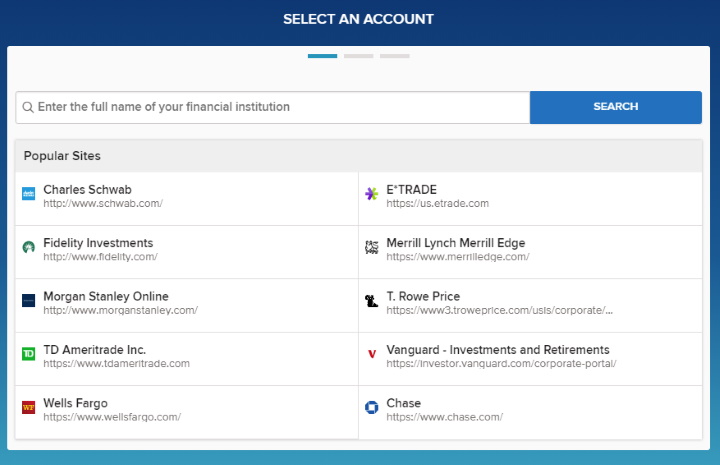
I have tested the brokerage connection with my Interactive Brokers and Schwab accounts and they work seamlessly. Smooth importing of the trades and then Stock Rover can run its portfolio analysis, rebalancing and monte-carlo analysis on the positions.
It simply cannot provide trade execution, which warrents the lower rating.
Alerts Are Average
Published alert rating: 2.67. Alerts can help me keep track of research conditions without repeatedly opening the same watchlist. The limitation is that a notification is only as useful as the underlying data, its update frequency, and the delivery method. I would not assume every alert is appropriate for a time-sensitive trading decision.
Stock Rover alerts are configurable to provide instant email notifications when a stock meets your custom criteria. For example, “Alert me if Netflix crosses over $200.” You can place alerts on fundamental indicators or prices; it is quite flexible.
News & Community Is Not the Main Attraction
Published financial-news rating: 2.00. News is useful for putting a company’s price movement or financial results into context, but it is not the main reason I choose Stock Rover. If reacting rapidly to breaking events were central to my strategy, I would evaluate a dedicated news service against that requirement.
Stock Rover consolidates news from over 20 news sources, including Forbes, MarketWatch, and The Wall Street Journal, providing a time-saving way to view events that may impact your stocks or the market. The news feeds are not real-time, but they are useful.
As a long-term investor, real-time news is not a priority. If real-time is your priority, take a look at MetaStock. Finally, there is no social chat or community within Stock Rover.
Stock Rover Alternatives: Which Approach Fits You?
I would compare alternatives based on the research process you want to follow. A platform built around company analysis serves a different purpose from one centered on charts, active trading, or investment commentary.
| If you mainly want to… | What I would compare |
|---|---|
| Build fundamental screens and analyze a portfolio | Stock Rover’s research and portfolio workflow |
| Read investment arguments alongside quantitative assessments | The approach covered in my Seeking Alpha review |
| Prioritize chart analysis and shared trading ideas | The workflow covered in my TradingView review |
| Research automated technical strategies | The capabilities covered in my TrendSpider review |
For the Stock Rover versus Seeking Alpha decision, I would begin with a simple question: do I primarily want to build and compare my own financial screens, or read and evaluate investment arguments? That distinction helps identify which platform deserves the first trial.
| Features | Stock Rover | Seeking Alpha | TrendSpider | TradingView | MetaStock |
|---|---|---|---|---|---|
| Best for: | Investors | Investors | Traders | Traders | Traders |
| Curated Stock Picks | ✘ | ✔ | ✘ | ✘ | ✘ |
| Free Plan | ✔ | ✔ | ✘ | ✔ | ✘ |
| Pricing | $0 | $29 | $49 | $24 | $41/m | $54 | $214 | $0 | $15 | $35 | $70 | $75|$100|$265 |
| Financial Screening | ✔ | ✔ | ✔ | ✔ | ✔ |
| 10-Year Financials | ✔ | ✘ | ✘ | ✘ | ✘ |
| Portfolio Management | ✔ | ✔ | ✘ | ✘ | ✘ |
| Research Reports | ✔ | ✔ | ✘ | ✘ | ✘ |
| Chart Pattern Scanning | ✘ | ✘ | ✔ | ✔ | ✘ |
| AI Stock Screening | ✘ | ✘ | ✔ | ✘ | ✔ |
| Financial News | ✔ | ✔ | ✔ | ✔ | ✔ |
| Stocks & ETFs | ✔ | ✔ | ✔ | ✔ | ✔ |
| FX/Commodity | ✘ | ✘ | ✔ | ✔ | ✔ |
| USA & Canada | ✔ | ✔ | ✔ | ✔ | ✔ |
| Global Market Data | ✘ | ✘ | ✘ | ✔ | ✔ |
If you prefer having stocks selected for you rather than conducting all the research yourself, see my comparison of stock picking services vs. DIY research
My Final Verdict
The strongest reason I recommend considering Stock Rover is that it supports the process I teach across my investing articles. A CAN SLIM-style screen helps investigate growth candidates. A Graham-style screen emphasizes financial condition and valuation. Fair-value research adds a price discipline, while portfolio tools help examine concentration, income, and the consequences of holding those stocks together.
Those connections matter more to me than the size of a feature list. I can explain why a company was added to the research list, what I need to investigate next, and how a potential investment would affect the wider portfolio. Stock Rover helps organize those decisions, but it does not remove the need to understand the business or define the strategy.
Premium Plus remains my preferred starting point for serious individual-stock research. I would use the trial to complete one full task: run a relevant screen, investigate a candidate, compare its valuation, and assess its potential role in the portfolio. That gives a more useful basis for subscribing than simply checking how many metrics are available.
Compare Stock Rover plans and available discounts
FAQ
Is Stock Rover real-time?
Yes, when you run a stock screen, Stock Rover provides up-to-the-minute data in the scan results. However, the stock charts in Stock Rover are not real-time. Stock Rover is not designed as a tool for real-time trading but for medium- and long-term investing.
Is Stock Rover good for value investing?
Yes, my testing shows that Stock Rover is the best screener and research tool for all value investing strategies. Stock Rover provides important criteria that all value investors need, with 7 Fair Value metrics, 6 Forward Cash Flow (FCF) calculations, and 4 Margin of Safety calculations.
Is Stock Rover free?
Yes, Stock Rover is free, and we rate it number one for free and paid stock screeners. For free, Stock Rover provides broker integration, portfolio reporting, screening, and analyst ratings.
Is Stock Rover good for growth investing?
Yes, Stock Rover is an excellent tool for long-term growth investing. In my testing, I developed the Liberated Stock Trader Beat the Market Growth Strategy, which outperformed the S&P 500 in 8 of the last 10 years. Stock Rover’s 20-year historical financial data, combined with Greenblatt ratios, is the only screener that enables this growth strategy.
Who are Stock Rover’s competitors?
Stock Rover’s competitors are TradingView, Finviz, Trade Ideas, and Portfolio 123. For US value, growth, and dividend stock screening, Stock Rover is the clear leader. But for AI day trading, Trade-Ideas is the best, and for international screening, charting, and community, TradingView is the better choice.
Does Stock Rover have an app?
Stock Rover does not have an app on the Apple or Google Play Store. The HTML5 design of Stock Rover will detect your device and automatically adjust for tablets and mobile devices. Additionally, I spoke with the head of business development at Stock Rover, and he said a dedicated mobile app is in development.
Is Stock Rover good for dividend investing?
My testing shows that Stock Rover is an industry leader in dividend investing strategies. Stock Rover has 22 unique dividend-related financial metrics that cover everything an income investor needs. Additionally, Stock Rover can predict your portfolio’s future dividend income, enabling you to adjust your investments to maximize dividends and minimize risk.
Is Stock Rover trustworthy?
Stock Rover is a legitimate and trustworthy company. As a partner, we have an exemplary business relationship. I have worked with the head of product development and the Stock Rover team to actively develop the product based on customer requests. I have also verified that their data comes from reputable sources like Zacks, Intrinio, and Quandl.
Is Stock Rover good for day traders?
No, Stock Rover is not good for day traders or swing traders. Stock Rover is for medium- to long-term investors who want to manage a stock portfolio and implement first-class investing strategies. My recommendation for day traders is Trade Ideas for AI Auto-Trading or TradingView for the world’s best stock charts and trading community.
Can Stock Rover place trades for me?
No, Stock Rover can connect to your broker for reporting purposes, but cannot execute trades.

Hi Allan, the trick is to select data from the historical database in a screener. Then plot the results on the chart and set the chart timeframes back to see the performance. For example use performance versus the S&P 500 for 2 calendar years ago. And set the chart timeframe for 1 year ago. Then you can see how the portfolio performed. More details here.
https://www.liberatedstocktrader.com/lst-beat-the-market-screener/
Hi there,
Love Stock Rover,but I don’t see how one can run backtests.Are you manually running them??
Thanks,
Allan