
A “trading system” sounds like something only professionals use—complex math, expensive tools, and constant screen time. In reality, a trading system is simply a repeatable process for deciding what to buy, when to buy, when to sell, and how much risk to take. The benefit is not just performance. The biggest benefit is consistency: you remove guesswork and reduce emotional decision-making.
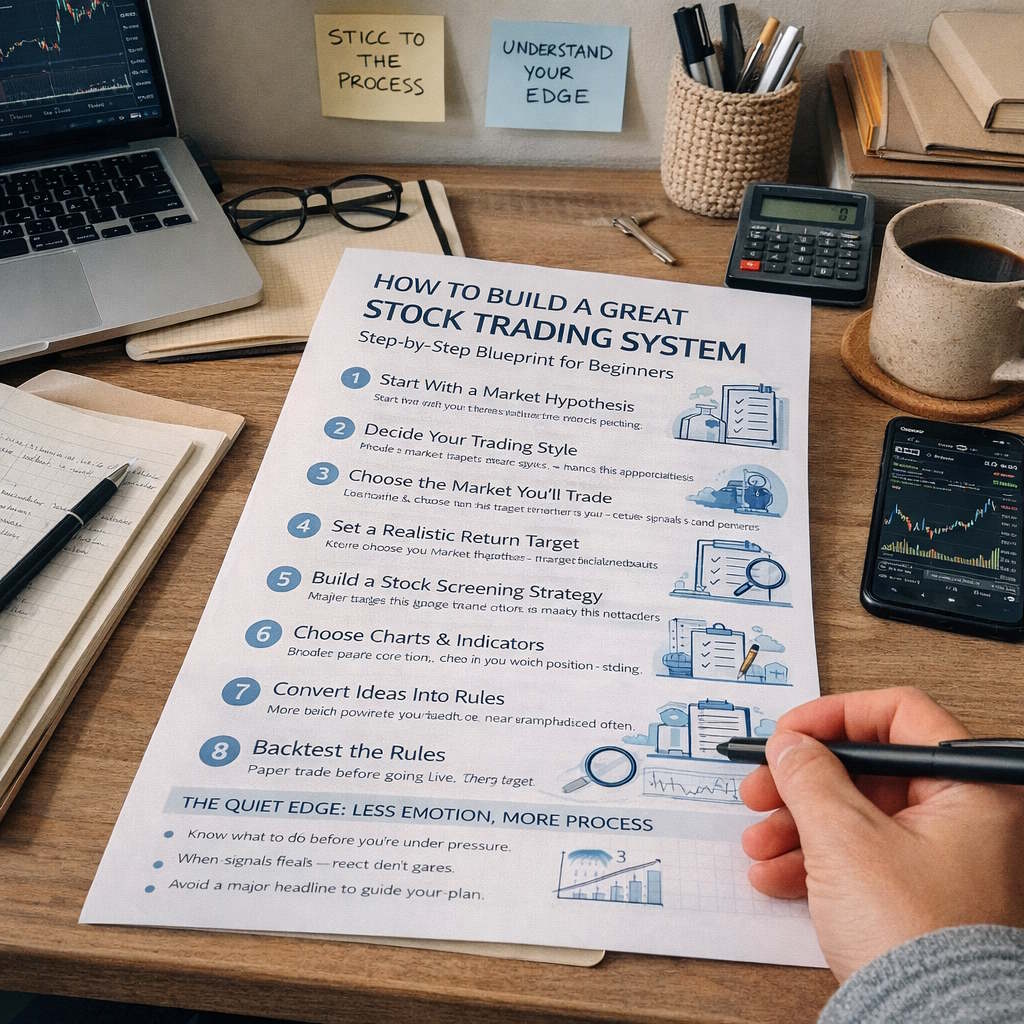
A strong system combines logic, testing, and rules. The source lesson emphasizes that building a system is part art and part science, and that it should be tested and expected to work over the timeframe you intend to trade. It also emphasizes using computers for mechanical testing and signal generation rather than relying on “on-the-fly” interpretation.
Developing a stock trading system combines logic, knowledge, experience, art, and science. Your system will need to perform well (higher than 7.5% on average per year) historically and be expected to perform well in the future, at least for the time frame you expect to use it.
The “Nirvana” of a trading system would need to perform well and need little “user interpretation” for it to function. This would mean using “trading robots” or a mechanical method. It is not necessarily a good idea to use a trading robot as that would place your trades for you, as this will essentially take any on-the-fly decision-making out of your hands.
However, you should use a mechanical method (computer) to help you test your systems and create the buy and sell signals for you.
In this context, your systems would have the following requirements.
- A good stock trading system must be backtested to prove that it worked in the past. This would prove that the logic upon which we based our assumptions is working.
- A good system allows us to trade less emotion, providing a market advantage. Emotion is known to be the culprit of many trading errors and losses.
- Automation of the fundamental screening for the stocks will save us time.
- Automating the technical indicators scan will narrow the list to focus only on our preferred candidates.
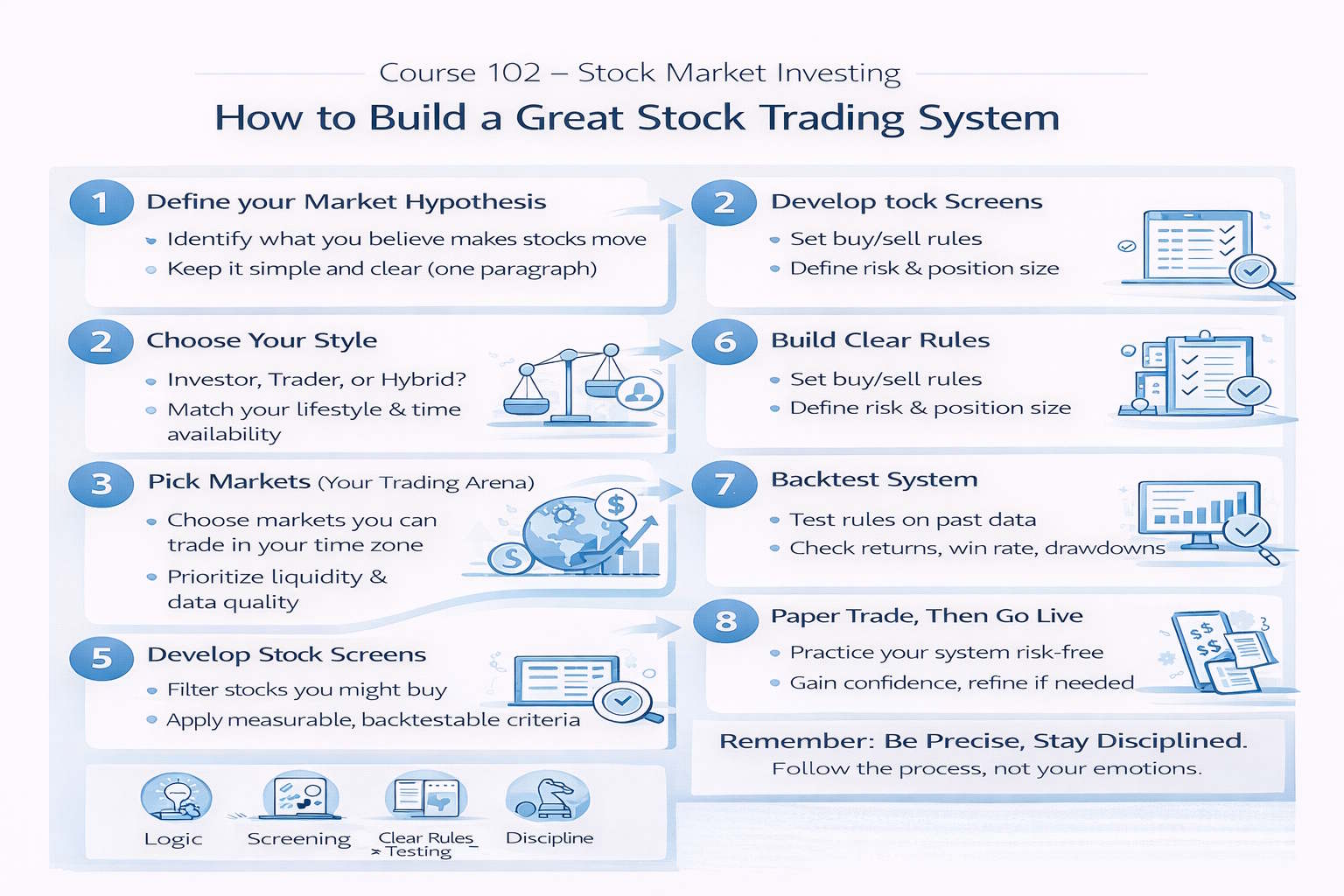
1. Start With a Market Hypothesis
Every trading system begins with a belief about how markets behave—your market hypothesis. The source lesson’s first step is to understand how the stock market works and build a hypothesis using fundamental and technical analysis as a foundation.
A good hypothesis is not a prediction like “stocks will go up.” It’s a rule-based idea like:
- “Stocks with accelerating earnings and strong relative strength tend to outperform over the next 6–12 months.”
- “Broad market trend filters reduce losses during major drawdowns.”
- “Mean reversion works best in large, liquid stocks after extreme short-term moves.”
Beginner rule: If you can’t explain your hypothesis simply, you can’t test it cleanly.
You want to be a successful stock investor but don't know where to start.
Learning stock market investing on your own can be overwhelming. There's so much information out there, and it's hard to know what's true and what's not.
Liberated Stock Trader Pro Investing Course
Our pro investing classes are the perfect way to learn stock investing. You will learn everything you need to know about financial analysis, charts, stock screening, and portfolio building so you can start building wealth today.
★ 16 Hours of Video Lessons + eBook ★
★ Complete Financial Analysis Lessons ★
★ 6 Proven Investing Strategies ★
★ Professional Grade Stock Chart Analysis Classes ★
Once you have a hypothesis, you need to design a system that will test it. This system can be as simple or complex as you like, but it should be able to give you accurate data about how your hypothesis is performing.
26 Best Stock Market Investing Books of All Time
2. Decide Your Style: Investor, Trader, or Both
Your lifestyle matters. A system fails quickly if it demands time you don’t have.
The source lesson explicitly asks you to decide whether you’ll be an investor, trader, or both, and links this to monitoring frequency (daily vs weekly) and timeframe (days/weeks vs longer).
Here’s the practical translation:
- Investor-style system: fewer decisions, longer holding periods, lower stress, fewer trades.
- Trader-style system: more decisions, tighter exits, higher activity, more execution risk.
- Hybrid system: longer-term selection with shorter-term timing rules.
Pick the style that matches your schedule. A system you can’t follow is worse than no system at all.
3. Choose the Market You’ll Trade (Time Zone and Liquidity Matter)
Many beginners assume they must trade their home market. Not necessarily. The source lesson suggests choosing markets wisely and even considering time zone advantages—e.g., someone in India with evening availability might focus on European market hours.
What matters most:
- Liquidity: more liquidity usually means tighter spreads and smoother fills.
- Data quality: you need reliable historical data to test your system.
- Your availability: can you act when your signals happen?
If you can only trade once per week, avoid a system that needs daily intervention.
4. Set a Realistic Return Target (and Don’t Get Scammed)
Beginners are vulnerable to unrealistic promises. The source lesson directly warns against claims like 100% or 1000% profits and frames 24% annualized as a very high long-run reference (Warren Buffett is used as an example of what “upper target” looks like in reality).
A better approach is to define targets in three layers:
- Process target: “Follow the rules for 50 trades without deviation.”
- Risk target: “Keep max drawdown below X%.”
- Return target: “Aim for long-run returns above a reasonable benchmark, net of costs.”
A system that makes money but gives you sleepless nights is not a great system.
5. Build a Stock Screening Strategy (Your System’s Foundation)
The source lesson is blunt: strong systems are built on screening—filtering thousands of stocks into a manageable list.
Screening answers: Which stocks are even eligible?
For a beginner, you want screening criteria that are:
- Measurable (no vague “seems strong” judgments)
- Repeatable
- Backtestable
Examples of screening dimensions mentioned in the source lesson include market cap, EPS concepts, revenue growth, and P/E ratio—core building blocks for fundamental selection.
Beginner tip: Start with 3–6 screening rules, not 30. Complexity often hides curve-fitting.
You need to understand the meaning of Capitalization, Earnings per Share, Earnings Acceleration, five-year revenue % increase, and Price Earnings Ratio. You will learn these topics later in this course.
To adopt a value investing strategy, you will want to understand the best criteria for selecting undervalued stocks.
6. Choose Charts and Indicators That Support Your Hypothesis
Once screening selects candidates, charts and indicators help with timing. The source lesson lists common price indicators and oscillators (RSI, moving averages, MACD, stochastics, etc.) and highlights volume and price-volume indicators like OBV and Chaikin Money Flow.
A common beginner error is stacking indicators until the chart looks “scientific.” Don’t do that. Choose indicators that answer one of these questions:
- Trend: Is the market or stock in an uptrend/downtrend?
- Momentum: Is strength improving or fading?
- Volatility: How wide should stops be?
- Confirmation: Is volume supporting the move?
Rule of thumb: Every indicator must earn its place by improving test results, not by looking impressive.
7. Turn your hypothesis into rules
Convert Your Idea Into Explicit Rules (No Interpretation)
A system is only a system when it becomes rules. The source lesson explicitly says to turn your hypothesis into rules and quantify your screening and technical choices.
You need rules for:
- Entry: what must be true to buy?
- Exit: what must be true to sell?
- Risk: how much can you lose on one trade?
- Position sizing: how big is each position?
Example rule set (simple and testable)
- Entry: Buy when price is above the 200-day moving average and breaks above the 50-day high.
- Stop-loss: Exit if price closes 8% below entry or breaks the 50-day moving average.
- Take-profit: Optional, or use trailing stop.
- Position size: Risk 1% of portfolio per trade.
What stock screening strategy will you use for stock selection?
- Find the Best CANSLIM Stocks Using a CANSLIM Stock Screener
- Dividend Growth Stock Screener: 5-Step Timeless Strategy
- 6 Steps to Build Your Dividend Stock Screener & Strategy
- Value Investing Strategy: 7 Proven Value Stock Screeners
What Technical Indicators will you use for buying and selling stocks?
You must select an excellent stock screener to help you formulate your rules.
8. Backtest the Rules (Because Belief Isn’t Evidence)
Backtesting is the process of applying your rules to historical data to see how they would have performed. The source lesson emphasizes that a good system must be backtested to show it worked historically and that mechanical testing reduces emotion. It also highlights that you can use a spreadsheet approach or dedicated backtesting software.
Backtesting tells you:
- Average return per trade / per year
- Win rate (percentage of winning trades)
- Average win vs average loss
- Max drawdown (worst peak-to-trough decline)
- Trade frequency (how often signals occur)
The most important beginner backtest metrics
Max drawdown. Many systems look great until you see the drawdown. Your system must be survivable psychologically and financially.
Beginner warning: Backtests can lie if you over-optimize. Keep rules simple, test across multiple market regimes, and avoid fitting to one perfect period.
When you backtest a stock, you look at how it would have done in the past if you had bought it and held it. This can help you determine whether it is a good investment.
Or you can use the best stock market software that fully automates backtesting without using Excel or downloading and manipulating data.
9. Paper Trade Before You Go Live
Even a strong backtest can fail in real life if you can’t follow it. Paper trading lets you test:
- Execution realism (do you get fills near expected prices?)
- Signal clarity (are rules unambiguous in real time?)
- Your discipline (do you override the system?)
The source lesson recommends letting your rules run, paper trading to confirm commitment, then tweaking if needed.
Think of paper trading as the bridge between theory and practice.
Beat The Market, Avoid Crashes & Lower Your Risks
Nobody wants to see their hard-earned money disappear in a stock market crash.
Over the past century, the US stock market has had 6 major crashes that have caused investors to lose trillions of dollars.
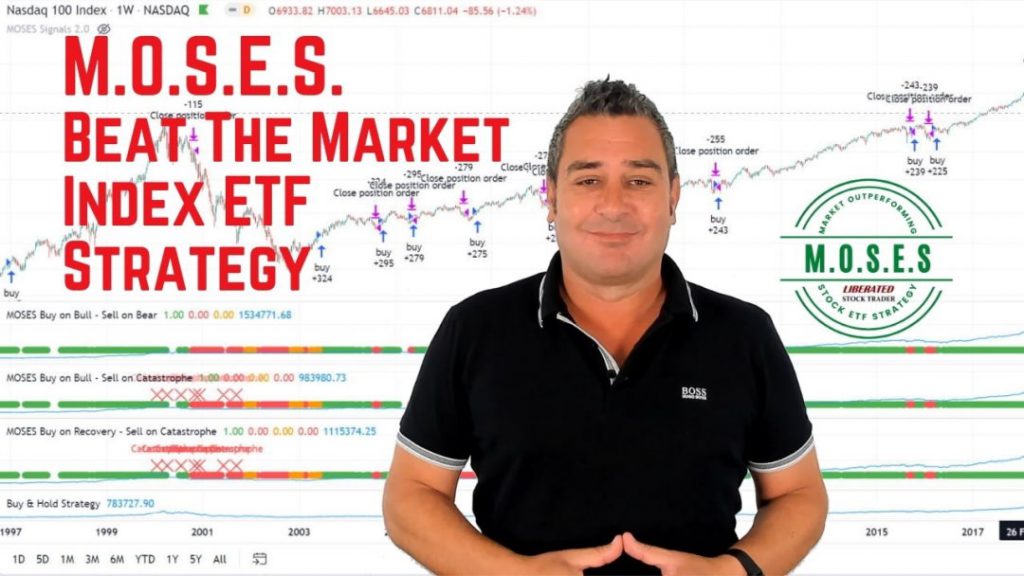
The MOSES Index ETF Investing Strategy will help you minimize the impact of major stock market crashes. MOSES will alert you before the next crash happens so you can protect your portfolio. You will also know when the bear market is over and the new rally begins so you can start investing again.
MOSES Helps You Secure & Grow Your Biggest Investments
★ 3 Index ETF Strategies ★
★ Outperforms the NASDAQ 100, S&P500 & Russell 3000 ★
★ Beats the DAX, CAC40 & EURO STOXX Indices ★
★ Buy & Sell Signals Generated ★
MOSES Helps You Sleep Better At Night Knowing You Are Prepared For Future Disasters
Ever Dreamed of Beating the Stock Market
Most people think that they can't beat the market, and stock picking is a game only Wall Street insiders can win. This simply isn't true. With the right strategy, anyone can beat the market.
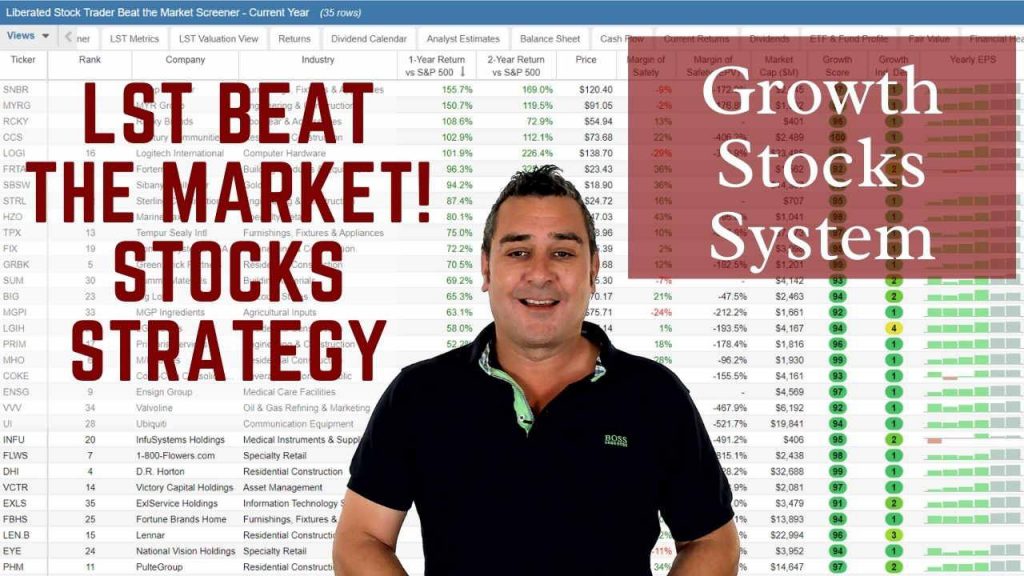
The LST Beat the Market Growth Stock Strategy is a proven system that has outperformed the S&P500 in 8 of the last 9 years. We provide all of the research and data needed to make informed decisions, so you no longer have to spend hours trying to find good stocks yourself.
The LST Beat the Market System Selects 35 Growth Stocks and Averages a 25.6% Annual Return
★ 35 Stocks That Already Beat The Market ★
★ Buy The Stocks & Hold For 12 Months - Then Rotate ★
★ Fully Documented Performance Track Record ★
★ Full Strategy Videos & eBook ★
Take The Pain Out Of Stock Selection With a Proven Strategy
10. Iterate Carefully: Improve What Matters, Not What Feels Good
After testing, the impulse is to “fix everything.” Don’t. Improve one variable at a time:
- Tighten screening? (fewer but higher-quality candidates)
- Improve exits? (reduce drawdowns)
- Add a market regime filter? (avoid trading in downtrends)
- Adjust position sizing? (improve risk-adjusted returns)
Keep a change log. If performance improves, you want to know why—not guess.
If your rules are working, implement your stock system and start to trade it. If not, you may need to refine the system. The best systems have been refined repeatedly to remove logical errors and improve the percentage of winning trades and profit per trade.
The Quiet Edge: Less Emotion, More Process
The source lesson calls out a major advantage: systems reduce emotional trading errors. That’s the real “edge” most beginners can actually access. Not inside information. Not speed. Not leverage.
A good system doesn’t promise perfection. It promises structure:
- You know what you’re doing before the market moves.
- You know what you’ll do if you’re wrong.
- You don’t need a headline to tell you how to react.
That’s what makes a system sustainable.
Join me and 20 million traders on TradingView for free. It's a great place to chart, scan, trade, and get my latest trading ideas and analysis.

Class Questions & Answers
What is a stock trading system (in plain English)?
A stock trading system is a repeatable set of rules for choosing what to buy, when to buy, when to sell, and how much risk to take—so decisions are consistent and less emotional.
Why do you need a “market hypothesis” before building rules?
A hypothesis explains what you believe works and why. Without it, rules become random, and you can’t test whether your logic actually produces an edge.
What is the main purpose of screening in a trading system?
Screening narrows thousands of stocks to a short list that matches your criteria, eliminating weak candidates and focusing attention on the most relevant opportunities.
Which backtest result is most important for beginners to check first, and why?
Max drawdown, because it shows the worst historical decline. If the drawdown is too large, you may abandon the system at the worst time, even if average returns look good.
Why should you paper trade a system before investing real money?
Paper trading tests whether the rules are clear in real time, whether execution is realistic, and whether you can follow the system without emotional overrides—before real losses are possible.