
When you’re picking an investment strategy, you need to know how each approach aligns with your financial goals and risk tolerance. The stock market isn’t one-size-fits-all—there are plenty of ways to pursue returns, and each path suits a different investor profile or time frame.
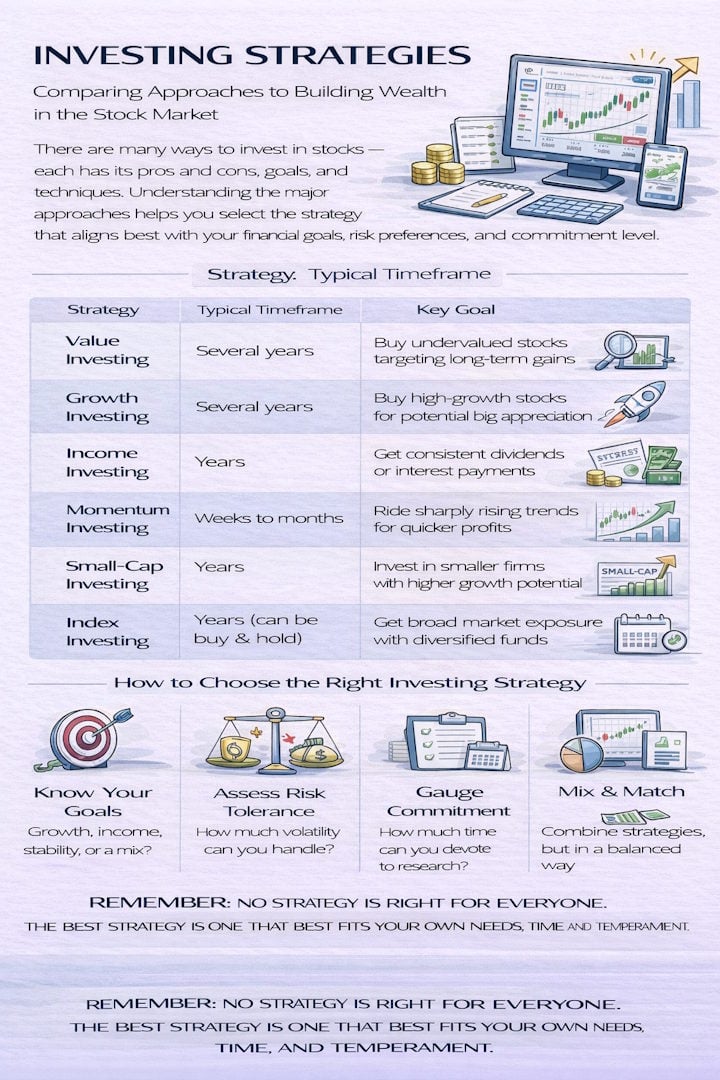
Some people chase companies with big expansion plans, others want steady dividends, some hunt for undervalued gems, and plenty look for quick moves. Before you put your money on the line, you’ll want to size up the real pros and cons of each method.
Your strategy choice really comes down to things like current market conditions, what you want out of investing, and how much volatility you can actually stomach. If you’re investing for the long haul, you’ll probably lean on fundamental analysis, looking for solid companies and good value.
Short-term traders, though, often care more about technical patterns and timing. Tools like Stock Rover can help you dig deep into financials and screen for stocks that fit your criteria. Getting familiar with these methods helps you build a portfolio that actually fits your goals and time frame.
Key Takeaways
- Different investment strategies match up with different risk levels and time horizons in the stock market.
- Each approach brings its own strengths and drawbacks, so you need to weigh them against your personal investment goals.
- Picking a strategy means understanding fundamental analysis, current market conditions, and your own financial objectives.
Growth Investing
Growth investing is all about buying shares in companies that you think will deliver strong revenue and earnings growth. You’re basically betting on businesses in fast-growing industries or those with serious potential for capital appreciation.
Growth investors prefer companies that reinvest profits in expansion, not those that pay dividends.
Advantages
Growth investing can offer much higher returns than more conservative strategies. If you pick companies with real earnings growth, you can see big capital gains as their stock prices rise.
This approach fits well with long-term financial goals. Growth stocks in booming sectors often outperform the market during good economic times.
Platforms like Stock Rover let you screen for companies with steady revenue and earnings growth, so you can find promising growth stocks more easily. Since you’re not chasing dividends, you can focus entirely on capital appreciation.
Disadvantages
Growth stocks usually trade at higher price-to-earnings ratios, so you end up paying a premium compared to value stocks. That can shrink your margin of safety if the market turns south.
Volatility is a big issue here. Growth stocks can swing wildly, especially if a company misses earnings or hits industry trouble.
You’ll need to put in real research. Not every company with a high valuation keeps growing; sometimes, projections just don’t pan out, and you take the hit.
Income Investing
Income investing is about building a portfolio that pays you a steady cash flow through dividends and interest. If you go this route, you’ll look at assets like dividend stocks, bonds, ETFs, and mutual funds with regular payments.
The dividend yield matters a lot—it tells you how much income you get each year compared to the stock price.
This strategy works best for folks who want passive income without having to sell their shares. Income stocks usually come from established companies with steady profits that share earnings with shareholders.
Dividend growth stocks sweeten the deal by raising payouts over time, helping you keep up with inflation.
DRIP / Dividend Reinvestment Calculator
Model how reinvested dividends can increase share count, grow portfolio value, and improve long-term total return compared with taking dividends in cash.
Inputs
Results
Formula Used
Walkthrough: Interactive Free Dividend Reinvestment (DRIP) Calculator
Benefits
Income-focused portfolios provide predictable cash flow, which you can reinvest or use for expenses. Getting regular payments brings a sense of stability and means you don’t have to time your sales.
These investments usually swing less than growth stocks, so you’ll see fewer wild price drops in bad markets. With platforms like Stock Rover, you can screen for top dividend-paying companies based on fundamentals and payout history.
Reinvesting dividends really boosts your long-term returns. Plus, something is reassuring about getting real money back without having to touch your positions.
Drawbacks
If stock prices go nowhere, you’re limited to just the dividend payments, so your wealth may not grow much. You might miss out on significant capital gains if you focus only on income.
High-dividend stocks aren’t immune to crashes—when markets tank, these can drop hard too. Companies can also suddenly slash or stop dividends if things go south, leaving you without the expected income.
Taxes can take a bite, since dividend income often gets a higher tax rate than long-term capital gains, depending on where you live.
Value Investing
Value investing means searching for stocks trading below their intrinsic value. You have to look past the current price and figure out what a company is truly worth by examining its fundamentals.
This approach involves analyzing financials, checking balance sheet strength, and crunching numbers like the P/E ratio to spot discounts.
Benjamin Graham started this whole philosophy, and Warren Buffett—his student—became its most famous success story. Graham’s book, “The Intelligent Investor,” basically set the rules for how value investors pick companies.
The core idea is intrinsic value: what’s the company actually worth, based on assets, earnings potential, market position, and future cash flows? If the stock trades way below that, value investors see an opportunity.
That gap between price and value is the margin of safety—it’s your buffer against losing money if the analysis isn’t perfect.
Value stocks usually have low price-to-earnings ratios, trade under book value, or just aren’t popular with most investors at the moment. Value investors hunt for solid companies that are overlooked or facing temporary setbacks.
A buy-and-hold mindset fits here, since it can take a while for undervalued companies to get noticed by the market. Stock Rover offers in-depth tools for fundamental analysis and value-play screening.
Advantages
Buying stocks below intrinsic value builds in a margin of safety, so you’re less likely to lose big if things go wrong or the market dips.
You get access to quality companies at bargain prices. This lets you pick up shares in businesses with strong fundamentals and healthy balance sheets at less than their intrinsic value.
The track record for value investing is solid. Warren Buffett’s results show that buying undervalued companies and holding on can generate real wealth over time.
Value stocks are usually less volatile than growth stocks. Established companies with proven business models just don’t swing as wildly.
Disadvantages
You’ll need to put in serious time. Digging through financials, calculating intrinsic value, and researching companies takes real effort and skill.
Value traps are a real risk. Sometimes a stock is cheap for a good reason—the company might be in decline, facing tough competition, or suffering from poor management. What looks like a deal could actually be a dud.
Patience gets tested. Undervalued stocks can remain undervalued for years before the market catches on, so your money might sit idle.
Sometimes, market conditions favor other strategies. Growth stocks can leave value investors in the dust during certain stretches.
It’s getting harder to find true bargains. With everyone having access to data and analysis tools, mispriced stocks are rare, and competition among value investors is fierce.
Active Intraday Trading
Benefits of Intraday Trading
If you’re trading actively during the day, you can jump on quick price moves and potentially rack up returns fast. Since you close out positions before the market shuts, you can recycle your capital over and over.
Leverage is a big draw here. With $10,000, you might control $50,000 worth of stock, so even small moves can lead to outsized gains.
You don’t have to worry about overnight news or global events messing up your trades—positions are closed before anything unexpected hits after hours.
| Advantage | Description |
|---|---|
| Capital efficiency | Funds can be redeployed multiple times daily |
| No overnight risk | Positions close before market shutdown |
| Scalping potential | Profit from minor price fluctuations |
Technical analysis is your main tool for spotting entry and exit points. Platforms like TradingView offer real-time charts, so you can track price and volume patterns in real time.
Volatility becomes your friend if you know how to read short-term moves. A good stock screener helps you find stocks with enough intraday action to make trading worthwhile.
Drawbacks of Intraday Trading
The risks are huge. Studies show that up to 80% of beginners lose their entire bankroll in the first year, so the odds aren’t in your favor.
Transaction costs pile up fast if you’re making dozens or hundreds of trades. Commissions and bid-ask spreads eat into your profits, so you need bigger gains per trade just to break even.
The time commitment is brutal. You have to watch the market constantly during trading hours, which doesn’t mix well with any other job.
The stress is real. Making split-second decisions all day can wear you down, leading to mistakes and bad judgment.
Getting good at technical analysis, order execution, and risk management takes years. Most folks just don’t have the knowledge or discipline to stay profitable for long.
Volatility cuts both ways. The same price swings that offer opportunity can wipe you out in minutes if you’re not careful. Without strict stop-losses, one bad trade can undo weeks of hard work.
The learning curve is steep and expensive. Most new traders end up paying for their education through losses before they ever find an edge.
Class Questions & Answers
What is an “investing strategy,” and why do you need one?
An investing strategy is a set of rules for what you buy, when you buy, how long you hold, and when you sell. You need one because it reduces emotional decisions and helps you stay consistent through market ups and downs.
What is the difference between growth investing and value investing?
Growth investing focuses on companies expected to grow earnings or revenue rapidly, often trading at higher valuations. Value investing focuses on companies that look underpriced relative to fundamentals (earnings, assets, or cash flow), often aiming for a “margin of safety.”
What is dividend investing, and when does it make sense?
Dividend investing focuses on companies that return part of profits to shareholders through regular cash payments. It can make sense if you want steadier income, lower volatility, and a business model with consistent cash flow—while still monitoring payout sustainability and debt.
What is trend-following (momentum) investing in simple terms?
Trend-following (momentum) investing means buying assets that are already rising and avoiding (or selling) assets that are falling, using rules such as moving averages, breakouts, or higher-high/higher-low structure. The goal is to ride sustained trends and control downside when trends reverse.
How do you choose the right investing strategy for you?
Choose based on your time horizon, risk tolerance, and how much time you can spend researching and monitoring. A good strategy matches your personality: if you can’t stick with it during drawdowns or boredom, it’s the wrong strategy—even if it looks good on paper.