
Stock research is the bridge between ideas and decisions. Without research, investing becomes guessing. With a structured research process, investing becomes a disciplined evaluation of risk, value, and opportunity. The goal is not to predict the future perfectly—it is to stack the odds in your favor by understanding what you own, why you own it, and what could go wrong.
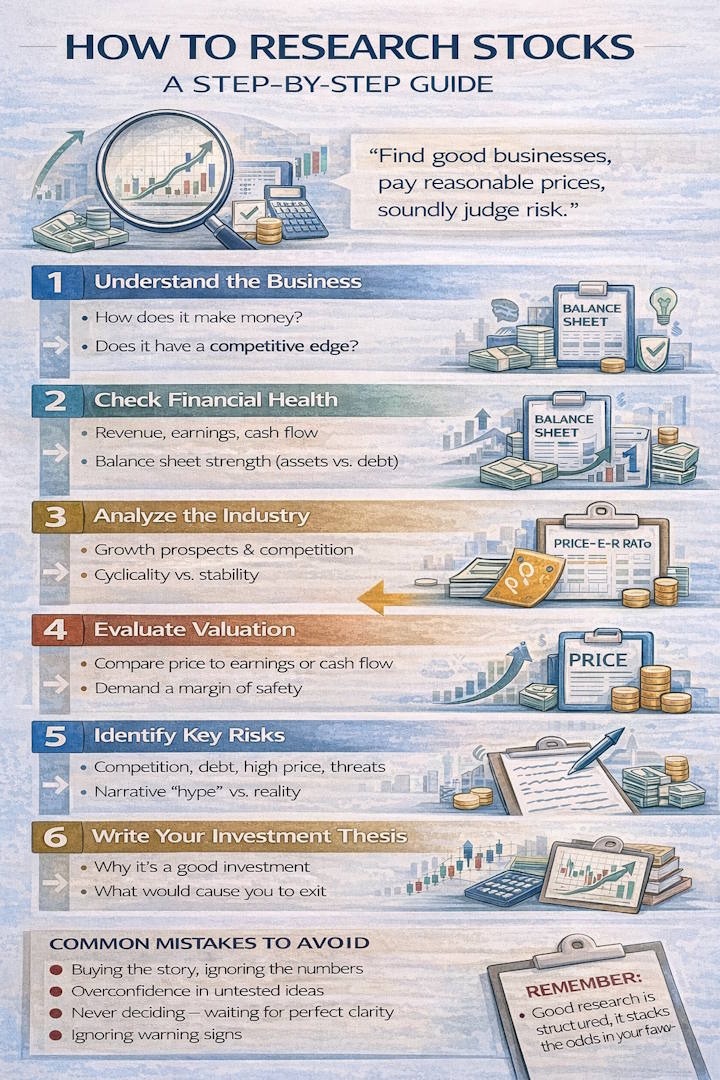
This lesson explains a step-by-step stock research framework designed for beginners. It avoids unnecessary complexity and focuses on what actually matters when deciding whether a stock deserves your capital.
What Stock Research Really Means
Stock research is the process of gathering, filtering, and interpreting information to decide whether a stock is worth buying, holding, or avoiding.
Good research answers four core questions:
- What does this company actually do?
- Is the business financially healthy?
- Is the stock attractively priced relative to its quality and prospects?
- What risks could permanently harm the investment?
If your research doesn’t answer these questions clearly, it’s incomplete.
Step 1: Start With the Business, Not the Stock Price
A common beginner mistake is starting with charts, price moves, or “what’s hot.” A stronger approach starts with the business itself.
Understand the business model.
Ask:
- How does the company make money?
- Who are its customers?
- What problem does it solve?
- Is demand recurring or one-off?
- Does it sell products, services, subscriptions, or a mix of these?
If you can’t explain the business in plain language, you shouldn’t invest in it.
Identify the company’s competitive position.
Look for signs of durability:
- Strong brand recognition
- Switching costs for customers
- Network effects
- Cost advantages
- Regulatory barriers
You’re not looking for perfection. You’re looking for a reason the company can defend profits over time.
Step 2: Check the Company’s Financial Health with Research Reports
A stock research report is an analysis of a publicly traded company prepared by a financial analyst. The report may include the company’s financial performance, competitive landscape, and potential investments.
The purpose of a stock research report is to provide investors with the information they can use to make informed investment decisions.
Types of Stock Research Reports
There are several different types of stock research reports, but most contain similar information. The first section of a typical report will provide an overview of the company and its business operations. This section may also include the company’s financial history and recent developments.
The second section will analyze the company’s stock price performance. This section may include information on the factors that have influenced the stock price and technical analysis of the stock chart.
The third section will discuss the company’s competitive landscape. This section may include information on the major competitors, their market share, and their strengths and weaknesses.
The fourth section will analyze the company’s potential investments. This section may include information on the company’s products, services, and markets. The fifth section will provide a conclusion and recommendations.
Understanding Analysts
To research stocks, you can use reports from financial analysts employed by research firms, such as Moody’s, Morningstar, or Zacks.
These research companies provide stock ratings and analysis written by market analysts. But there are biases in institutional stock research, as detailed in the book Full of Bull by Stephen T. McLennan:
“The analysts tend to avoid negative opinions as they tend to receive flak from the management teams and pressure that they may lose access to the companies they cover. Analysts are not paid for the performance of their stock ratings; therefore, they have limited motivation to be truthful.”
“Wall Street Analysts are bad at stock picking.”
“Does buy really mean buy the stock? What if the highest rating used is a strong buy? Does that mean that buy is more negative than strong buy?”
“Wall Street is oriented towards increasing stock prices; they must be positive to convince people to continue buying.”
“In a 2006 CFA Magazine Research article by Mike Mayo, it was noted that of the recommendations on the Top 10 Largest Cap stocks in the US, there were 193 Buy Ratings and only 6 Sell Ratings. Systemic Bias…?”
Source: Stephen T. McLennan – Book Full of Bull
So, if you cannot rely on rating and research agencies, you must learn to research stocks yourself.
Research stocks for long-term investing
Alternatively, you can perform your own research using powerful stock research software. Our favorite tool for independent stock research is Stock Rover, which provides powerful, unbiased, real-time research reports.
Long-term investors use the company’s financial reports and news to research companies they are interested in investing in. The problem with performing this research manually is that it is incredibly time-consuming.
To save time, investors should use Stock Rover, which combines essential fundamental financial information into a platform that offers powerful stock screening and portfolio management.
Research stocks for day trading
If you are day trading, you will primarily use real-time financial news and technical analysis software to perform your research. The nature of day trading is that trades typically last less than one day, so you are not focused on financials; you use real-time charts and news events to trade.
This article highlights the difference between technical and fundamental analysis.
Where to research stocks
You can research stocks using various resources, including financial websites, stockbrokers, and the news.
Financial websites often have information on individual stocks, such as historical prices and analyst ratings. You can also use these websites to create hypothetical portfolios and track your investments.
The news can also be useful for learning about the stock market and providing information on upcoming events that may affect prices.
Here is a list of services that provide exceptional stock research reports and real-time financial news services.
How to get stock research reports
Stock Rover, Motley Fool, Benzinga, Morningstar, Zacks, IBD, and Seeking Alpha are great sources for stock research. Below is a table comparing the research services.
| Research Service | Rating | Price Per Year |
| Stock Rover Premium Plus | ★★★★★ | $0-$279 |
| Motley Fool Stock Advisor | ★★★★★ | $199 |
| Benzinga Pro – Real-time News | ★★★★★ | $799 |
| Morningstar Premium | ★★★★☆ | $249 |
| Zacks Ultimate | ★★★★☆ | $2995 |
| IBD Leaderboard | ★★★☆☆ | $828 |
| Seeking Alpha Pro | ★★★☆☆ | $2400 |
Free stock research reports
Free stock research reports may be available with your brokerage account, but if not, Stock Rover provides free research reports for all companies on the Dow Jones 30 Index.
One of the best features of the Stock Rover platform is the Dynamic Research Report. This service lets you generate a professional, readable PDF report on any stock’s current and historical performance.
The research report creates something new: a human-readable, real-time report that highlights a company’s competitive and market position, and its historical and potential dividend and value returns. The image below shows the dividend-adjusted commentary on Microsoft, a company I invested in after identifying its excellent potential using my Buffett Stock Screener.
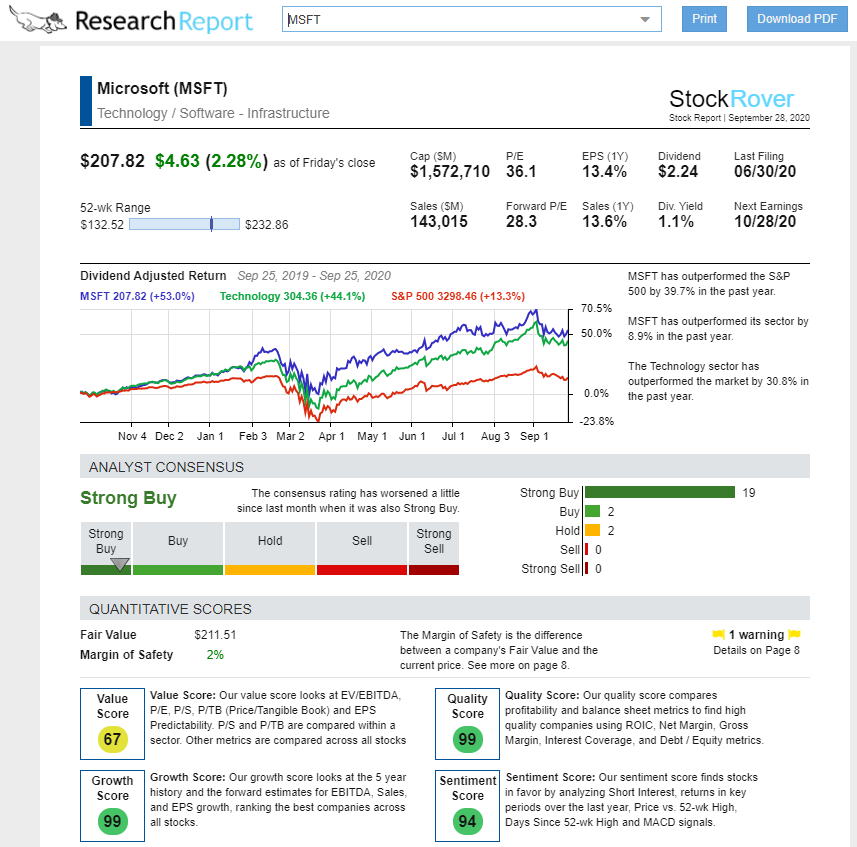
The best thing about Stock Rover’s Research Reports is they are Real-time, so the information is always up-to-date.
The Stock Rover research reports provide a comprehensive summary of any of the 10,000+ stocks listed on US and Canadian exchanges. Research reports can be viewed in a browser and exported as PDFs for portability and sharing.
- Download a complimentary Stock Rover Research Report Now
Stock Newsletters – Stock Pickers
Many newsletter services are available where you can register to receive stock recommendations. You will usually receive a daily or weekly newsletter recommending buy and sell recommendations. These services come in two flavors: “Free Newsletters” and “Pay for Services.”
At all costs, avoid any Free Stock Tips Newsletters. The companies that run free newsletters provide biased data as they earn money from the companies they promote. Companies often pay them if they promote with stock. So if they promote the stock well enough, they can sell it as the price rises, making money at your expense.
Premium newsletters can be a useful source of information, but you have to research the provider’s track record. Ensure they beat the market year after year. At least 90% of stock tippers do not consistently beat the market.
Be your own Stock Analyst.
Investing in yourself and making your own decisions is the best way to improve your profits and success in the market. When it comes to your own money, you can only trust yourself. Make a good investment in stock market education and spend time using fundamental and technical analysis to make informed decisions.
Review revenue and earnings trends.
Look for:
- Consistent revenue growth over multiple years
- Profits that are stable or improving
- Clear explanations when growth slows or declines
Volatility isn’t always bad, but unexplained inconsistency is a warning sign.
Examine cash flow
Cash flow confirms whether profits are real.
Focus on:
- Operating cash flow: Is the core business generating cash?
- Free cash flow: Is there cash left after maintaining the business?
- Cash consistency: Are cash flows reliable or erratic?
A company that reports profits but struggles to generate cash deserves extra caution.
Assess the balance sheet.
Check:
- Cash vs. short-term obligations
- Total debt relative to earnings
- Debt maturity (does a lot come due soon?)
A strong balance sheet increases resilience during downturns. Weak balance sheets force companies into bad decisions at the worst times.
Step 3: Understand the Industry and Market Context
No company operates in isolation. Industry conditions shape what’s possible.
Industry structure matters
Ask:
- Is the industry growing, mature, or shrinking?
- Is competition intense or limited?
- Are pricing pressures rising or falling?
- Is technology changing the landscape?
A great company in a declining industry faces long-term headwinds. An average company in a growing industry may benefit from favorable tailwinds.
Cyclicality vs. stability
Some industries are highly cyclical (e.g., commodities, construction, autos). Others are more stable (e.g., consumer staples, healthcare).
Understanding cyclicality helps you interpret:
- Earnings swings
- Valuation changes
- Risk during economic downturns
Step 4: Evaluate Valuation (What Are You Paying?)
A great business can still be a bad investment if the price is too high. Valuation connects research to discipline.
Use valuation as a range, not a precise number
Valuation is an estimate, not a fact. The goal is to answer:
- Is the stock clearly cheap?
- Clearly expensive?
- Or roughly fairly priced?
Common valuation tools:
- Price-to-earnings (P/E)
- Price-to-sales
- Free cash flow yield
- Comparison to historical valuation ranges
- Comparison to peers
Avoid anchoring on a single metric. Look for convergence across several measures.
Demand a margin of safety.
Because estimates can be wrong, many investors require a buffer—buying only when the price is meaningfully below the reasonable value.
This reduces the cost of being wrong.
Step 5: Identify the Key Risks (Before You Buy)
Every stock has risks. The mistake is ignoring them.
Types of risks to consider
- Business risk: Loss of customers, competition, disruption
- Financial risk: Excessive debt, refinancing risk
- Execution risk: Management missteps
- Regulatory risk: Policy or legal changes
- Valuation risk: Paying too much for future growth
- Narrative risk: Market expectations becoming unrealistic
A good research process doesn’t eliminate risk—it makes risk visible.
Step 6: Form an Investment Thesis
An investment thesis is a short, written explanation of why the stock should perform well over time and what would prove you wrong.
A strong thesis includes:
- Why the business is attractive
- Why is the valuation reasonable
- What must go right
- What would cause you to exit
Example structure:
“I believe this company will grow earnings over the next X years because ____. At today’s price, the valuation assumes ____, which I believe is conservative/realistic/optimistic. I would reassess if ____ happens.”
Writing the thesis forces clarity and prevents emotional decisions later.
Step 7: Use Technical Analysis for Timing (Optional but Useful)
Fundamental research tells you what to buy. Technical analysis can help decide when to buy or sell.
Practical uses:
- Avoid buying into clear downtrends
- Identify support and resistance zones
- Use trend confirmation for entries
- Set predefined exit levels
You don’t need complex indicators. Even simple trend filters can reduce poor timing.
Step 8: Decide Position Size and Portfolio Fit
Research doesn’t end with “buy or not.” It ends with how much.
Ask:
- How confident am I in this thesis?
- How volatile is the stock?
- How correlated is it with existing holdings?
Position sizing is risk management. Even a great stock shouldn’t dominate your portfolio unless you fully understand the consequences.
Common Research Mistakes Beginners Make
Avoid these traps:
- Confirmation bias: Only seeking information that supports your view
- Story over numbers: Falling in love with narratives that lack financial support
- Overconfidence: Assuming one good idea justifies oversized risk
- Endless research: Never deciding because you want “removal of all uncertainty.”
- Headline-driven decisions: Letting news or opinions replace analysis
Good research is structured, not obsessive.
A Simple Stock Research Checklist
Before investing, confirm you can answer “yes” to most of these:
- I understand how the company makes money
- The business is financially healthy
- Cash flow supports reported profits
- The balance sheet is resilient
- The valuation is reasonable with a margin of safety
- I understand the main risks
- I have a written thesis
- The position fits my portfolio
If several answers are “no,” wait.
The Real Purpose of Stock Research
Stock research is not about finding certainty. It’s about making informed decisions in the face of uncertainty. Markets will always surprise you. But investors who research systematically:
- Make fewer emotional decisions
- Avoid obvious blow-ups
- Stay confident during volatility
- Improve long-term consistency
That is the real edge.
Class Questions & Answers
What is the main goal of stock research?
The goal of stock research is to evaluate a company’s business, financial health, valuation, and risks so investment decisions are based on evidence rather than guesses or emotions.
Why should stock research start with understanding the business?
Because financial numbers only make sense when you understand how the company makes money, who its customers are, and whether it has a sustainable competitive position.
Why is cash flow important when researching stocks?
Cash flow shows whether profits are supported by real money coming into the business. Companies can report accounting profits while still struggling to generate cash.
What is an investment thesis, and why is it useful?
An investment thesis is a written explanation of why you believe a stock will perform well and what would prove you wrong. It helps maintain discipline and avoid emotional decisions.
Why is valuation an essential part of stock research?
Because even a high-quality business can be a poor investment if the price is too high. Valuation helps determine whether expected returns justify the risks.