
You’re looking to grow your wealth but don’t want to take on wild risks. The big question: how many stocks should you actually own? If you hold too few, your portfolio can swing up and down with every earnings miss. If you go overboard, performance dilutes, and managing it becomes a headache.
Most evidence points to holding 15 to 30 carefully chosen stocks for real diversification without making your life miserable.
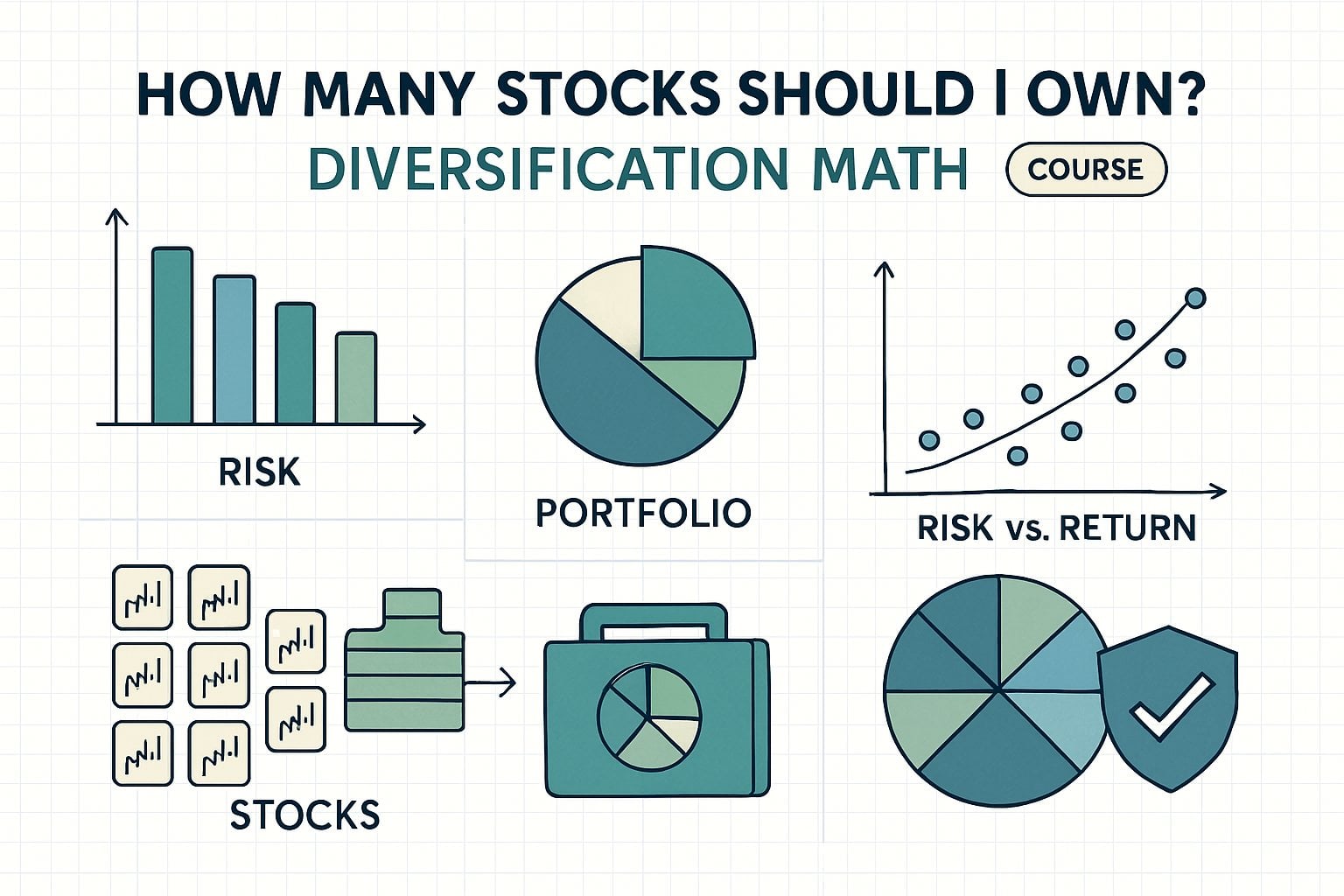
You can use diversification math to figure out your sweet spot. The idea is to reduce company-specific risk while maintaining efficiency. Tools like Stock Rover help you screen for quality across sectors, so you can build a mix that spreads risk but still matches your goals.
Diversification isn’t about owning everything under the sun—it’s about owning enough of the right stuff. Once you get how correlation and position sizing work, you can decide whether to add single stocks or use index funds to fill the gaps. The real trick is to manage exposure, not just rack up the number of holdings.
Key Takeaways
- Shoot for 15–30 stocks for a good balance of risk and simplicity.
- Use diversification math to guide how much you put in each sector.
- Combine stocks with funds or ETFs for efficient coverage.
How Many Stocks Should I Own?
The “right” number of stocks depends on how much diversification you want, how much time you’re willing to spend, and how confident you feel about picking winners. You’re always balancing risk reduction against practicality—enough holdings to spread risk, but not so many that keeping up becomes impossible.
Recommended Number of Stocks for Diversification
Most studies place the range for when diversification really works at 20 to 30 stocks. Academic research shows that holding about 10 stocks yields roughly 90% of the possible risk reduction. If you bump it up to 20–30 stocks, returns tend to smooth out a bit more, but you’re not adding a ton of complexity.
If you own fewer than 10 stocks, you’re basically rolling the dice on company-specific risk. Say one stock tanks 40%—that’s going to hurt. With 20 or more, a single flop won’t wreck the whole portfolio.
Stock Rover lets you screen across sectors and market caps, so you can spot if you’re too heavy in one industry or region.
| Portfolio Size | Approximate Diversification Benefit |
|---|---|
| 1–5 stocks | Very low |
| 10 stocks | ~90% of market diversification |
| 20–30 stocks | Broad diversification |
| 50+ stocks | Minimal added benefit |
Key Factors That Influence Position Size
Your ideal number depends on portfolio size, strategy, and risk tolerance. With $5,000, trading costs might limit you to a handful of positions. If you’ve got $100,000, you can spread it out over 20+ stocks without getting too concentrated.
Diversifying across different sectors or geographies gets you more bang for your buck. If you own three tech stocks, that’s not really diversification, even if you have a dozen tickers.
If you’re a market junkie and use tools like Seeking Alpha for research, you can handle more holdings. If you’re more hands-off, fewer stocks—or an ETF—just makes life easier.

Trade-Offs of Owning More or Fewer Stocks
If you own too few stocks, your results hinge on just a couple of companies. You might crush it some years, but one bad pick can ruin your returns. Go to the other extreme—too many stocks—and you’ll likely see your gains diluted, plus it’s a pain to track everything.
With 20–30 stocks, you hit a nice middle ground between diversification and manageability. Beyond that, adding more names does little to reduce risk, but it increases your workload.
If you’re juggling a big portfolio, try TrendSpider or similar tools to automate chart analysis and alerts. Automation can save your sanity when you’re tracking lots of tickers.
The Math of Diversification
Diversification means spreading your money across multiple assets to reduce the risk that one dud will wreck your whole portfolio. The math shows that unsystematic risk declines as you add holdings, but that each new stock contributes less and less.
Reducing Unsystematic Risk
Unsystematic risk covers stuff like bad management, product recalls, or lawsuits—things you can’t always see coming. You can’t dodge these entirely, but you can blunt their impact by owning stocks from different sectors.
Research shows that owning 10–20 stocks across unrelated industries eliminates most unsystematic risk. After that, what’s left is systematic or market risk—and you just can’t diversify that away.
| Number of Stocks | Approx. % of Unsystematic Risk Reduced |
|---|---|
| 1–5 | 50–70% |
| 10–20 | 80–90% |
| 25–30 | 90–95% |
Stock Rover lets you screen by sector, market cap, and correlation, so you can build a mix that fits your risk tolerance.
Diminishing Returns of Adding Stocks
Each new stock you add reduces portfolio volatility slightly less than the last. The benefit curve flattens after about 20–30 holdings. Beyond that, you’re just making your life harder without much payoff.
A portfolio of 10 stocks might reduce volatility by half compared with a single stock. If you go to 30, you only shave off a tiny bit more. It’s a classic case of diminishing returns.
Keep this in mind when considering adding more names. For smaller portfolios, 15 carefully picked stocks usually hit the sweet spot between diversification and sanity.
Modern Portfolio Theory Explained
Modern Portfolio Theory (MPT) basically says that mixing assets with different correlations can boost your risk‑adjusted returns. The goal is to maximize expected return at a given level of volatility.
You can visualize this as an efficient frontier, where each point represents a portfolio mix that maximizes return for its level of risk. When assets move differently—say, tech and utilities—you’ll see steadier performance.
With TradingView, you can chart correlations and backtest combos to see how diversification affects volatility. MPT doesn’t eliminate market risk, but it helps you identify the most efficient mix for your goals.
Building a Diversified Portfolio
A diversified portfolio means you’re spreading risk across industries and asset types, so one loser doesn’t sink the ship. By mixing stocks, bonds, and other assets that react differently to market shocks, you manage volatility more effectively.
Choosing Stocks Across Sectors
Start by owning stocks from multiple sectors instead of piling into one area. A balanced approach might include names from technology, healthcare, finance, consumer goods, and energy. Each sector responds differently to market cycles, so spreading out helps smooth out volatility.
Aim for 20–30 well-researched stocks to get broad exposure without making rebalancing a nightmare. Use Stock Rover to screen for companies with strong fundamentals, steady earnings, and low correlation with one another.
Don’t overdo it—owning too many stocks can drag down performance and rack up costs. Focus on leaders in each sector, not a series of small roles. Check sector weights every quarter to make sure nothing’s out of whack.
Asset Classes Beyond Stocks
Stocks drive growth, but other asset classes help smooth the ride. Bonds, REITs, commodities, and cash equivalents can provide a buffer when stocks drop. For instance, bonds tend to rise as investors seek safety, offsetting declines in stocks.
Get exposure through ETFs or mutual funds that track different markets. Each asset class has its own risk and return profile, so diversifying helps keep your portfolio steady.
Think about your risk tolerance and time horizon. Younger investors typically lean more heavily on stocks, while those nearing retirement often shift toward bonds and cash. TradingView can help you check historical correlations before you decide on allocations.
Balancing Stocks and Bonds
Your stock-to-bond ratio really sets your risk level. The classic split is 60% stocks and 40% bonds, but you can tweak that. More stocks mean higher potential returns (and risk); more bonds add stability but tamp down growth.
Pay attention to bond duration and credit quality. Shorter maturities reduce interest rate risk, and investment-grade bonds lower default risk. Include both government and corporate bonds for added breadth.
Rebalance at least once a year or if your allocations drift more than 5%. That way, your portfolio management remains disciplined and aligned with your risk profile.
Using Funds and Indexes for Diversification
Diversified funds make life easier by bundling lots of securities into one package. They let you spread risk across sectors, regions, and asset classes without having to buy dozens of individual stocks.
Exchange-Traded Funds and Mutual Funds
Exchange-traded funds (ETFs) and mutual funds both give you built-in diversification. Each holds a basket of stocks, bonds, or both, based on its strategy. ETFs trade throughout the day like regular stocks, while mutual funds are priced at the end of each day.
ETFs often come with lower expense ratios and better tax efficiency. Mutual funds, on the other hand, allow for automatic reinvestment and fractional shares, which is handy for regular investing.
Use ETFs for trading flexibility and transparency. Go with mutual funds if you like automated contributions or want more active management.
| Feature | ETF | Mutual Fund |
|---|---|---|
| Trading | Intraday on exchanges | End-of-day NAV |
| Costs | Usually lower | Often higher |
| Tax Efficiency | Higher | Lower |
| Management | Passive or active | Active or passive |
Before you buy, check fund size, tracking error, and fees. Stock Rover can help you compare fund fundamentals and find low-cost, diversified picks.
Index Mutual Funds and Broad Market Exposure
Index mutual funds track a benchmark such as the Russell 2000 Index, the S&P 500, or the MSCI World. They aim to match—not beat—the market, which keeps costs and turnover low.
A single index fund can give you exposure to hundreds or thousands of companies. For example, a Russell 2000 fund covers small-cap U.S. stocks, while a total market fund includes large-, mid-, and small-cap names.
You can mix index funds to balance U.S. and international exposure. Check the fund’s prospectus for sector weights and rebalancing frequency. Index funds work well if you want simplicity, transparency, and long-term compounding—without all the trading.
Benefits and Limits of ETFs
ETFs give you diversification and liquidity in one package. You can buy or sell them whenever the market’s open, making them convenient for quick adjustments or rebalancing.
Plenty of ETFs track broad indexes, but you’ll also find ones aimed at specific sectors, commodities, or factors like value or momentum.
But let’s be real—not every ETF spreads your risk equally. Narrow or leveraged ETFs can ramp up risk and tracking error. Always check the underlying index and holdings before you jump in.
You’ll also run into bid-ask spreads and brokerage commissions, which sneak in extra costs. Monitor spreads and trading volumes to avoid unnecessary slippage.
If you’re trading actively, platforms like TrendSpider automate charting and alerts, so you can handle ETF entries and exits without babysitting every move.
Managing Your Portfolio Effectively
Managing your portfolio means juggling time, cost, and diversification. You spread risk by owning different assets, but you also need to keep trading expenses in check and avoid tracking so many holdings that it becomes unwieldy.
Time and Effort in Portfolio Management
You can’t ignore your portfolio and hope for the best. The more stocks you own, the more time you’ll spend digging through financials, watching earnings, and tweaking allocations.
Most people find that 20–30 stocks hit the sweet spot for diversification without consuming all their free time.
Set up a review schedule that fits your style. Quarterly reviews work for long-term investors. If you’re more active, maybe check things weekly.
Monitor metrics such as volatility, sector weight, and how your holdings move together.
Reliable tools like Stock Rover automate fundamental analysis and portfolio alerts, saving you hours of manual digging. That way, you can focus on making decisions rather than just collecting data.
Keep a checklist handy:
- Update allocation targets.
- Rebalance if weights drift 5–10% from your goals.
- Jot down your reasons for each trade.
Sticking to a schedule helps you avoid knee-jerk reactions and keeps your process on track.
Trading Costs and Brokerage Considerations
Every trade chips away at your returns, even if commissions are low. Bid-ask spreads, slippage, and taxes all take a bite.
If you trade a lot, those costs add up fast—especially with smaller portfolios.
Select a brokerage that aligns with your trading style. Long-term investors may prioritize low account fees and robust research tools. If you’re active, you want fast execution and clear spreads.
Don’t just look at the commission—check the total cost per trade.
| Cost Type | Description | Typical Impact |
|---|---|---|
| Commission | Fixed or per-share fee | Declining but still relevant for options and international trades |
| Spread | Difference between bid and ask | Higher in thinly traded stocks |
| Taxes | Capital gains and short-term taxes | Reduces net returns |
If you trade frequently, consider using Trade Ideas to backtest your strategies. Backtesting helps you cut out unnecessary trades and keep costs in check.
Avoiding Over-Diversification
Owning too many stocks can water down returns and make your life harder. Once you’re past about 30 holdings, adding more doesn’t really reduce risk much.
Over-diversification increases your trading and tracking error, and you might end up mimicking an index while paying for active management.
Instead, aim for quality diversification—spread across sectors, market caps, and geographies, but keep each position meaningful.
Check correlation data to make sure your holdings don’t all move together when the market swings. Tools like TrendSpider help you visualize these relationships with automated charting and volatility analysis.
When considering adding a stock, ask yourself: Does this actually lower my risk, or am I just adding noise? If it doesn’t help your risk-return mix, probably best to skip it.
FAQs
Diversification works best when you balance the number of holdings with what you can actually manage. There’s no magic number—it depends on your goals, risk tolerance, and portfolio size.
What is the minimum number of stocks you should own to achieve diversification?
Most research indicates that 10 to 30 stocks are sufficient to reduce company-specific risk and achieve meaningful diversification. Drop below 10, and you’re basically betting on individual outcomes. If you want broader exposure with less hassle, an ETF or index fund lets you hold hundreds of stocks with a single trade.
How does portfolio size impact diversification strategy?
A small portfolio limits your number of positions, especially if you want to avoid high trading costs.
As your account grows, you can spread your capital across more sectors and regions.
For instance, a $5,000 portfolio might work with 5–10 stocks, while a $100,000 portfolio can comfortably support 20–30.
What are the risks and benefits of owning fewer versus more stocks?
Fewer stocks make it simple to track news and performance, but you’re more exposed to single-company blowups. Pack in too many, and you’ll dilute returns and make management a headache.
You’re always trading focus for protection—fewer stocks mean bigger swings, more stocks mean steadier but slower growth.
Is there an optimal stock count for beginner investors to aim for diversification?
If you’re just starting, 10 to 15 high-quality stocks across different sectors usually does the trick.
That’s enough to keep risk in check without drowning you in research.
You can use Stock Rover to screen for strong companies—look at profitability, debt, and valuation—before you add them to your list.
How should your investment amount influence the number of stocks in your portfolio?
Your total capital sets the size of each position. Every holding should be big enough to matter, but not so big that one loser wrecks your results.
If you’re investing $10,000, aim for positions of about $700–$1,000 each to keep things balanced and limit your risk.
What diversification strategies can you apply with an investment budget of $5,000 to $100,000?
If you’ve got $5,000, you’ll probably want to stick with low-cost ETFs or maybe just a few broad, reliable stocks.
Once your budget hits $25,000 or $50,000, you can start mixing in individual stocks alongside sector ETFs. That way, you get a bit more coverage without overcomplicating things.
With $100,000 or more, you can diversify into U.S. and international equities, bonds, and some alternatives. I’d suggest using TradingView to monitor global markets and see how different sectors stack up in real time.
Class Questions & Answers
Why does the number of stocks you own matter?
The number of stocks you own affects diversification and risk. Too few stocks can leave you exposed to one company’s bad news, while too many stocks can dilute your best ideas and become difficult to monitor properly.
What is the main benefit of owning more than one stock?
The main benefit is diversification: spreading your money across different companies can reduce the impact of any single stock performing badly, which helps smooth portfolio volatility and reduces “single-company” risk.
What is a practical stock-count range many long-term investors use?
Many investors find a middle ground—often roughly 10 to 30 stocks—because it can provide meaningful diversification while still being manageable to research and review. The “right” number depends on your time, skill, and strategy.
How should your time and skill level influence how many stocks you own?
If you have limited time or are a beginner, fewer holdings can be easier to monitor and understand—provided you still diversify. If you can research deeply and track positions consistently, you may handle more stocks without losing quality control.
What is one simple alternative if you want broad diversification without managing many individual stocks?
Use diversified funds such as index funds or ETFs. They can provide exposure to many stocks in one investment, reducing single-company risk while requiring far less ongoing research and monitoring.