
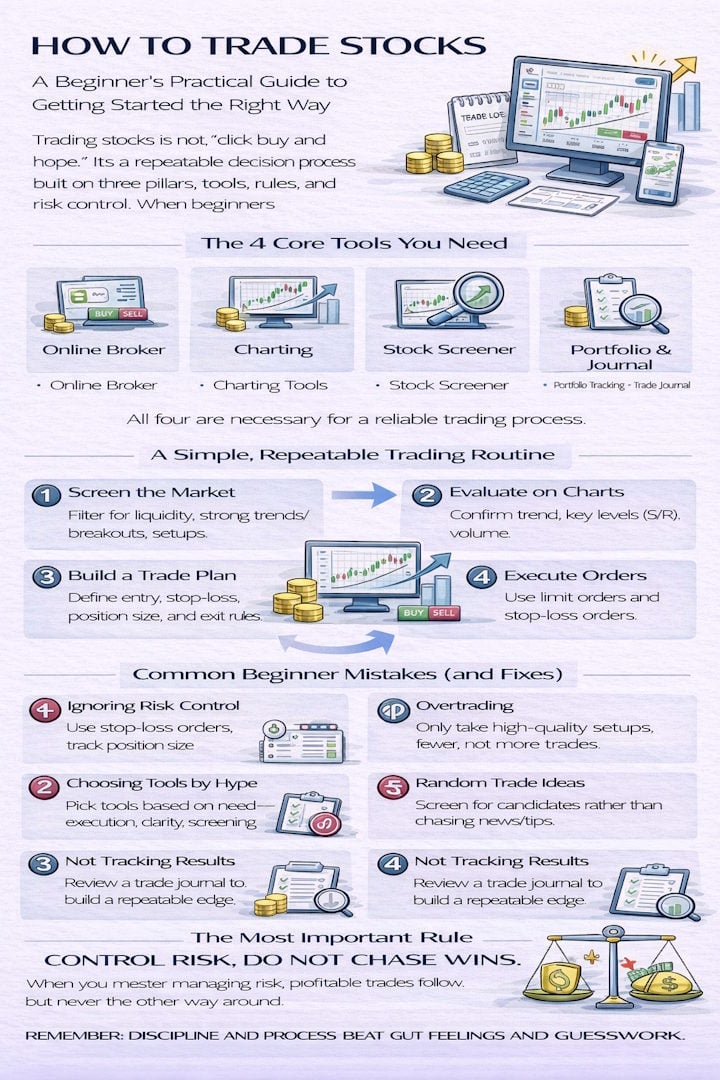
Trading stocks is not “click buy and hope.” It’s a repeatable decision process built on three pillars: tools, rules, and risk control. When beginners struggle, it’s usually because one of those pillars is missing—often risk control.
This lesson gives you a clear, real-world path to start trading stocks responsibly. You’ll learn what you actually need (and what you don’t), how to choose the right setup, and how to avoid the most common early mistakes.
Trading vs. Investing: Know Which Game You’re Playing
Before choosing tools or placing trades, decide whether you are trading or investing, because the workflow is different.
- Investing focuses on owning businesses for months or years, with decisions driven mainly by fundamentals and long-term trends.
- Trading focuses on shorter time horizons (days to weeks, sometimes minutes to hours) and relies more heavily on price action, liquidity, risk rules, and execution.
Both can be valid. The problem is mixing them accidentally—for example, entering a quick trade but refusing to exit when it goes wrong, turning it into a long-term “investment” you never intended.
A simple rule: define your expected holding period before you enter.
The Minimum Setup to Trade Stocks
You do not need a complicated “pro” setup to start. But you do need a few essentials that cover the full trading cycle:
- Find trade ideas
- Evaluate price behavior
- Execute orders safely
- Track positions and learn from results
That translates into four core tool categories:
- Broker
- Charting
- Stock screener
- Portfolio tracking + trade journal
Let’s break each one down.
Choose an Online Broker: The Foundation of Execution
Your broker is the infrastructure that actually places trades. A beginner-friendly broker should make it easy to execute orders cleanly and control risk.
What matters most in a broker (beginner priorities)
A strong broker for beginners typically offers:
- Low trading costs (commissions and fees)
- Reliable order execution (fast fills, stable platform)
- Good order types (market, limit, stop-loss, trailing stop)
- Clear account reporting (positions, realized/unrealized profit, transaction history)
- Basic research tools (news, fundamentals)
- Customer support that responds when something breaks
Two features are especially important for risk management:
- Stop-loss capability: you need a way to predefine risk.
- Order controls: limit orders, stop orders, and the ability to review the order before sending.
A beginner’s checklist before opening an account
Ask these practical questions:
- Can you place limit orders and stop-loss orders easily?
- Does the platform show bid/ask spread clearly?
- Are quotes real-time or delayed?
- Are there extra fees for market data?
- Is the interface stable on the devices you’ll use?
Trading success isn’t only analysis—execution quality matters.
Charting Tools: Where Decisions Become Visual
Charts turn price history into a readable map. A good charting tool helps you answer:
- Is the stock trending up, down, or sideways?
- Where are key support/resistance zones?
- Is volume confirming the move?
- Is volatility high or manageable?
Beginners don’t need dozens of indicators. What matters is clarity and consistency.
What your charting tool must do
At a minimum, it should offer:
- Multiple timeframes (daily + weekly are key for beginners)
- Volume display
- Basic overlays (moving averages)
- Drawing tools (trendlines, support/resistance)
- Watchlists
- Clean, readable charts
Free vs. paid charting
Free charting is often enough to start. Paid charting becomes valuable when you want:
- Faster performance and more features
- Advanced scanning or alerts
- More indicators or custom scripts
- Multi-monitor / multi-chart layouts
- Better data coverage (international, intraday, etc.)
A sensible approach is to start free, then upgrade only if you can clearly name what the upgrade solves.
Stock Screeners: How You Find Candidates Efficiently
A stock screener filters the market so you don’t rely on random tips. Instead of asking “what should I trade?”, a screener lets you ask “which stocks meet my criteria?”
Common screening criteria include:
- Price range (avoid extremely illiquid penny stocks)
- Average volume (liquidity filter)
- Market cap (small, mid, large)
- Volatility (daily ATR or percent range)
- Basic fundamentals (EPS growth, profitability, debt)
- Technical conditions (breakouts, moving average alignment)
Why screening matters for beginners
Screening reduces two major risks:
- Illiquidity risk — helps you avoid stocks with wide spreads and bad fills
- Information overload — narrows choices to a manageable list
A useful beginner screener starts with liquidity first, then adds strategy-specific filters.
Portfolio Tracking and Trade Journaling: The “Hidden Tool” That Makes You Better
Many beginners track trades casually, but improvement requires structure.
A proper tracking setup should tell you:
- What you own and why
- Entry price, size, and risk per trade
- Exits (planned vs. actual)
- Performance by strategy type
Why a trade journal matters
A journal turns trading from random outcomes into feedback:
- Are losses coming from bad entries or bad exits?
- Are winners larger than losers on average?
- Are you breaking rules under stress?
- Are certain market conditions consistently hurting results?
This is how trading becomes a skill instead of a gamble.
A Simple “Tool Stack” That Covers Everything
Here’s a practical way to think about the tools in one view:
| Tool | What It’s For | Beginner Must-Have Feature |
|---|---|---|
| Broker | Placing trades and managing orders | Limit + stop-loss orders |
| Charting | Visual decision-making | Clear trend/levels + volume |
| Screener | Finding candidates | Liquidity and basic filters |
| Portfolio + Journal | Tracking performance and learning | Risk per trade + rule tracking |
If any of these are missing, your process becomes fragile.
A Beginner’s Step-by-Step Routine for Trading Stocks
Here is a repeatable workflow you can use weekly:
Step 1: Screen the market
Filter for liquidity and strategy conditions (trend, breakout setups, strong relative strength, etc.).
Step 2: Evaluate on charts
Confirm:
- Trend direction
- Key levels (support/resistance)
- Volume behavior
- Volatility range (how wild is the stock?)
Step 3: Build a trade plan
Write down:
- Entry trigger
- Stop-loss level (where the idea is wrong)
- Profit target or exit rule
- Position size based on risk limit
Step 4: Execute with controlled orders
Prefer limit orders when possible. Set your stop-loss (or define the rule clearly).
Step 5: Review after the trade
Record:
- What you did
- Whether you followed the plan
- What you would improve next time
This routine is simple, but it creates discipline—and discipline is what most beginners are missing.
Common Beginner Mistakes (and the Fix)
Mistake 1: Trading without a stop or exit rule
Fix: Define the exit before the entry.
Mistake 2: Choosing tools based on marketing hype
Fix: Choose tools based on what your process needs: execution, clarity, screening, tracking.
Mistake 3: Overtrading
Fix: Fewer, higher-quality trades with clear setups beat constant clicking.
Mistake 4: Ignoring liquidity and spreads
Fix: Use volume and spread checks as a mandatory filter.
Mistake 5: Not tracking performance
Fix: Journal trades. Improvement requires feedback.
The Most Important Mindset Shift
Trading becomes manageable when you accept this truth:
You are not trying to be right all the time. You are trying to manage risk so that when you’re wrong, the damage is small—and when you’re right, the gains are meaningful.
Tools help. But the real edge is disciplined process.
Class Questions & Answers
What are the four essential tool categories a beginner needs to trade stocks?
A beginner needs (1) an online broker to execute trades, (2) charting tools to analyze price and trend, (3) a stock screener to find candidates efficiently, and (4) portfolio tracking plus a trade journal to measure performance and improve.
Why are limit orders often safer than market orders for beginners?
Limit orders control the execution price, reducing slippage and preventing unexpected fills during volatility or wide bid/ask spreads. Market orders prioritize speed, which can lead to worse pricing when markets move quickly.
What is the purpose of a stop-loss?
A stop-loss limits downside by exiting when price reaches a level that invalidates the trade idea. It protects capital and prevents a small loss from becoming a portfolio-damaging loss.
What is the main advantage of using a stock screener?
A screener filters the market based on your criteria, helping you avoid random “tips,” reduce information overload, and focus only on liquid stocks that match your strategy conditions.
Why is a trade journal important even if you’re not trading frequently?
A trade journal creates feedback. It helps you identify whether results come from a repeatable edge or from luck, shows where rules are being broken, and reveals which setups and market conditions work best for you.