
When people say “the stock market,” they often imagine a single place—usually New York—where stocks move up and down all day. In reality, the stock market is a global network of venues where ownership in companies is bought and sold.
Understanding that global structure is a big step toward becoming a confident investor, because it explains where prices come from, why some markets dominate, and how risk spreads across regions.
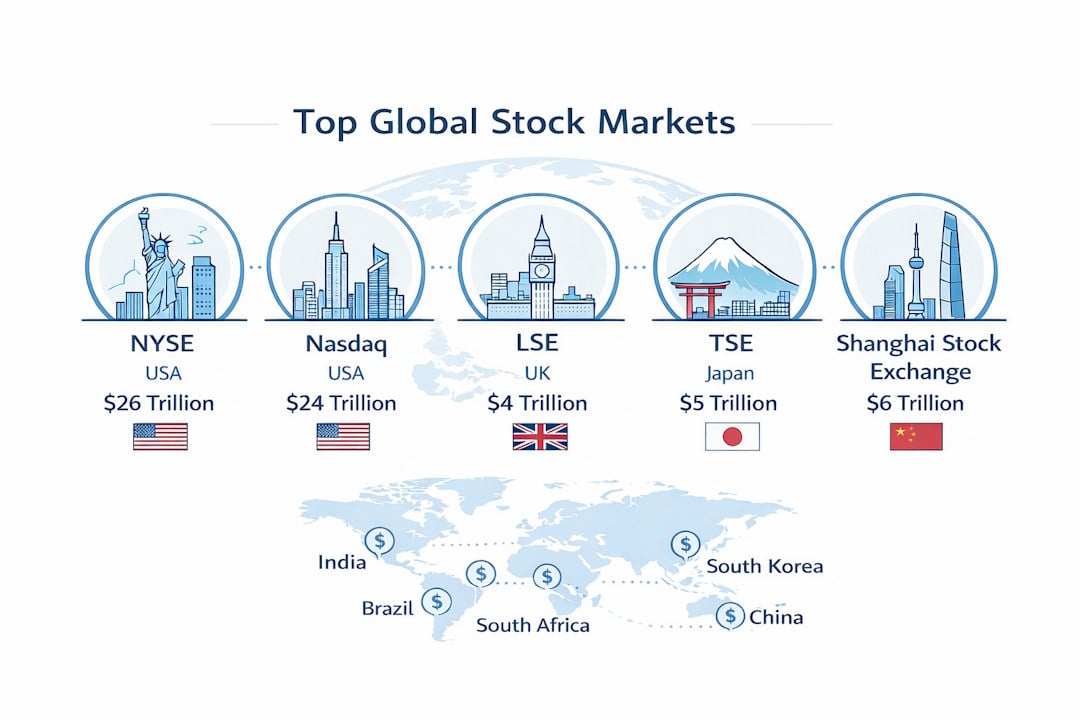
This lesson breaks the world’s stock markets into simple building blocks: the different kinds of markets, the main risks you take when you invest, and the major global hubs that influence prices worldwide.
The goal is not to memorize exchange names, but to build a mental model you can use whenever you read financial news or invest internationally.
The Stock Market Is Not One Market—It’s a System
A stock represents a slice of ownership in a company. The “stock market” is the system that enables trading those slices at scale, with constantly updated prices. That system includes:
- Trading venues (where orders meet and trades happen)
- Market participants (retail investors, institutions, funds, banks)
- Rules and oversight (listing requirements, trading rules, disclosure standards)
- Infrastructure (data feeds, clearing, settlement)
Once you see the stock market as a system, much of the confusion disappears. Prices do not “move randomly.” They are the output of many participants reacting to information and negotiating value through buying and selling.
Different Types of Stock Markets (Exchanges, OTC, and ECNs)
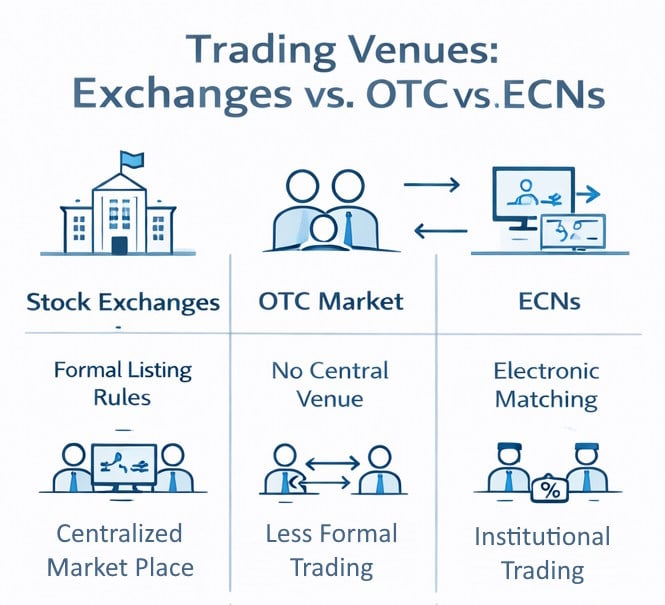
One of the most useful beginner insights is that “a stock market” can mean different things depending on where the trading occurs. The core venue types include exchanges, over-the-counter (OTC) markets, and electronic communication networks (ECNs).
Stock exchanges (the most visible)
Exchanges are the best-known marketplaces. They tend to have:
- Formal listing standards
- High transparency (quotes and trades are widely visible)
- Deep liquidity (many buyers and sellers)
Exchanges are where most people think trading happens (e.g., NYSE).
OTC markets (less formal, often smaller)
OTC markets trade securities outside of centralized exchanges. OTC securities are often:
- Smaller or less widely followed companies
- Less liquid (fewer active buyers/sellers)
- Potentially wider bid/ask spreads (higher trading friction)
Less formality doesn’t automatically mean “bad,” but it does mean you should be more careful about execution quality, pricing, and the reliability of information.
ECNs (fast electronic matching)
ECNs are computerized systems that match buy and sell orders electronically, often used by institutional investors to trade efficiently and sometimes anonymously.
As a beginner, you don’t need to master the technical details of ECNs. What matters is the practical takeaway: orders can be routed to different venues, and that affects liquidity, speed, and how easily you get a fair price.
Why Some Markets Are “Bigger” Than Others
Stock markets tend to become the largest in regions with strong economic foundations:
- Large and productive economies (which create many investable companies)
- Stable legal frameworks and investor protections
- Strong corporate governance and disclosure standards
- High participation (domestic and foreign investors)
- Deep liquidity (making it easy to enter/exit positions)
This creates a reinforcing cycle: when a market is trusted and liquid, more capital flows there, making it even more liquid and influential.
A practical implication for investors: where a company trades and how developed its home market is can affect volatility, regulation risk, and currency exposure.
The World’s Major Stock Markets: A Beginner’s Map
Global stock markets are distributed across North America, Europe, and Asia. But influence is not evenly distributed. A small number of major hubs often set the tone for global risk appetite and valuation.
Your course lesson highlights several important observations about global market dominance—especially the concentration of market capitalization in the United States.
Instead of trying to memorize every exchange, focus on what each major hub represents:
United States: the center of global equity gravity
The U.S. markets are extraordinarily large and globally influential. The lesson notes that the U.S. stock market accounts for 46% of the world’s capitalization (in 2024) and that it is worth more than the next seven exchanges combined.
Beginner takeaway: if you own global index funds or international ETFs, the U.S. often becomes a major portfolio driver—even when you “diversify globally.”
Europe: many exchanges, shared influence
Europe is not one exchange—it’s a region with multiple major markets. While the region is large and developed, trading is spread across different countries and venues. For investors, Europe matters because it provides diversification by sector mix, currency exposure, and different regulatory environments.
Asia: major hubs with different drivers
Asia includes large, fast-evolving markets with their own macroeconomic drivers (exports, manufacturing, domestic consumption, and demographics). The lesson specifically mentions Japan and China as major markets, with Shanghai highlighted as a major exchange.
Beginner takeaway: Asian markets can behave differently from U.S. markets due to currency moves, domestic policy, and different sector leadership.
Market Capitalization and “Scale” Facts: Why Size Matters
Market size matters because it influences liquidity, stability, and the ease of trading at fair prices. Your lesson includes several striking comparisons designed to show how concentrated capital can be:
- The U.S. market is 46% of global capitalization in 2024.
- The U.S. market is worth more than the next seven exchanges combined.
- Microsoft is worth more than the entire Brazilian stock market (as stated in the lesson).
- Microsoft, Apple & Google combined are worth more than the entire Chinese stock market (as stated in the lesson).
You don’t need these as trivia—use them as intuition: global equity value is highly concentrated, and mega-cap companies can move indexes and sentiment more than beginners expect.
How the World’s Markets “Move Together”
Beginners often assume diversification means “nothing moves together.” In practice, many markets correlate during stress, especially when global investors become risk-averse.
Why do correlations rise?
- Global funds rebalance across countries at the same time
- Macro events (interest rates, inflation, recessions) hit multiple regions
- The same large institutions are active everywhere
- Index investing links flows across markets
This doesn’t mean international diversification is useless—it means diversification works best when you understand what you’re diversifying across: currencies, economic cycles, sector composition, and political/regulatory regimes.
The Risks of Investing in the Stock Market (Beginner-Realistic View)
1) Company-specific risk
A company can disappoint: earnings fall, competition rises, products fail, and management makes poor decisions. Stock ownership means you participate in those outcomes.
2) Permanent loss risk (including bankruptcy)
If a company fails, shareholders are near the back of the line in liquidation. This is why “great story” doesn’t equal “great investment.”
3) Volatility and timing risk
Prices can swing sharply. The lesson notes that prices can move quickly, and you may not be able to sell at the price you paid.
This matters most if you invest money you might need soon.
4) Liquidity and execution risk (especially outside major exchanges)
In smaller markets or OTC names, the “real” tradable price can be less favorable than expected because spreads are wider and trading is thinner.
5) Behavioral risk (the silent portfolio killer)
Many investors don’t lose because the market is “rigged.” They lose because they react emotionally—buying after big rises, selling after scary drops, and abandoning good plans at bad times.
A simple discipline rule for beginners: avoid making major investment decisions based on a single headline. Build a process.
A Practical Beginner Strategy: Learn the Structure, Then Choose Simplicity
If you’re new, the world’s stock markets can feel too large to grasp. The best approach is staged:
- Understand venue types (exchange vs OTC vs ECN), so you know what “market quality” means.
- Understand global concentration so you’re not surprised when U.S. mega-caps dominate global returns.
- Invest with diversification by using broad funds if you’re not ready to analyze individual stocks in depth.
- Commit to a time horizon long enough to survive volatility.
- Measure success realistically: the lesson notes that 82% of fund managers failed to beat the market over the last ten years (as stated on the page).
That fact is not meant to discourage you—it’s meant to encourage humility and process. Beating the market is hard; consistent discipline is powerful.
Class Questions & Answers
What’s the difference between an exchange, an OTC market, and an ECN?
An exchange is a centralized marketplace with formal listing standards and high transparency; OTC markets are less formal venues often used for smaller securities; ECNs are electronic matching systems that pair buy and sell orders quickly, often used by institutions.
Why does the U.S. stock market influence global investing so much?
Because global market value is highly concentrated in the U.S. (the lesson notes that the U.S. accounts for 46% of global market capitalization in 2024), and many of the world’s largest companies and funds are U.S.-listed, global portfolios, indexes, and sentiment often follow U.S. moves.
What does “markets move together” mean, and why does it happen?
It means different countries’ markets can rise or fall at the same time, especially during global stress. This happens because big investors rebalance globally, macro forces like interest rates affect many regions, and index flows link markets more than most beginners expect.
What are the main risks a beginner should understand before buying stocks?
The big risks are company-specific underperformance, permanent loss (including bankruptcy), short-term volatility (prices can swing fast), liquidity/execution risk (especially in smaller venues), and behavioral risk—making emotional decisions during market moves.
If most fund managers fail to beat the market, what should a beginner do?
Start with a simple, diversified approach (often broad index funds), keep costs low, focus on a long time horizon, and build a consistent process. The point isn’t “never try”—it’s to respect how hard consistent outperformance is and avoid unnecessary complexity early on.