
Before you learn how to analyze stocks, build trading systems, or evaluate financial statements, you need to understand something more basic:
Why do businesses exist in the first place?
Every stock you buy represents ownership in a real company. That company is not a ticker symbol or a chart pattern. It is an organization of people, capital, and ideas trying to solve problems and generate profits.
If you don’t understand this foundation, investing becomes speculation.
If you do understand it, investing becomes logical.
This lesson explains the economic purpose of business, how companies create value, and why this matters directly to stock market investing.
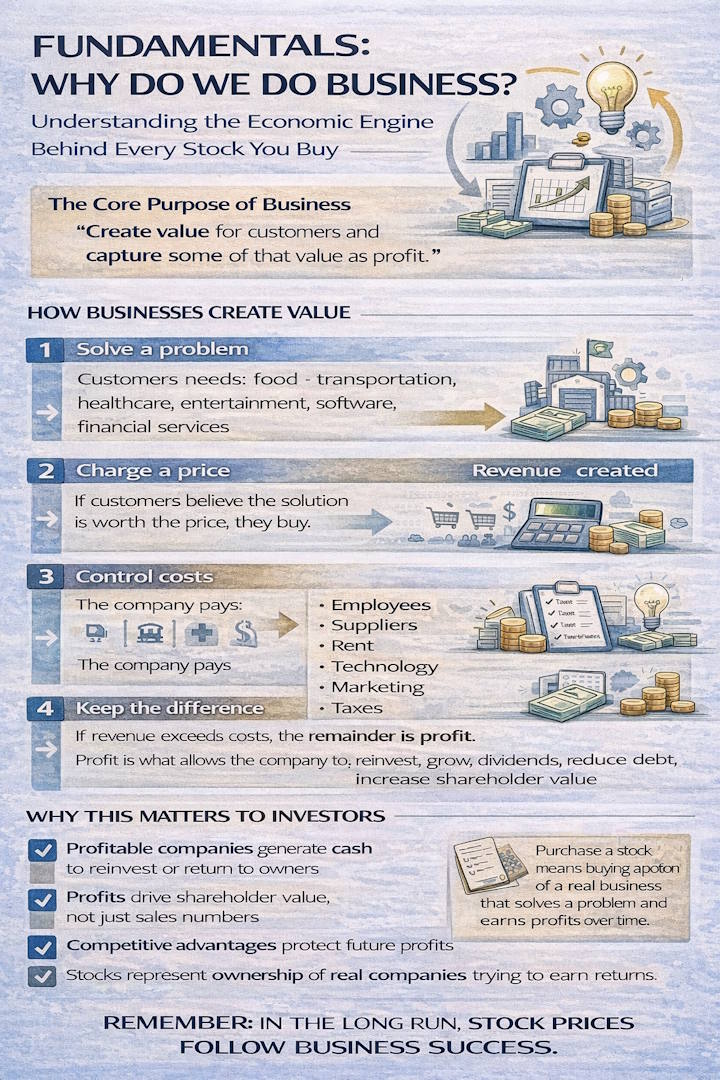
The Core Purpose of Business
At its simplest level, a business exists to do one thing:
Create value for customers and capture some of that value as profit.
That’s it.
A business identifies a problem or need, offers a solution, and charges more for the solution than it costs to provide.
If the value customers receive is greater than the price they pay, the business survives and grows.
If not, it fails.
This simple exchange is the foundation of capitalism—and the foundation of stock investing.
How Businesses Create Value
Every successful company follows the same economic chain, even if the product looks very different.
Step 1: Solve a problem
Customers have needs:
- food
- transportation
- healthcare
- entertainment
- software
- financial services
A business offers a product or service that solves one of those needs better, faster, or cheaper than alternatives.
Step 2: Charge a price
If customers believe the solution is worth the price, they buy.
Revenue is created.
Step 3: Control costs
The company pays:
- employees
- suppliers
- rent
- technology
- marketing
- taxes
These are expenses.
Step 4: Keep the difference
If revenue exceeds costs, the remainder is profit.
Profit is what allows the company to:
- reinvest
- grow
- pay dividends
- reduce debt
- increase shareholder value
No profit → no sustainability.
Why Profit Matters More Than Revenue
Beginners often focus only on sales growth. But revenue alone does not create value.
A company could generate huge sales and still lose money if costs are too high.
For example:
- Revenue = €1,000,000
- Expenses = €1,100,000
- Result = loss
That business destroys value.
Now compare:
- Revenue = €500,000
- Expenses = €300,000
- Result = €200,000 profit
The second business is healthier—even though it’s smaller.
Investors own profits, not revenue.
This is why earnings, margins, and cash flow matter more than headlines about “record sales.”
From Business Profits to Shareholder Returns
So how does business success turn into stock gains?
There’s a direct chain:
Customer value → Revenue → Profit → Cash → Shareholder value → Stock price
Let’s walk through it.
Profits generate cash
Profitable companies accumulate cash over time.
Cash gives management choices
Management can:
- reinvest in growth
- acquire competitors
- pay dividends
- buy back shares
- strengthen the balance sheet
All of these can increase shareholder value.
Shareholder value drives stock prices
If investors believe a company will produce more future profits, they’re willing to pay more for the stock today.
That’s why stocks rise when earnings expectations improve.
Why Some Businesses Succeed While Others Fail
Not all companies make money equally well. Some struggle for years, while others dominate industries.
What makes the difference?
Competitive advantage
The most valuable businesses have advantages that protect profits.
Examples:
- Strong brands (customers trust them)
- Patents (legal protection)
- Network effects (more users make the product better)
- Cost advantages (can produce cheaper than competitors)
- Switching costs (customers stay because leaving is hard)
These advantages make it difficult for competitors to steal customers.
When competition is weak, profits stay high.
When competition is intense, profits shrink.
As an investor, you want businesses that can defend their profits, not fight constant price wars.
The Link Between Business Quality and Stock Performance
Here’s a principle that every investor eventually learns:
Great businesses tend to become great investments over time.
Not always immediately—but over years.
Why?
Because:
- growing profits → rising cash flows
- rising cash flows → higher intrinsic value
- higher intrinsic value → higher stock prices
Weak businesses do the opposite:
- unstable profits
- constant dilution or debt
- falling confidence
- declining prices
In the short term, anything can happen.
In the long term, business quality dominates price movements.
Stocks Are Ownership, Not Lottery Tickets
One of the biggest mindset shifts beginners must make is this:
When you buy a stock, you are not betting on a number going up.
You are buying:
- a share of future profits
- a share of assets
- a share of risk
- a share of management decisions
You are becoming a partial owner.
Thinking like an owner changes behavior:
- You care about earnings
- You care about debt
- You care about competition
- You care about strategy
Not just price swings.
Why Understanding Business Fundamentals Protects You
If you don’t understand how businesses work, you become vulnerable to:
- hype
- rumors
- social media noise
- short-term volatility
- “hot stock” chasing
But when you understand fundamentals, you can ask:
- Does this company actually make money?
- Is growth sustainable?
- Does it have real advantages?
- Is the valuation reasonable?
These questions protect you from many beginner mistakes.
The Big Picture: Markets Follow Business Reality
Markets may look chaotic day-to-day, but over long periods, stock prices reflect business performance.
Strong businesses:
- grow earnings
- reinvest intelligently
- survive downturns
- compound wealth
Weak businesses:
- burn cash
- take on too much debt
- dilute shareholders
- disappear
The stock market is simply the mechanism that transfers ownership of these businesses.
So before analyzing charts, indicators, or trading systems, remember:
The foundation of investing is understanding why businesses exist and how they make money.
Everything else builds on that.
A Simple Framework to Remember
When evaluating any stock, start with this mental model:
- What problem does the company solve?
- How does it make money?
- Are profits consistent and growing?
- Does it have advantages competitors can’t easily copy?
- If I owned the whole business, would I want it?
If the answers are weak, no amount of technical analysis will fix that.
If the answers are strong, you may have found something worth deeper research.
Class Questions & Answers
What is the primary purpose of any business?
The primary purpose of a business is to create value for customers and capture part of that value as profit.
Why is profit more important than revenue for investors?
Because profits represent the money left after expenses. Investors ultimately benefit from profits and cash flow, not just sales volume.
How do business profits lead to higher stock prices?
Profits generate cash, which increases shareholder value through reinvestment, dividends, or buybacks. Higher expected future profits raise the company’s intrinsic value and typically the stock price.
What is a competitive advantage?
A competitive advantage is something that protects a company’s profits—such as strong branding, patents, network effects, or cost leadership—making it hard for competitors to take customers away.
Why should investors think like business owners rather than traders?
Because buying a stock means owning part of a real business. Understanding how the company earns money and manages risk leads to better long-term decisions than focusing only on short-term price moves.
My favorite so far