
When beginners hear “fastest-growing stock markets,” they often imagine a list of countries to chase for quick profits. That’s not the right mindset. A fast-growing market can be a powerful long-term wealth engine—but it can also be volatile, concentrated, or driven by one exceptional decade that may not repeat.
In this lesson, we’ll build a clear framework for understanding what is growing, why it grows, and how a novice investor can use that information without falling into the trap of performance-chasing.
The key idea is simple: stock markets grow because companies grow—their earnings, their cash flows, and the value investors are willing to pay for those future profits. But the path is rarely smooth, and the “fastest growers” can change depending on the time period you measure.
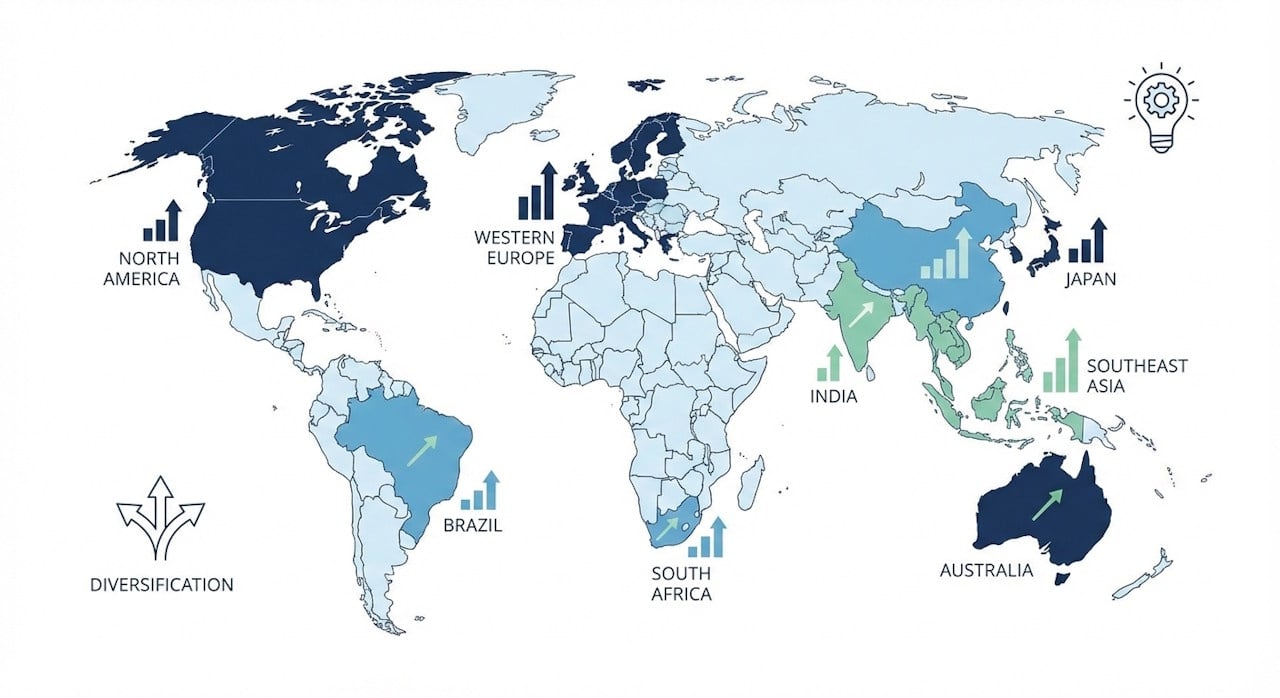
What Does “Fastest-Growing Stock Market” Actually Mean?
A stock market can “grow” in a few different ways. Investors often mix these up, so let’s separate them:
- Index price return
This is the change in the index level over time. If an index rises from 1,000 to 2,000, that’s a 100% price return. - Total return (price + dividends)
Some markets (and many value-heavy indexes) return meaningful dividends. If you ignore dividends, you may underestimate long-term results. - Market capitalization growth
Market cap is the total value of all listed companies in that market (shares outstanding × price). A market can expand because prices rise, because more companies list, or because firms issue more shares.
When people say “fastest-growing stock markets” in practical investing terms, they usually mean the best long-term index performance over a defined period—like the 20-year comparisons in the Course 102 lesson.
Chart: The 12 Major Stock Market Indexes Compared
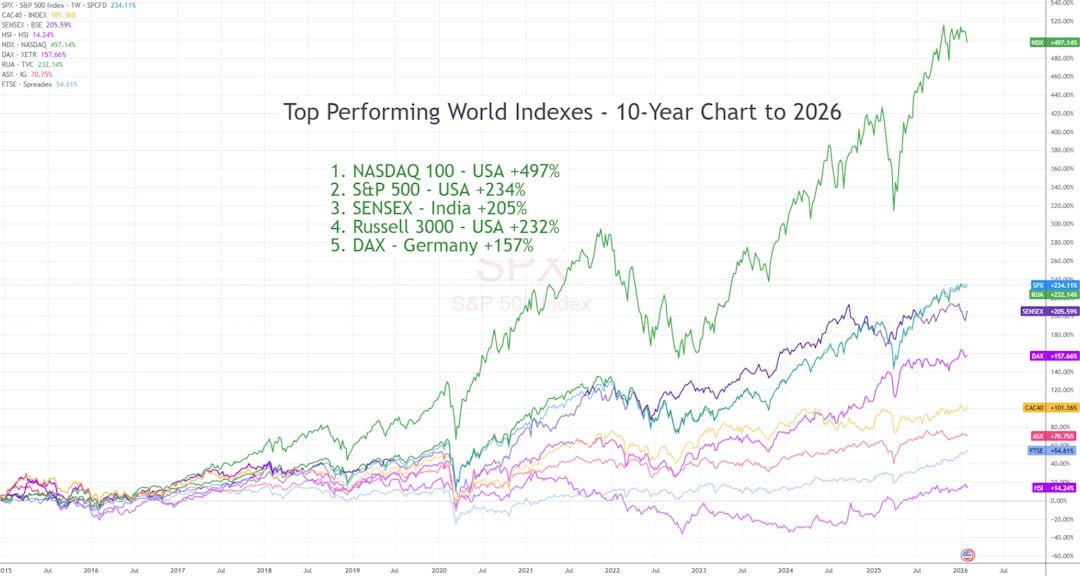
20-Year Stock Index Growth & Returns
Nasdaq 100 USA: 497%
The Nasdaq 100, launched in 1985, is a stock market index of the 100 largest non-financial stocks listed on the Nasdaq. The Nasdaq 100 is heavily weighted towards technology stocks and, as such, is often used as a barometer for the technology sector. The index includes companies from various industries, but most are in the technology sector.
S&P 500 USA: 234%
The S&P 500 was first published in 1957 and is now maintained by Standard & Poor’s, a division of McGraw-Hill Financial. The index includes companies from various industries, including healthcare, financials, industrials, and technology.
The S&P 500 is an index of 500 stocks chosen for their size and liquidity. Stocks are weighted by market value, so larger companies have a greater effect on the index. The index is widely used to measure the US stock market.
Sensex India: 205%
The Sensex is an index of stock prices on the Bombay Stock Exchange. It is one of the oldest and most popular stock indices in India. The index is widely used as a barometer of the Indian stock market.
The Sensex comprises 30 stocks of large, well-established, and financially sound companies across key sectors of the Indian economy.
DAX Germany: 157%
The German DAX is an index of 30 stocks traded on the Frankfurt Stock Exchange. It is a weighted index, with the largest companies having the greatest influence on its movements. The DAX is the most widely followed index of German stocks and is considered a good barometer of the country’s economy.
Some companies that make up the DAX are Adidas, Allianz, BASF, BMW, Daimler, and Siemens.
Nikkei Japan: 225: 202%
The Nikkei 225 is a stock market index comprised of the top 225 stocks traded on the Tokyo Stock Exchange. It is often considered one of the most important indicators of the Japanese economy.
The Nikkei Index was first published in 1950 and is now one of the most widely-watched stock indexes in the world. It is often used as a benchmark for other Asian markets.
FTSE 100 UK: 81%
The London FTSE 100 is an index of London’s 100 largest publicly-traded companies. It is one of the world’s most widely used stock market indices. Companies on the London FTSE 100 are among the world’s largest and best-known, including HSBC, Vodafone, and British Airways. The index is calculated based on the share prices of these companies.
Why Long-Term Time Windows Matter (and Short-Term Rankings Mislead)
A one-year “top market” list is often dominated by temporary factors: commodity spikes, currency swings, policy surprises, or a brief risk-on rally. That’s exciting—but it’s not a reliable foundation for building wealth.
A 10–20 year window is more informative because it tends to capture:
- multiple economic cycles,
- different interest-rate regimes,
- shifts in technology and consumer behavior,
- and periods of both boom and stress.
The lesson’s focus on long-term growth rates is useful precisely because it encourages investors to think beyond headlines.
What Makes Some Markets Grow Faster Than Others?
Fast-growing stock markets tend to share a few characteristics. Think of these as “tailwinds” that push long-term returns higher.

1) Faster economic growth (but filtered through public companies)
A growing economy helps—but only if that growth shows up in listed companies’ revenues and profits. Some countries grow rapidly, while much of the growth happens in private firms or state-controlled sectors that are not fully reflected in public markets.
2) Strong corporate earnings growth
Markets ultimately follow earnings power. When a country produces globally competitive firms, earnings can grow for decades, and the index benefits as well.
3) Expanding participation and capital markets development
As more households invest (pensions, retirement accounts, mutual funds, ETFs), the equity market gets a steady inflow of long-term capital. That can raise valuations and deepen liquidity.
4) Sector composition (the “index personality”)
This is a huge one. If an index is heavily weighted toward high-growth sectors (such as technology), it may outperform for extended periods—especially if those sectors dominate global innovation. Conversely, an index concentrated in mature sectors (utilities, legacy banking, oil majors) may grow more slowly but can offer higher dividends or defensive characteristics.
5) Valuation starting point
Even a great market can deliver poor returns if investors pay too much at the start. Likewise, a slower-growing market can still perform well if it begins undervalued and valuations normalize upward.
A Beginner’s Mistake: Chasing the “Hottest” Market
It’s tempting to look at a chart and conclude: “I should put all my money in the top performer.” That approach usually fails because the top performer often becomes expensive, crowded, and vulnerable to disappointment.
Here’s a more stable way to use “fastest-growing market” insights:
- Use them to understand where growth has observed (innovation, productivity, expanding middle class, global competitiveness).
- Then choose a diversified plan that includes exposure—but doesn’t bet everything on a single region or sector.
- Rebalance over time so you’re not constantly buying what just went up.
A practical, novice-friendly approach is to hold a broad, diversified equity allocation (global or multi-region) and then add small “tilts” to areas you believe have long-term tailwinds—without turning your portfolio into a single-theme gamble.
How to Invest in Fast-Growing Markets Without Stock-Picking
Many beginners don’t want to analyze individual stocks across countries, and that’s sensible. The most common entry points are:
- Index funds / ETFs tracking major benchmarks (e.g., S&P 500, Nasdaq 100, India-focused funds)
- Global funds that automatically allocate across countries
- Emerging market funds for diversified exposure outside developed markets
Your course lesson also prompts a smart question after presenting the index results: if you were to buy an index-tracking fund, which index would you choose?
That’s the right question—but the best answer depends on your timeframe and risk tolerance:
- If you want simplicity and broad exposure, a diversified global approach is often easiest.
- If you want higher growth potential, you might tilt toward growth-heavy indexes—but accept higher volatility.
- If you want home-country familiarity, you might start locally and diversify outward as you learn.
The Bottom Line for New Investors
Fast-growing markets are valuable to study because they reveal where long-run wealth creation has been strongest. In the lesson’s long-term snapshot, India’s Sensex and U.S. Nasdaq-related indexes stand out as leaders over the measured period.
But investing success isn’t about picking the single best past performer—it’s about building a plan that you can stick with through volatility. Use market-growth data to inform diversification and long-term strategy—not to chase whatever looks hottest today.
Get More Stock Market Statistics & Facts
So, if you were to buy an index-tracking fund, which one would you buy?
Class Questions & Answers
What does “fastest-growing stock market” usually mean in investing?
It usually refers to the strongest long-term performance of a major stock index over a defined period (often measured as percentage growth), sometimes including dividends when total return is used.
Why can short-term “top market” rankings be misleading?
One-year or short-window leaders are often driven by temporary forces such as commodity swings, currency moves, policy shocks, or investor sentiment. Long-term windows better reflect business growth and multi-cycle performance.
What is the Sensex, and what does it represent?
The Sensex is a major Indian stock index composed of 30 large, established companies and is used as a barometer of the Indian stock market’s overall health and direction.
Why did the Nasdaq 100 perform so strongly in the lesson’s long-term comparison?
The Nasdaq 100 is heavily weighted toward growth and technology-oriented companies. When innovation-led sectors grow earnings rapidly, and investors value that growth highly, a tech-heavy index can outperform—though it may also be more volatile.
How can a beginner invest in fast-growing markets without picking individual stocks?
By using diversified index funds or ETFs that track major benchmarks (e.g., broad US indexes, India-focused funds, or global/emerging-market funds). This provides exposure while reducing single-stock risk.
Beat The Market, Avoid Crashes & Lower Your Risks
Nobody wants to see their hard-earned money disappear in a stock market crash.
Over the past century, the US stock market has had 6 major crashes that have caused investors to lose trillions of dollars.
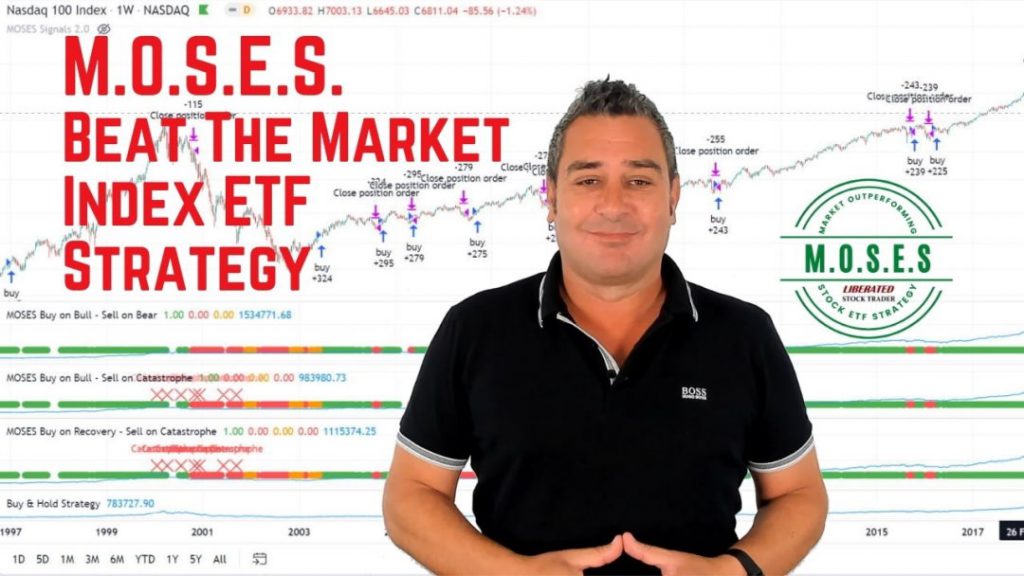
The MOSES Index ETF Investing Strategy will help you minimize the impact of major stock market crashes. MOSES will alert you before the next crash happens so you can protect your portfolio. You will also know when the bear market is over and the new rally begins so you can start investing again.
MOSES Helps You Secure & Grow Your Biggest Investments
★ 3 Index ETF Strategies ★
★ Outperforms the NASDAQ 100, S&P500 & Russell 3000 ★
★ Beats the DAX, CAC40 & EURO STOXX Indices ★
★ Buy & Sell Signals Generated ★
MOSES Helps You Sleep Better At Night Knowing You Are Prepared For Future Disasters