
The fastest path I know to competence in the stock market combines serious reading, structured courses taught by certified analysts, data-backed research on what chart signals work, and risk-free practice on a charting platform before your own money is exposed. I have spent decades investing and hold an IFTA Financial Technical Analyst certification; that is how I would rebuild my own education if I had to start again tomorrow.
If you want one recommendation to start with, take a structured course written by a certified market analyst, because it gives beginners a tested sequence for financial analysis, charts, and portfolio building rather than a pile of disconnected tips.
Everything else on this list- the books, audiobooks, communities, charting tools, and backtesting work- builds on that foundation. By the end of this piece, you will know which resources deserve your hours and which ones quietly waste them.
Key Takeaways
Build knowledge from certified sources: professional-grade books, structured courses, and data-backed research rather than social media tips.
Practice on free charting platforms and paper trading accounts before committing real capital to any strategy.
Write down your trade rules, backtest them, and treat news and market direction as inputs to a documented system.
1. Read the finest books on stock trading analysis
Studying reputable stock trading books is the cheapest serious education available, and the titles worth your time are the ones professionals study to pass their certification exams. Books cover fundamental analysis, technical analysis, charting, and risk management in one place, which scattered videos rarely do.
The trade-off is time. Teaching yourself from print costs little but demands patience, so quality filtering is essential when thousands of titles compete for attention.
With thousands of books to read, where do you start? I recommend you read the books finance professionals use to learn technical analysis. Here are the best books that professional market technical analysts study to qualify for the International Federation of Technical Analysts (IFTA) or Chartered Market Technician (CMT) certifications.
The stock trading books I highly recommend are:
The first two are reference works you will reopen for years. Reminiscences of a Stock Operator teaches trading psychology through narrative, which sticks better than a lecture on discipline ever does.
If you want a wider selection, my ranked list of the best trading books and the companion guide to the best technical analysis books sort the classics by what you need to learn first. Readers coming from a Warren Buffett angle should also see the best value-investing books of all time for guidance on reading financial statements.
2. Join an online trading community
A large, active community exposes you to more chart ideas in a month than solo study produces in a year. TradingView hosts millions of traders publishing annotated charts, and reading how others justify an entry sharpens your own reasoning.
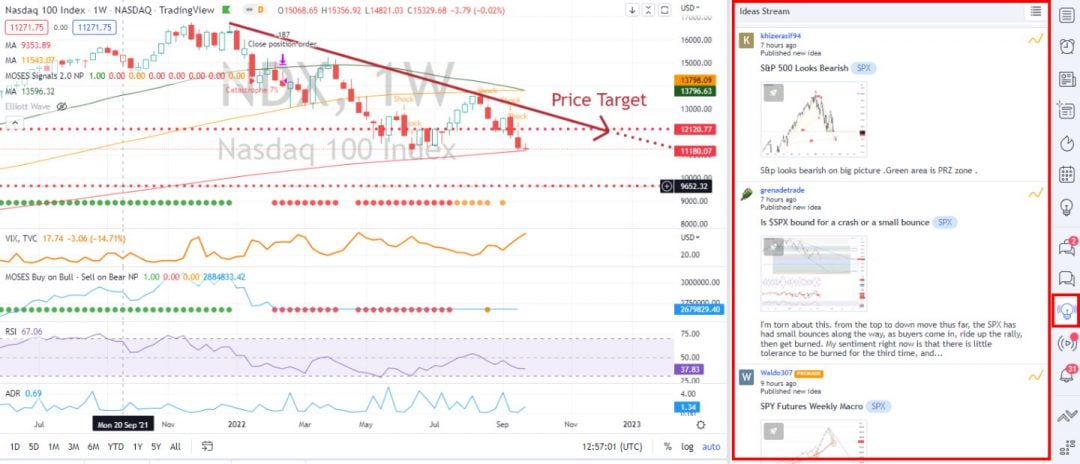
I publish ideas and chart analysis there myself and update thousands of followers, so I see the good and the bad of crowd-sourced analysis daily.
Chart, Scan, Trade & Join Me On TradingView for Free
Join me and 20 million traders on TradingView for free. TradingView is a great platform for connecting with other investors, sharing ideas, creating charts, and engaging in live chat.
Use communities as a source of hypotheses to test, never as a source of instructions to follow. The published idea that includes its invalidation level is worth ten that only shout a price target.
Two habits keep this productive. Follow contributors who show their chart and their reasoning, and mute anyone posting screenshots of profits without a method attached.
3. Listen to investing audiobooks
Audiobooks convert dead time into study time, which is the single easiest scheduling win available to a working beginner. A commute, a garden shift, or a walk with the dog covers a chapter without touching your desk hours.
The narrative titles work best in audio. Michael Lewis and Scott Patterson explain how the financial system operates through stories about real desks and real failures, and that context explains price behavior in ways a formula does not. Our Top 20 Best Stock Market & Finance Audiobooks List includes great listens, such as the highly rated “Flash Boys” by Michael Lewis and “The Quants” by Scott Patterson. Fill your day with learning without being chained to your desk.
I recommend these five great stock trading audiobooks:
- Flash Boys – Machine trading’s impact on the stock market
- Dark Pools: The Rise of the Machine Traders
- Liars Poker – Stocks, Bonds & Leveraged Trading – Michael Lewis
- The Big Short – Financial Crisis 2008 True Story
- The Quants – Impact of HFT Trading on Financial Markets
My full roundup of the top 20 best stock market audiobooks ranks a much longer list. If you prefer shorter formats, there are also podcasts to learn stock market investing that fit a 30-minute drive.
Keep technical instruction in print. Chart mechanics need diagrams, and audio cannot show you a trendline.
4. Understand Stock Picking Services
Stock-picking services shorten research time by providing a shortlist, and Motley Fool Stock Advisor and Seeking Alpha are two useful models. One tells you what to buy, the other arms you to decide for yourself.
Motley Fool Stock Advisor issues specific long-term recommendations with accompanying written theses. That format suits long-term investing where participants prefer a documented rationale for each position and a buy-and-hold holding period.
See the Seeking Alpha vs. Motley Fool Review
Seeking Alpha sits closer to a research platform. It combines quantitative ratings with contributor analysis across thousands of securities, which suits investors who want to stress-test their own thinking against opposing views on the same stock.
Read the thesis before the ticker. A pick you cannot explain is a pick you will sell at the first drawdown, and that habit costs more than any subscription.
My comparison of the best stock-picking services documents how the major providers differ in coverage, pricing, and methodology. Pair any subscription with your own process for analyzing a stock so you remain the decision-maker.
5. Take a free stock trading course
A structured free course beats random YouTube browsing because the material arrives in a deliberate order with no gaps. The concern with most free trading courses is the instructor: many educators hold no certification in market analysis or fund management, and it shows in the content.
Liberated Stock Trader publishes four free stock market training courses that I wrote as a certified market analyst.
Our Free Trading Courses Include:
- Course 101 – Introduction to Investing – This course will cover various investing-related topics, including investment vehicles, managing financial risk, and trading in various markets.
- Course 102 – Stock Market Investing – This course starts by looking at the different types of stock markets and how they have grown in recent years. We will then compare the global stock markets and examine their main differences. We will also examine the boom and bust cycles that often occur in the stock market and learn how to profit from them.
- Course 103 – Technical Analysis – Technical analysis studies what has happened, what is happening, and what will happen in the future with asset prices. Analysis and prediction are performed using stock charts.
Course 101 is the right entry point if terms like ETF, mutual fund, or brokerage account are still fuzzy. It also explains how to handle tax obligations and whether to trade inside a tax-sheltered IRA versus a regular account.
The lessons also introduce cross-asset relationships, touching on how physical gold and commodity futures respond to economic cycles. Beginners who want a shorter orientation first can start with my notes for stock market beginners.
Work through them in sequence and take notes by hand. The recall difference between passive watching and active note-taking is large enough to matter over 20 hours of study.
6. Invest in expert training
Paid training compresses the learning curve because someone has already removed the material that does not work. Books, videos, and audiobooks all teach, though they leave you to assemble the sequence yourself, which is where most beginners lose months.
The Liberated Stock Trader Pro course delivers 16 hours of video lessons plus an eBook, written by me as a certified market technician. The curriculum covers financial analysis, chart analysis, stock screening, and portfolio construction.
You want to be a successful stock investor but don't know where to start.
Learning stock market investing on your own can be overwhelming. There's so much information out there, and it's hard to know what's true and what's not.
Liberated Stock Trader Pro Investing Course
Our pro investing classes are the perfect way to learn stock investing. You will learn everything you need to know about financial analysis, charts, stock screening, and portfolio building so you can start building wealth today.
★ 16 Hours of Video Lessons + eBook ★
★ Complete Financial Analysis Lessons ★
★ 6 Proven Investing Strategies ★
★ Professional Grade Stock Chart Analysis Classes ★
Liberated Stock Trader Pro Investing Course
★ 16 Hours of Video Lessons + eBook ★
★ Complete Financial Analysis Lessons ★
★ 6 Proven Investing Strategies ★
★ Professional Grade Stock Chart Analysis Classes ★
The volume of conflicting information online is the real obstacle for beginners entering stock investing, and a single vetted curriculum solves that. Browse the full range of stock market courses to see which level fits your current knowledge.
7. Start paper trading with free stock charting tools
Paper trading is where theory meets your own temperament, and free stock charting tools make that practice cost nothing. If you are researching how to start trading stocks, simulated software lets you master the mechanics of buying and selling stocks without risk.
Practice with simulated capital until your entries and exits follow written rules rather than impulse. The discipline you build here transfers directly to a funded brokerage account.
Major brokerage platforms including Fidelity, thinkorswim, and TradeStation offer simulated trading alongside live accounts. Choosing the right stock broker lets you rehearse on the exact interface you will eventually trade through. My review of the best stock trading platforms for beginners compares the main options.
5 Best Free Stock Trading Software
- TradingView: Best Free Stock Charting Software, App & Community
- Stock Rover: Best Free Stock Analysis & Research Tool
- Benzinga Pro: Free Real-time News & Charts
- Finviz: Fast, Free Stock Charting & Screening
- TC2000: Best Free Charts for Technical Analysis Scanning
TrendSpider adds automated pattern detection for traders who want trendlines drawn algorithmically. My guide to free stock charting tools and the ranked top 10 best free stock charting tools detail each platform’s data limits.
8. Learn how stock trendlines work
Trendlines answer the first question that should precede any trade: is this stock rising, falling, or going nowhere? Drawn across a series of highs or lows, they also mark the support and resistance levels where price has repeatedly turned.
Market direction shapes outcomes more than individual stock selection for most beginners. During a prolonged bear market, strong companies fall with everything else, while in a powerful bull market even weak businesses drift higher.
The mega-cap weighting effect deserves attention. Apple, Microsoft, Amazon, and Nvidia carry enough index weight to bend the apparent market trend for weeks, which can mask what the average stock is doing.
Dow Theory provides a framework for reading the direction of the major indices, and it is covered in depth in the Pro training. Ichimoku Cloud analysis offers a second lens for anticipating where a trend may stall.
You can use Dow Theory to assess market direction using the major indices. Dow Theory is discussed in depth in our Pro training. You can even use Ichimoku Cloud Theory to try to predict market direction.
9. Learn which indicators and patterns work
Most chart indicators and patterns do not produce a reliable edge, and automated backtesting is how you separate the few that do from the majority that do not. I have spent years testing candlestick patterns and indicator combinations on large sample sizes to identify which setups hold up.
That research changed how I trade. Several widely taught candlestick formations show no consistent advantage when you measure thousands of occurrences rather than admire a handful of textbook examples.
Video: The Best Indicators for Stock Trading
Additionally, I have tested candlestick patterns used in trading to discover the few that work consistently.
Start with a small set. The Relative Strength Index, a moving average, and the MACD cover momentum, trend, and convergence; stacking six more indicators on the same chart adds noise rather than information.
Consider volatility and liquidity alongside any signal. A pattern that works on heavily traded large caps behaves differently on thinly traded small caps where spreads punish every entry.
Automated chart pattern recognition tools speed up scanning once you know which formations to look for.
10. Prepare a stock trading strategy
Choosing your strategy is the decision that determines everything downstream, from which stocks you screen for to how often you check your account. Value investing targets undervalued companies, growth investing targets price appreciation, and an income approach focuses on collecting dividends.
Your available time and risk tolerance narrow the field quickly. Buy-and-hold demands hours per month, swing trading demands attention several times a week, and day trading demands your full working day against high-frequency competitors.
Here are some great strategies to help you decide:
- MOSES ETF Investing Strategy: Beat The Market & Lower Risk
- Liberated Stock Trader Beat the Market Growth Stock Strategy
- Find the Best CANSLIM Stocks Using a CANSLIM Stock Screener
- How To Find Undervalued Stocks Like a Pro Value Investor
- How To Analyze Stocks: Fundamental vs. Technical Analysis
- 6 Steps to Build Your Dividend Stock Screener & Strategy
There is certainly a lot to consider when building out your investing strategy. There is a core question: Should you use a day trading strategy or a buy-and-hold strategy? Is Value investing like Warren Buffett for you, or is the more time- and nerve-intensive swing trading more your style?
Beat The Market, Avoid Crashes & Lower Your Risks
Nobody wants to see their hard-earned money disappear in a stock market crash.
Over the past century, the US stock market has had 6 major crashes that have caused investors to lose trillions of dollars.
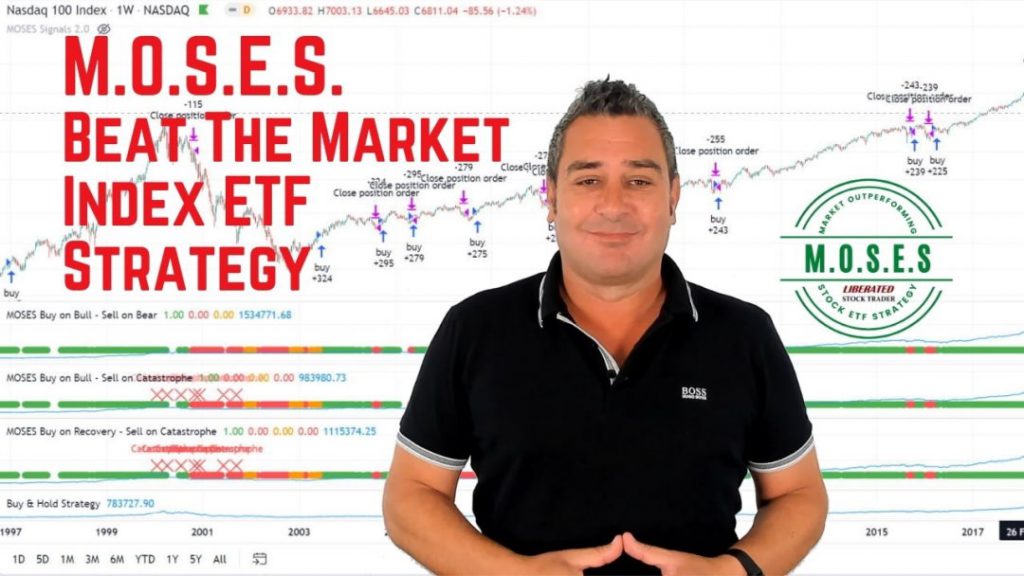
The MOSES Index ETF Investing Strategy will help you minimize the impact of major stock market crashes. MOSES will alert you before the next crash happens so you can protect your portfolio. You will also know when the bear market is over and the new rally begins so you can start investing again.
MOSES Helps You Secure & Grow Your Biggest Investments
★ 3 Index ETF Strategies ★
★ Outperforms the NASDAQ 100, S&P500 & Russell 3000 ★
★ Beats the DAX, CAC40 & EURO STOXX Indices ★
★ Buy & Sell Signals Generated ★
MOSES Helps You Sleep Better At Night Knowing You Are Prepared For Future Disasters
For a broader survey, review the investing strategies lesson in Course 102 before committing capital.
11. Build your stock trading system
Your trading system is the written set of rules that converts a strategy into repeatable decisions. It outlines which indicators trigger a buy, what conditions force a sell, how many shares you purchase, how much trading capital goes into a single position, and where the stop loss sits.
Write these rules before you buy anything. A documented exit strategy removes the internal negotiation you would otherwise have while watching a position fall.
Ask one question of every open holding: are the reasons I bought this still valid? If they are not, the position management decision is already made.
Risk management belongs in the rules, not in your judgment on the day. Cap the loss per trade, account for trading costs that erode small, frequent positions, and specify what happens after two consecutive losses.
These are all known as trade rules. Establishing your criteria for buying, holding, and selling a stock before buying it can help take the emotion out of a trade. Read 10 Steps to a Professional Stock Market System. Emotions are your worst enemy; you must treat your investment decisions with logic, not a slice of gut feel. This is when backtesting comes to the rescue.
My ten-step framework for building a stock market trading system walks through each rule in order, and tracking your trades in a journal is how you find out whether you are following your own system.
12. Learn strategy backtesting
Backtesting tells you whether your rules produced a profit across historical data, which is the only evidence available before you risk real money. An untested hypothesis carries no more weight than a hunch.
The process is slow. Running a strategy across years of price history and thousands of trades takes hours. That work reveals which of the Relative Strength Index, moving average, or MACD settings performed in live market conditions and which looked good only in theory.
Rules based on your stock trading style. Also, advanced traders will use thorough stock backtesting to ensure the strategy has worked in the past.
While system backtesting is time-consuming, it helps you understand which indicators, such as the Relative Strength Index, Moving Average, and MACD, have actually worked in a real-world environment in the past.
While past performance is no indicator of future performance, you can see statistically what has worked and has not worked over thousands of trades.
13. Use real-time trading news
Real-time financial news moves stock prices within seconds, so any trader reacting to events needs a streaming feed rather than a delayed one. Earnings releases, an unexpected IPO filing, or a macro data print can reprice a stock before a refreshed webpage catches up.
Track both macro and company-specific events. Interest rate decisions shift the whole market between bull and bear phases, while an earnings miss moves one ticker on the NYSE or Nasdaq.
If you trade the news, you will want news delivered in real-time, which might cost.
A Quick Summary of the Most Reliable Financial News Services & Apps:
- Benzinga Pro: Real-time stock news for traders
- MetaStock R/T: Real-time global financial news app
- Bloomberg: Best finance TV channel
Reuters and Bloomberg both provide deep coverage for investors tracking macro developments. Benzinga Pro focuses on cost-effective real-time streaming with trader-oriented alerts.
News trading has a learning curve, and the lesson on how to trade the news in Course 102 covers how price reacts to headlines before, during, and after release.
Conclusion
Learning to trade is a sequence, not a single purchase. Read the books professionals study, work through structured courses taught by a certified analyst, then test what you have learned on free charting platforms using simulated money.
From there, the work gets specific. Pick a strategy that fits your available hours, write down your buy and sell rules, backtest them against historical data, and add a real-time news feed if your holding period is short enough to need it.
Give yourself a realistic timeline. Sixteen hours covers the theory; competence with your own capital takes considerably longer, and the traders who last are the ones who keep a journal and review it.
FAQ
How do I learn to trade on the stock market?
Learning to trade the stock market is an intellectual endeavor. You must avoid day trading scammers with Lambo's on TikTok and knuckle down to reading serious trading books and taking professional trading courses from industry professionals.
Can I get rich off stocks?
The best way to get rich off stocks is to own your own business and grow that business to an initial public offering (IPO). Secondarily, you can get rich off stocks but expect at most 25% profit yearly.
Which stock trading site is best for beginners?
For beginners, the best site for learning stock trading is LiberatedStockTrader.com; it offers extensive free and premium stock trading training from an industry-certified professional market analyst.
Can I teach myself the stock market?
Yes, you can teach yourself stock market trading, but it takes at least 100 hours of study and practice to develop good knowledge and confidence. Start by reading high-quality stock trading books and taking these online trading courses.
Do you need math for stock trading?
Basic math knowledge is helpful for stock trading, but understanding how financial news, macroeconomics, and sentiment affect stock markets is more beneficial.
Do millionaires invest in stocks?
Yes, millionaires do invest in stocks because stocks are one of the most profitable assets available. Millionaires spread their investments across a portfolio of assets, real-estate 3 annually, bonds 1-2%, and the stock market 7-9% per year. A highly successful independent stock trader can expect a long-term annual profit of a maximum of 25%.
Can you trade stocks for a living?
Yes, you can trade stocks for a living if you are a fund manager. If you are an independent trader requiring $5000 for living expenses every month and making 15% in annual stock trading profits after tax, you will need a trading portfolio of at least $400,000.
Can I start trading with nothing?
No, you cannot start trading with nothing. You need capital to make profits despite what social media influencers tell you. Best to save money and take time to study investing so you can avoid losing your hard-earned cash needlessly.
What is the easiest way to learn trading?
The easiest way to learn trading is to take a respected stock trading training course from an industry-certified professional who will provide an unbiased guide through the investing process. Following TikTok traders and YouTube influencers' cryptocurrency pump-and-dump schemes should be avoided.
Which trading is most profitable?
Long-term trading in growth stocks is the most profitable strategy. Day trading should be avoided because humans cannot compete against high-frequency machine traders. Short to medium-term swing trading can also be profitable.
How many hours does it take to learn stocks?
The truth is that learning stock investing takes multiple years. Anyone who tells you it is easy is being misleading. You can learn the theory of stock trading in 16 hours. But putting theory into practice takes a lot of time. For 99.9% of investors, it is best to invest in broad-market ETFs over the long term.
How many days will it take to learn stock market trading?
To learn stock trading properly will take at least 30 days of study and 300 days of full-time practice. I have been trading for 20 years, and I understand the effort it takes to understand the stock market.
Do you need 25k to trade stocks?
No, you do not need 25K to invest in the stock market; you can start investing with only $20. However, if you want to be an active pattern day trader in the USA, you need at least a $25K account balance.
What skills do traders need?
The skills a trader needs are:
- The ability to continually learn.
- A structure to learning and strategy development.
- Self-discipline to stick to the plan.
- The ability to learn from mistakes.
- A positive attitude, but not overconfident.
What do rich people invest in?
Rich people invest in stocks, bonds, fine art, fine wine, and real estate. Most importantly, rich people buy businesses and invest in people because those people make them richer through the power of leverage.
How to become rich in five years?
You can become rich in five years by growing your own business to fabulous wealth, robbing a bank, or marrying a rich person. Otherwise, you need to invest a lot of time growing rich slowly through earning and investing.
Can you make $1,000 a day trading stocks?
Yes, you can make $1,000 per day in stock trading if you have an account balance of $36.5 million and a trading profit of 10% per year. If you think you can make $1,000 a day in any other way, you are being misled by social media influencers.
Here is the calculation. $1,000 per day * 365 days per year = $365K. 10% return on $36.5 million = 365K per year.
How to day trade with $100?
You cannot day trade with $100. More money is needed. Any online influencer who tells you differently is misleading you.
Is trading like gambling?
Trading is similar to gambling because you make bets that your hypothesis will be proven correct. However, trading stocks is also different from gambling because the stock market goes up over the long term, and you have a lot of news and financial information at your disposal. So, trading stocks is more like investing than gambling over longer timeframes.
How much can a beginner earn trading?
If you use a stable, proven long-term investing strategy, you can expect to make 8% to 10% per year on your investment. If you are day trading, you can expect to lose your entire investment.
