
You’re eager to trade, but risking your savings before you’re actually ready? That’s just not smart. Paper trading gives you a way to practice in real market conditions, but with pretend money.
You can test strategies, build discipline, and gain confidence—without any real financial risk.

You get to simulate buying and selling stocks, ETFs, or crypto just like you’re actually in the market. Platforms like TradingView make it simple, with real-time data and charting tools that feel like the real thing.
You’ll figure out how orders work, experience volatility, and notice how emotions creep in—all without losing a cent.
Paper trading lets you refine your approach before you go live. You can try out different strategies, track results, and tweak things as you see what works. Over time, you’ll see which methods actually fit your goals and risk comfort.
Key Takeaways
- Paper trading lets you practice trading in real market conditions without risking money
- You can test and refine strategies to improve performance before going live
- The right platform provides realistic tools, data, and feedback for skill growth
What Is Paper Trading?
Paper trading means using virtual money to simulate buying and selling in real markets. You get to test strategies, measure performance, and build trading discipline without risking any actual cash.
It’s basically live conditions, but you’re just practicing—so when you make real trading decisions, you’re not going in blind.
Modern tools like TradingView and TrendSpider have paper trading features that mirror live market feeds. You can try out stocks, forex, or crypto strategies in conditions that feel pretty close to the real thing.
This method lets you learn order types, timing, and portfolio management before you risk anything. You also get to document performance—things like win rate, average profit per trade, and drawdown—under controlled conditions.
| Paper Trading / Simulation | Key Paper Trading Features | Notes & Limitations |
|---|---|---|
| TradingView Best for new and experienced traders who want realistic order execution practice directly on charts. | ✔ Integrated “Paper Trading” broker with virtual balance and no real money. ✔ Supports stocks, crypto, forex, futures and more from one account. ✔ Customizable account balance, currency, leverage and commissions ✔ Multiple simulated accounts to test different strategies. ✔ Simulates full futures lifecycle (execution, expiration, fees, balance changes). Available on desktop and mobile apps. | Built-in real-time paper trading account.
|
| Trade Ideas Best for active day traders and strategy developers wanting to test AI-driven and rules-based systems in live markets. | ✔ Full simulated trading environment using Trade Ideas’ Brokerage Plus module. Connects signals from Trade Ideas (incl. AI strategies) to a paper account. ✔ Practice momentum and day-trading strategies in real time without risking capital. | Professional simulated trading via Brokerage Plus
|
| Stock Rover Best for investors focused on research, portfolio construction and what-if analysis rather than intraday order simulation. | ✔ Create portfolios or watchlists and simulate adding/removing positions and dates of purchase. ✔ Run performance analytics, correlations, and scenario analysis on portfolios. ✔ Strong integration with fundamental screener and research tools. | Portfolio & trade planning simulation (not live order paper trading)
|
| Seeking Alpha Best for fundamental investors using articles, Quant Ratings and model portfolios who want to track hypothetical holdings. | ✔ Can “follow” Quant Ratings, model portfolios and newsletter ideas in a virtual portfolio. ✔ Combines research, ratings and alerts to support manual simulation of strategies. | Portfolio tracking & idea simulation (no native paper broker)
|
Simulated Trading Versus Real Trading
Simulated trading copies real trading mechanics but strips away the emotional and financial pressure. You’ll enter and exit positions, set stop-losses, and analyze charts, but it’s all with virtual funds.
When you go live, slippage, liquidity, and execution speed actually affect your results. In a simulation, those factors might not match reality. That’s why paper trading builds your skills, but not your emotional resilience.
Here’s a quick table to compare:
| Feature | Simulated Trading | Real Trading |
|---|---|---|
| Capital Used | Virtual Money | Actual Funds |
| Risk | None | Real Financial Risk |
| Emotion | Minimal | High |
| Market Execution | Approximate | Real-Time |
| Learning Focus | Strategy Testing | Profit and Loss Management |
Use paper trading to dial in your process, then try small live positions to really test your nerves.
Benefits of Risk-Free Learning
Paper trading gives you a way to build confidence and sharpen decisions without any real losses. You’ll test entry and exit rules, position sizing, and portfolio diversification—totally risk-free.
You get to make mistakes safely. You can look at what went wrong, adjust, and try again. Tools like Stock Rover help you link simulated trades with deep research, so you can see how your strategy connects to company fundamentals.
Consistent review and recordkeeping become habits here. You’ll track metrics, spot bias, and develop discipline before real money’s involved.
How Paper Trading Works
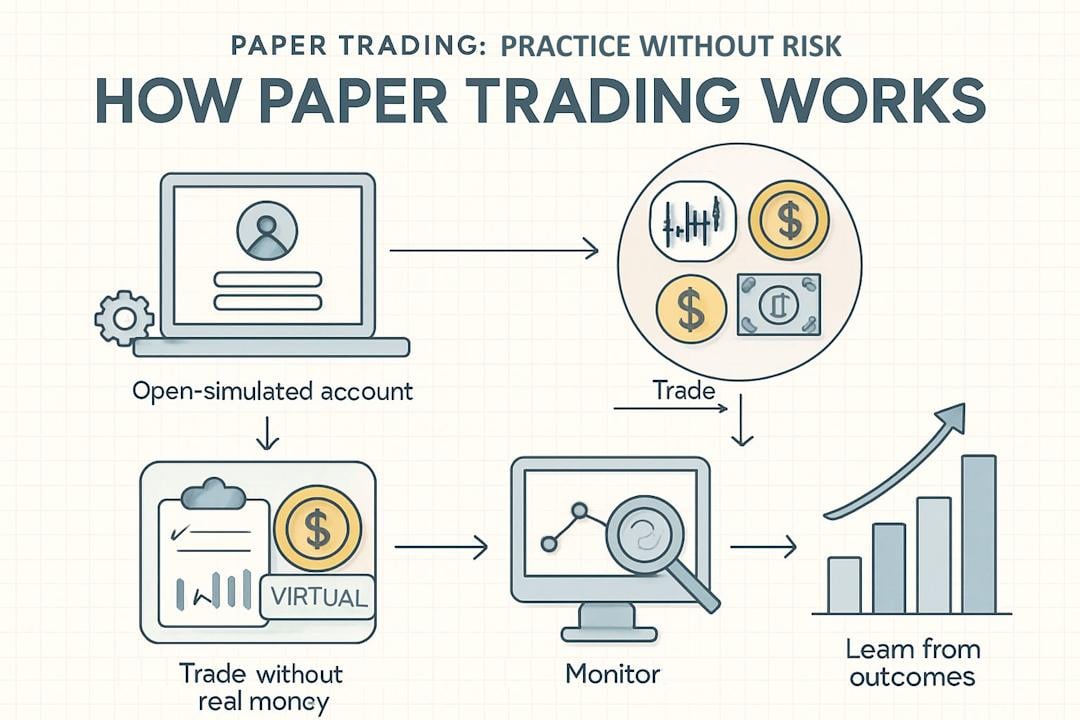
Paper trading mimics live market conditions with simulated trades, pretend funds, and real-time data. You place orders, manage positions, and track performance, just as you would with real money—but there’s no financial risk.
Setting Up a Paper Trading Account
You’ll start by opening a paper trading account on a trading platform that supports simulation. Most major brokers and trading software offer this.
Register like you would for a live account, but skip the funding part.
Once you’re in, pick the markets you want to trade—stocks, forex, crypto, or options—and set your virtual balance, usually anywhere from $10,000 to $1,000,000. The amount doesn’t change your results, but it helps you get a feel for position sizing and risk.
Platforms like TradingView or Trade Ideas let you swap between live and simulated modes with a click. You can test order types—market, limit, stop-loss—and see how they’d play out in real conditions.
Before you start, double-check your account settings: time zone, currency, margin options. These details make sure your simulated results actually match your trading environment.
Using Demo Accounts and Virtual Money
A demo account looks and feels like a real trading account, but you’re using virtual money or virtual funds. Every trade you make adds or subtracts from your simulated balance.
You’ll get to see order flow, slippage, and execution speed—without risking a dime.
Demo accounts are great for testing strategies, tracking results, and sharpening your entries and exits. Maybe you want to practice a moving average crossover strategy and log the win rate over 50 trades.
Just remember, demo trading doesn’t trigger those real-world nerves, so your results might not match what happens when real money’s at stake. Treat it as training, not a promise.
Traders often use demo accounts to compare platforms or brokers before putting up real funds. It’s a good way to judge charting tools, execution, and user experience.
Accessing Real-Time Market Data
Paper trading only works if your platform gives you real-time market data. Without live quotes, your simulated trades won’t reflect actual market moves.
Look for platforms that offer Level I or Level II data—you’ll see bid-ask spreads and trade volume. Tools like MetaStock or Benzinga Pro stream this info for stocks and ETFs, so you can practice in realistic conditions.
Real-time data is a must for time-sensitive strategies like day trading or scalping. You’ll watch how prices react to news, volatility, or earnings releases.
If you only get delayed data, stick to swing or position trading practice—not intraday stuff. Always check your data source and latency before trusting your results.
Developing and Testing Trading Strategies
You’ll sharpen trading strategies by planning trades, analyzing price data, tracking results, and managing risk. Every step gives you a shot at testing decisions in real market conditions, minus the financial sting.
Building a Trading Plan
A trading plan lays out your goals, entry and exit rules, position size, and how you’ll measure success. It’s your checklist to keep things consistent and keep you honest.

Write it down and run it through paper trading before you risk real money.
Set real targets—maybe a monthly return goal or a maximum drawdown limit. Define which markets and time frames you’ll trade. For instance, day traders work intraday, while swing traders hold for days.
Here’s a simple table for structure:
| Element | Example |
|---|---|
| Entry Signal | 20-day moving average crossover |
| Exit Rule | Stop-loss at 2% below entry |
| Position Size | 2% of account per trade |
Check in and adjust your plan each week. If a rule keeps failing, tweak it—don’t just toss the whole plan.
Applying Technical Analysis
Technical analysis helps you spot price trends and timing signals. You’ll test chart patterns, momentum indicators, and moving averages to see if your trading ideas hold up.
Stick with a few reliable tools instead of drowning in indicators.
TrendSpider can automate charting and backtest setups for you. Compare how different indicators perform over different time frames. For example, check if RSI divergences line up with moving average crossovers before you pull the trigger.
Keep your analysis rule-based. Spell out what triggers an entry or exit, so you don’t let emotions take over. Mix trend, volume, and volatility data to confirm signals.
When you’re testing, log both winners and losers to see which setups actually work.
Evaluating Performance with a Trading Journal
A trading journal turns all your raw trade data into lessons. Record every simulated trade: date, instrument, entry, exit, position size, and how it played out. Jot down why you entered and what you felt during the trade.
Use metrics like win rate, average profit/loss per trade, and expectancy to measure how you’re doing. You can use a spreadsheet, but tools like Trade Ideas automate tracking and spot patterns for you.
Review your journal every week. Find the mistakes you keep making—maybe bad timing or weird position sizing. Note what’s working and what’s not, then update your plan.
Journaling keeps you disciplined and helps you treat paper trading as seriously as the real thing.
Risk Management in Practice
Risk management keeps one bad trade from wiping you out. Set a max loss per trade—usually 1–2% of your total capital. Use stop-loss orders and avoid overleveraging.
Try out different risk-to-reward ratios to see what you can sustain. A 1:3 ratio means risking $100 to try for $300 profit. Track how often you hit those targets in your paper trading.
Stock Rover can break down your portfolio exposure and sector concentration. Spread your bets across asset types to avoid too much correlated risk.
If you keep seeing drawdowns, shrink your positions or tighten your stops. Adjust your risk controls as your strategy and confidence grow.
Choosing the Right Paper Trading Platform
Picking a paper trading platform means weighing usability, market access, and analytical tools. You want accurate data, flexible order types, and realistic execution—otherwise, you’re just playing games. The top platforms let you test, learn, and track results like you’re actually in the market.
Features to Look For
Start with real-time market data. If quotes are delayed, your results—especially for day trading or options—won’t mean much. Look for platforms that simulate real fills, including slippage and commissions.
You’ll want customizable watchlists, charting tools, and trade journals. These help you track performance and refine your approach. Platforms like TradingView let you practice across global markets: stocks, futures, forex, and crypto, all with detailed charts and indicators.
Check for mobile and desktop compatibility so you can practice anywhere. The best platforms also show risk metrics, letting you measure drawdowns and win rates.
Before you settle, try the interface yourself. If placing orders or navigating charts feels clunky, move on. Ease of use is just as important as analytics when you’re building trading discipline.
Comparing Popular Platforms
Paper trading platforms really differ in depth and price. Here’s a quick breakdown of some popular options:
| Platform | Best For | Key Strength | Limitation |
|---|---|---|---|
| TradingView | Global markets | Advanced charting, community scripts | Limited order types in free tier |
| Trade Ideas | Day traders | AI trade signals, backtesting | Steep learning curve |
| Stock Rover | Long-term investors | Fundamental screening | No real-time trading simulation |
| Benzinga Pro | Active stock traders | Fast news feeds | Higher subscription cost |
Your choice should match your trading goals. If you’re all about short-term trades, you’ll want to focus on execution speed and data accuracy.
For fundamental practice, Stock Rover stands out with deep research and portfolio analytics.
Double-check that your chosen platform actually reflects live conditions. Some simulators boost liquidity or skip transaction costs, which can give you a false sense of confidence when you go live.
Transitioning from Paper Trading to Real Trading
Think of paper trading as a training ground, not a permanent stop. Once you rack up consistent virtual profits for several months, it’s time to try small positions with real money.
Stick to the strategies you’ve practiced. Keep your trade sizes tiny at first, since the emotional swing between simulated and real markets is bigger than most expect.
Experienced traders often track win rate, average profit per trade, and drawdown before committing to larger trades.
Increase your exposure slowly, but only if your results hold steady in actual market conditions. Tools like TrendSpider can help you automate technical analysis and keep your discipline intact as you shift from practice to real trades.
Review your trades every week. Make sure your paper trading habits—planning, risk control, journaling—carry over when real money’s on the line.
Limitations and Best Practices
Paper trading lets you practice execution, sharpen strategies, and get a feel for market behavior without risking your cash. But keep in mind, simulated results can stray from reality because of emotions, market structure, and liquidity quirks that only show up in live trading.
Differences Between Simulated and Live Markets
Simulators give you virtual capital and usually assume perfect order fills. In real trading, you’ll face slippage, delayed execution, and changing spreads that can eat into profits.
Market depth and liquidity shift in seconds, especially if you’re trading fast movers like forex or small-caps.
Emotions hit differently, too. Paper trading feels safe—no fear, no greed. But when real gains or losses show up, stress can mess with your decisions. Learning to handle that emotional shift is a must before risking real funds.
Some tools, like TradingView, include live data and realistic order books, which helps narrow the gap. Still, no simulator can truly capture how markets react to surprise news or big institutional trades. Treat your simulated results as a learning tool, not a promise.
Common Mistakes to Avoid
Traders often think they’re ready after a handful of good paper trades. They forget about transaction costs, taxes, and liquidity limits that can shrink real profits.
Always add these factors when you test strategies.
Stick to realistic capital and leverage. Planning to trade $10,000 for real? Use that amount in your simulation, too. It keeps your expectations grounded and makes risk management habits easier to transfer.
Track every trade with care. Record your entry, exit, position size, and your reasoning—use a spreadsheet or a tool like Stock Rover. Look for patterns, not just totals.
Don’t fall for curve-fitting. A strategy that nails it in a backtest might flop when the market changes. Test your ideas across different time frames and assets before you up your stakes.
When to Move to Real Trading
Make the jump only if you follow your plan consistently and keep your emotions in check, win or lose. A solid benchmark: at least three months of simulated trading with steady returns and disciplined execution.
Start with the smallest position sizes you can. This lets you test execution, slippage, and liquidity in the real world without risking much. Only scale up as your confidence and results hold up.
Here’s a quick checklist:
- Consistent profit over several market cycles
- Clear risk limits and stop-loss rules
- Documented trade journal
- Realistic expectations about drawdowns
If you check all these boxes, open a live account with limited funds. Keep monitoring your results and refine your process using what you learn from real trades—not just simulations.
Lesson Review Questions
1. What is paper trading, and why is it useful for new investors?
Paper trading is simulated investing using virtual money instead of real capital. It allows beginners to learn how markets, orders, and trading platforms work without risking financial loss. It builds confidence and foundational skills before placing real trades.
2. How does paper trading help investors practice order types and trading mechanics?
Paper trading platforms let users place market orders, limit orders, stop-loss orders, and other trade types exactly as they would in a real brokerage account. This hands-on practice helps investors understand execution behavior, fills, slippage, and timing before risking real money.
3. What limitations of paper trading should investors be aware of?
Paper trades skip emotional pressure and real financial consequences, which means decision-making may feel easier than in real markets. Simulated results also do not reflect slippage, liquidity issues, or partial fills that occur with real capital. As a result, performance in paper trading can appear unrealistically strong.
4. How can paper trading improve an investor’s discipline and strategy?
By tracking trades, reviewing mistakes, and testing rules, investors can refine their strategy without losing money. Paper trading encourages building habits such as setting stop-loss levels, following entry and exit criteria, and maintaining a trading journal—all essential skills for real trading.
5. When should an investor transition from paper trading to real-money investing?
An investor should switch to real trades once they consistently follow a defined process, understand their platform fully, and have demonstrated stable results over time in the simulator. The transition should be gradual, starting with small position sizes to ease into the emotional reality of real-money trading.
6. How can paper trading help investors avoid costly early mistakes?
Paper trading allows investors to practice without financial consequences, helping them identify errors such as entering the wrong order type, overtrading, misunderstanding volatility, or failing to set risk controls. These lessons reduce the likelihood of expensive mistakes when real money is on the line.
FAQ
How can you start paper trading with no financial risk involved?
Just open a free demo account on most major trading platforms. These accounts mimic real market conditions using virtual funds.
Try TradingView for stocks, forex, and crypto paper trading. Set a clear goal for each session—maybe testing stop-losses or trade timing—and log your results. Treat every trade like it’s real to build solid habits.
Where can you access Level 2 quotes while paper trading?
Some simulators include Level 2 data, showing real-time bid and ask depth. Availability depends on the platform and data provider.
Pro tools like Trade Ideas or certain broker demo accounts offer Level 2 quotes for active traders. Use this info to analyze liquidity and order flow before jumping in.
Is real-time data available in paper trading platforms, and how can it affect your practice?
A lot of paper trading platforms use delayed data—usually by 15–20 minutes. Real-time data lets you test intraday strategies much more accurately.
Platforms like TrendSpider and MetaStock give you real-time charting and alerts, which can really help with timing and decisions. Always check your data settings to see if your simulator uses live or delayed feeds.