
The stock market is where you buy small pieces of real businesses. Those pieces are called shares or stocks. When you own a share, you participate in that company’s success or failure.
This lesson shows you the main ways to invest in the stock market, the role of dividends, how you can get real estate exposure through stocks, and why you should be very careful with penny stocks. By the end, you should be able to describe the key stock investing styles and decide which mix makes sense for your goals and risk tolerance.
If you have not already done so, it can help to review the lessons on stock market booms and crashes and managing financial risk. They give you important context for the strategies we cover here.
How Stocks Make You Money
Stocks can reward you in two main ways:
- Capital gains: the share price rises and you sell at a higher price than you paid.
- Dividends: the company pays you a cash distribution from its profits.
For example, if you buy a stock at $10 and sell at $12, your capital gain is $2 per share, or 20% (ignoring fees and taxes). If the company also pays $0.50 per year in dividends while you hold the stock, your total return combines both the price gain and the dividend income.
Most stock investing strategies focus on one or both of these sources of return. Some aim for fast price growth, others prefer slower growth with reliable dividends. The right approach depends on your time horizon, income needs, and risk tolerance.
Main Ways to Invest in the Stock Market
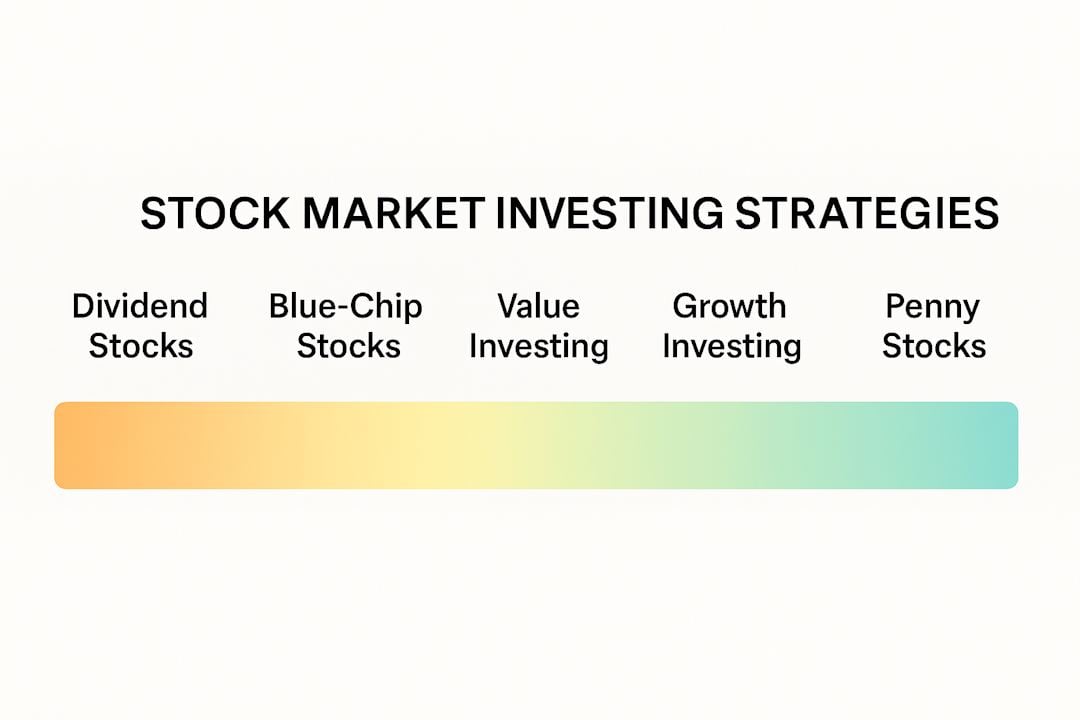
The stock market offers a wide range of choices:
- Buying individual stocks for growth or value
- Buying stocks for dividends and income
- Investing through ETFs and mutual funds
- Getting real-estate exposure via REITs
- Speculating in penny stocks or other high-risk ideas (not recommended for beginners)
We will focus on the core building blocks for long-term investors: growth stocks, value stocks, dividend stocks, real-estate through the market, and the red flag of penny stocks.
Growth Stocks: Buying Future Potential
Growth stocks are companies expected to grow sales and earnings faster than the overall market. They are often newer businesses that have found a profitable niche and are expanding quickly.
Typical features of growth stocks:
- Rapid revenue growth, often in new or disruptive industries
- Profits that are still developing, or profits being reinvested into expansion
- Little or no dividend; cash is used for growth
- Valuations (P/E, P/S) can be high because investors are paying for future potential
Key questions to ask about a growth stock:
- How long can this high growth realistically last?
- Can the company turn growth into sustainable profits?
- Does it have a durable competitive advantage in its niche?
- Is management experienced and trustworthy?
Growth investing can deliver strong returns but comes with higher volatility and the risk that expectations are never met. For a deeper data-driven comparison between growth and value, see the research in Value vs. Growth Stocks: I Tested Both.
Value Stocks: Buying at a Discount
Value investing is about buying solid companies for less than they are worth. The focus is on the relationship between the price of a stock and its “intrinsic value,” based on fundamentals like earnings, cash flow, assets, and competitive position.
Value investors believe that markets are often wrong in the short term. Stocks can become:
- Overvalued – too expensive relative to the company’s real worth
- Undervalued – too cheap relative to the company’s real worth
A disciplined value investor looks for undervalued stocks, buys when prices are low versus intrinsic value, and holds until the market re-prices the stock more fairly. This style is closely associated with investors like Warren Buffett.
To learn more about how to analyze value and fair price, see the guide Mastering Value Investing: A Complete Strategy Guide.
Dividend Stocks: Investing for Income
Many established companies share part of their profits with shareholders in the form of dividends. Dividend stocks can provide a steady income stream alongside any price growth.
Common types of dividend payments:
- Regular cash dividends: the standard quarterly payout most investors think of.
- Special or extra dividends: a one-off, usually larger payment, often after an unusually profitable period or asset sale.
- Liquidating dividends: distributions during company liquidation, returning remaining assets to shareholders.
Dividend stocks are often large, mature businesses with stable earnings. They may not grow as fast as early-stage growth companies, but they can offer more predictable returns.
Key Dividend Metrics You Must Know
Three simple formulas will help you understand dividend stocks:
| Metric | Formula | What it Tells You |
|---|---|---|
| Dividend Payment | Number of Shares × Dividend per Share | Your total income in currency terms (“How many dollars do I get?”) |
| Dividend Yield | Annual Dividend per Share ÷ Share Price | Your income as a % of the current share price (“What % return in dividends do I earn?”) |
| Dividend Payout Ratio | Dividends per Share ÷ Earnings per Share | What portion of profits the company pays out versus reinvests |
Example – Dividend payment: You own 100 shares. The share price is $200, and the company pays a dividend of $5 per share.
Dividend Payment = 100 × $5 = $500 per year, or $125 each quarter.
Example – Dividend yield: Joe owns 1,000 shares at $10 each. The annual dividend is $0.50 per share.
Dividend Yield = $0.50 ÷ $10 = 0.05 = 5%
This 5% is the income he earns on his money before any share price changes. If the price falls while he holds the stock, total return will be lower. If the price rises, total return will be higher.
For step-by-step methods and a full income strategy, see How to Calculate Dividend Yield & Triple Your Income and the guide Mastering Dividend Stocks: DIY Strategies for Steady Income.
The Ex-Dividend Date
The ex-dividend date is the cut-off date for getting the next dividend payment. It is typically one or two business days before the record date.
- If you own the stock before the ex-dividend date, you receive the dividend.
- If you buy the stock on or after the ex-dividend date, you do not receive that upcoming dividend; the seller does.
What Dividend Payouts Can You Expect?
On the major U.S. stock indices, thousands of companies pay dividends. While exact numbers change over time, the broad patterns are:
- Roughly half of listed companies pay a dividend.
- Only a very small number pay double-digit dividend yields (>10%).
- A large portion fall in the 2–5% yield range.
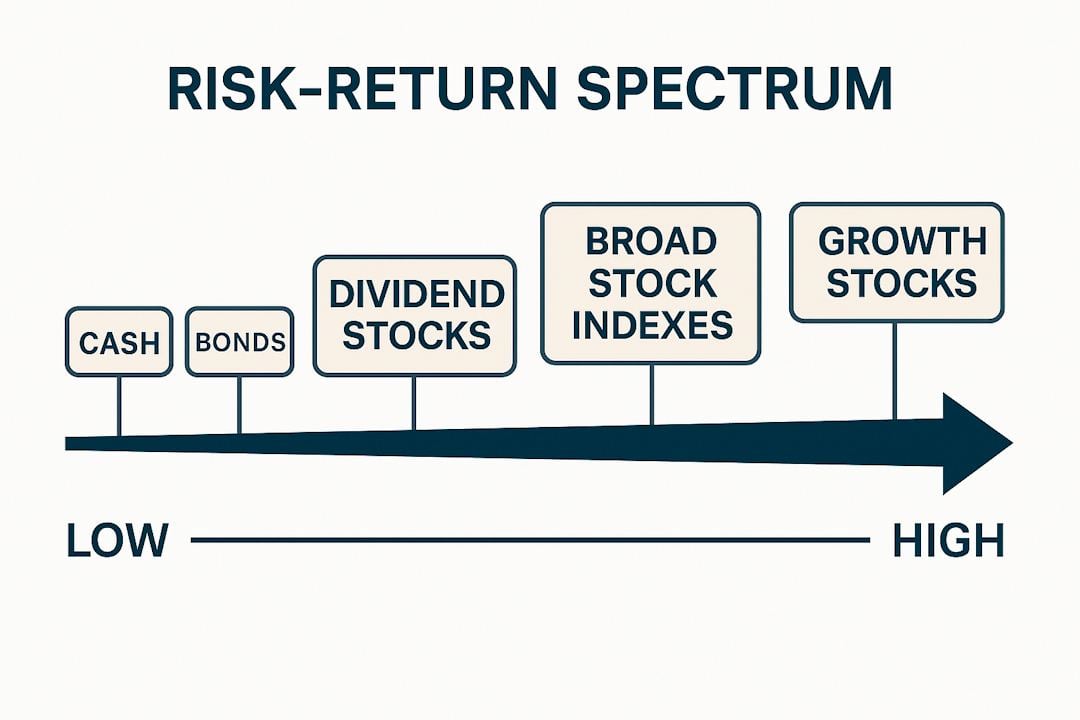
A reasonable expectation for mainstream dividend stocks is often in the 3–5% range. Higher yields can be tempting, but they may signal trouble: falling share prices, unsustainable payout ratios, or a business under stress.
Always combine dividend analysis with a check on the company’s financial health and business outlook. A high yield on a collapsing stock can destroy capital even as you collect income.
Real Estate Through the Stock Market
You do not have to buy an apartment building to invest in real estate. There are several ways to get property exposure through the stock market:
- REITs (Real Estate Investment Trusts): Companies that own and operate income-producing properties such as offices, apartments, warehouses, and shopping centers. By law, many REITs distribute a high percentage of income as dividends.
- Real estate operating companies (REOCs): Listed companies that own and operate property but may not have REIT status.
- Real estate ETFs: Funds that hold a basket of REITs and real-estate-related stocks, providing diversification across many properties and regions.
- Property crowdfunding: Online platforms where investors pool money to buy specific properties. You buy shares in the deal, not the building itself.
Each route has its own risk level, liquidity, and fee structure. For a more detailed discussion of REITs specifically, see What is a Real Estate Investment Trust (REIT)? and the related course lesson on Investing in Hedge Funds & REITs.
Penny Stocks: Why Beginners Should Avoid Them
Penny stocks are usually very low-priced shares (often under $5) of small companies with limited trading volume and limited public information. They are often promoted as a way to get “huge gains” from tiny companies.
In reality, penny stocks are one of the riskiest corners of the market:
- Extreme volatility: very small price moves translate into huge percentage changes.
- Poor liquidity: it can be hard to sell your shares without accepting a much lower price.
- Limited information: many issuers have short histories, weak financial disclosure, or no real business.
- Scams and manipulation: pump-and-dump schemes and misleading promotions are common.
Because of these risks, most serious investors avoid penny stocks altogether, especially when building a long-term wealth plan. Your time and capital are almost always better spent on quality stocks and diversified funds.
Combining Strategies: What Fits Your Goals?
Most real-world portfolios combine several of the ideas in this lesson rather than relying on just one style. Here are a few simple combinations:
- Long-term growth focus: a core of broad-market index funds or ETFs, plus a smaller allocation to individual growth stocks.
- Income focus: diversified dividend stocks, REITs, and dividend-focused ETFs, with some value stocks for stability.
- Balanced approach: a mix of growth, value, and dividend stocks, plus ETFs for diversification.
Ask yourself:
- How much price volatility can I tolerate without losing sleep?
- Do I want regular income now, or am I focused purely on long-term growth?
- How much time do I want to spend researching individual companies?
If you want help putting these ideas into a single plan, the guide 8 Steps to Build a Balanced & Profitable Stock Portfolio walks you through constructing a portfolio using growth, value, and income investing.
How This Lesson Fits in the Course
In this lesson you learned the main ways to invest in the stock market: buying growth, value, and dividend stocks, using REITs and real-estate funds, and avoiding the trap of penny stocks. Combined with your understanding of risk from the previous lesson, you now have a clearer map of the choices in front of you.
Next, we go deeper into the specific types of stocks, their pros and cons, and how to match them to your personal situation.
Lesson Review Questions
1. What are the two main ways stocks can generate returns for investors?
Stocks can generate returns through capital gains and dividends. Capital gains come from selling a stock at a higher price than you paid, while dividends are cash payments from a company’s profits that are distributed to shareholders.
2. How does growth investing differ from value investing?
Growth investing focuses on companies expected to grow sales and earnings faster than the market, often with higher valuations and little or no dividend. Value investing focuses on buying companies whose shares trade below their estimated intrinsic value, emphasizing fundamentals and a margin of safety rather than rapid growth.
3. How do you calculate dividend yield, and what does it tell you?
Dividend yield is calculated by dividing the annual dividend per share by the current share price: Dividend Yield = Annual Dividend ÷ Share Price. It tells you the percentage return you receive each year in dividends relative to the price you pay for the stock.
4. What is a REIT, and why might an investor use one instead of buying a property directly?
A REIT (Real Estate Investment Trust) is a company that owns and operates income-producing real estate and typically distributes a large share of its income as dividends. Investors may choose REITs to gain diversified real-estate exposure, professional management, and liquidity on the stock exchange without needing to buy, finance, or manage property directly.
5. Why are penny stocks considered especially risky for new investors?
Penny stocks are risky because they are usually very small, thinly traded companies with extreme price volatility, poor liquidity, limited reliable information, and a higher chance of fraud or manipulation. Small price moves can cause large percentage losses, and it can be hard to sell your shares at a fair price.
6. If your goal is steady income with moderate risk, which types of stock market investments from this lesson are most suitable?
For steady income with moderate risk, a mix of established dividend-paying stocks, REITs, and diversified dividend or income-focused ETFs is usually more suitable than pure growth stocks or penny stocks. You might also include some high-quality value stocks to balance income and stability.