
Stock options are one of the most flexible tools in the financial markets. They allow investors to speculate on price movements, hedge risk, generate income, or leverage a position with far less upfront capital than buying shares outright. However, options involve complex mechanics such as strike prices, expiration dates, premiums, intrinsic value, extrinsic value, volatility, and time decay. Understanding these components is essential before placing your first options trade.
This lesson explains what options are, how they work, the difference between calls and puts, how to use options for hedging or speculation, how options are priced, and why most beginner traders underestimate the risks. By the end, you will understand the foundational concepts needed to navigate the options market responsibly.
What Are Stock Options?
A stock option is a contractual agreement that gives the holder the right, but not the obligation, to buy or sell a stock at a specific price before a certain date. Options are considered “derivatives” because their value is derived from the price of an underlying asset, typically a publicly traded stock or ETF.
Each option contract typically represents 100 shares of the underlying stock. This leverage makes options powerful tools for both income generation and speculation, but it also increases the risk of significant loss if used improperly.
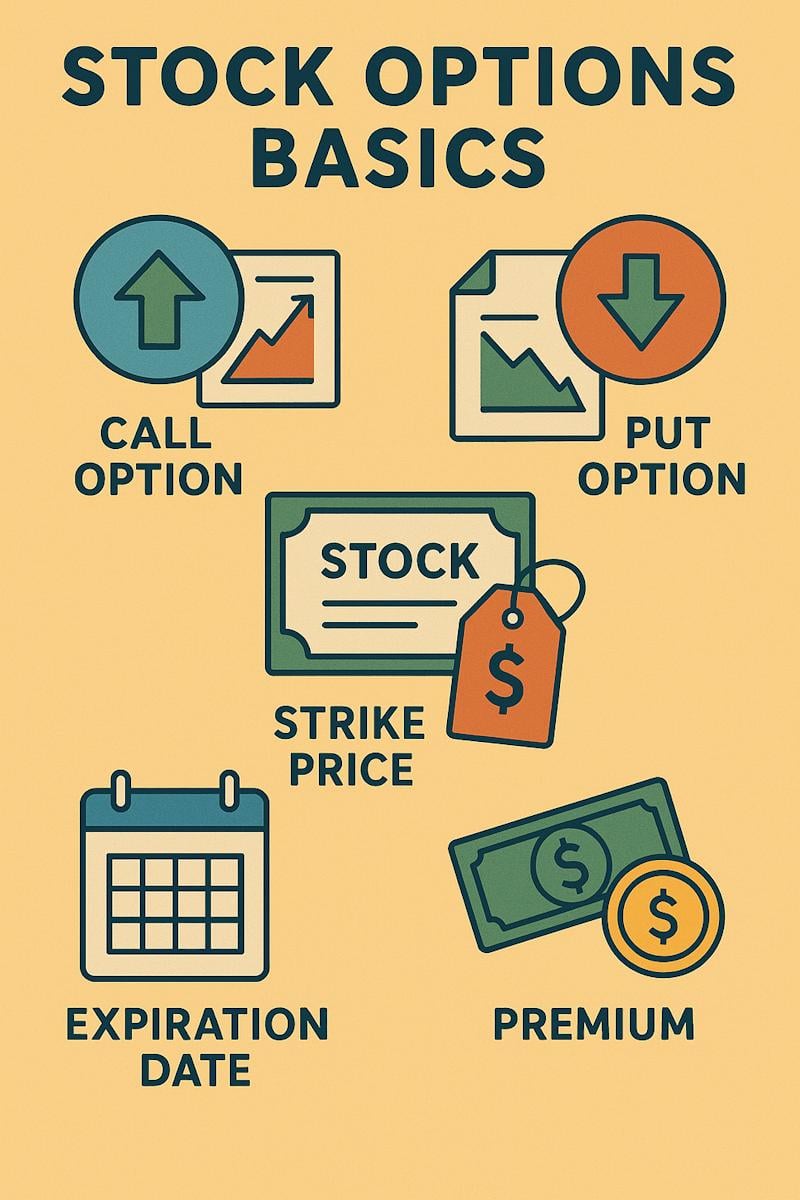
Key Terms You Must Understand
- Call Option – Gives the holder the right to buy shares at the strike price.
- Put Option – Gives the holder the right to sell shares at the strike price.
- Strike Price – The agreed-upon price at which the option can be exercised.
- Expiration Date – The deadline by which the option must be used, or it expires worthless.
- Premium – The price paid to buy the option.
- American-Style Options – Can be exercised anytime before expiration.
- European-Style Options – Can only be exercised on the expiration date.
Together, these elements determine the option’s value, risk profile, and suitability for different strategies.
Call Options Explained
A call option gives you the right to purchase a stock at a specific strike price before expiration. Buyers of call options want the stock price to rise.
Example: Buying a Call Option
Assume Apple stock trades at $150. You purchase a call option with:
- Strike price: $155
- Expiration: One month
- Premium: $3 per share (or $300 for one contract)
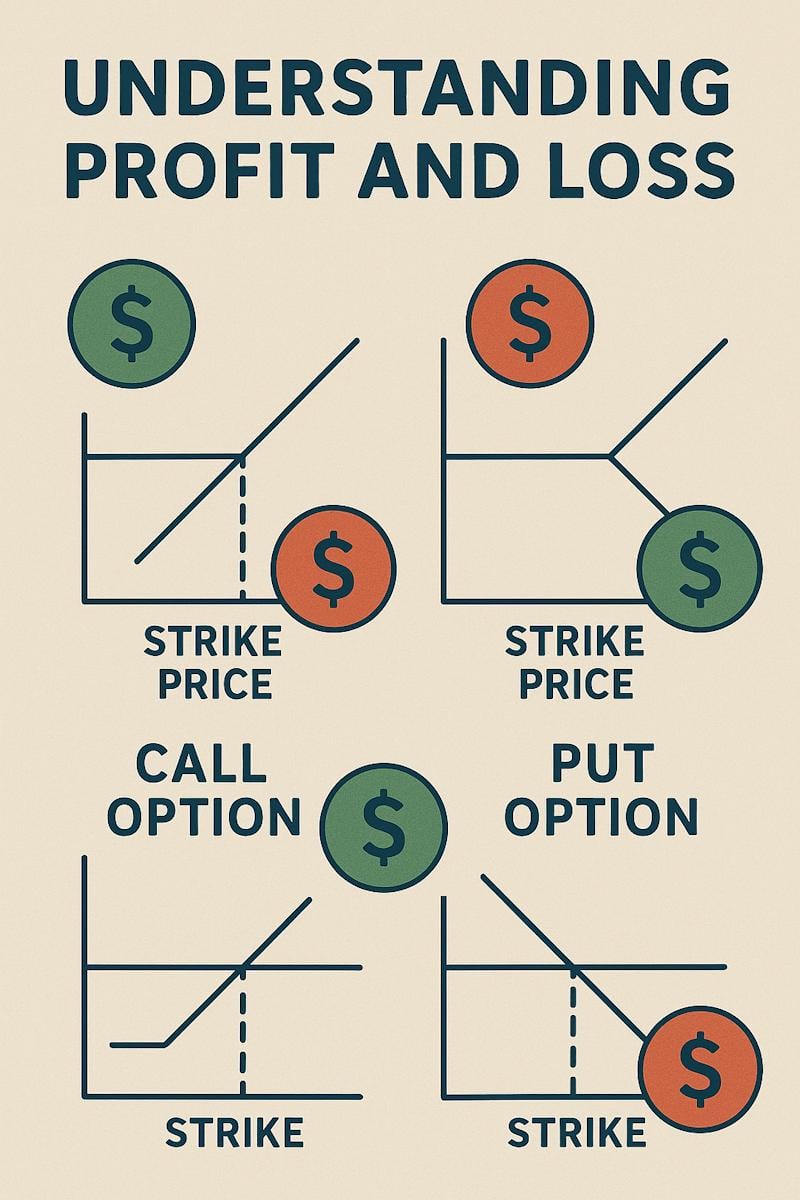
For the trade to be profitable at expiration, Apple must rise above $158 ($155 strike + $3 premium). If Apple jumps to $170, your call is worth $15 per share in intrinsic value. Your profit is:
Profit = ($170 – $155 – $3) × 100 = $1,200
If Apple stays below $155 by expiration, the option expires worthless, and you lose the $300 premium.
Put Options Explained
A put option gives you the right to sell a stock at the strike price. Buyers of puts want the stock price to fall.
Example: Buying a Put Option
Assume Tesla trades at $250. You buy a put with:
- Strike: $240
- Premium: $4 per share
- Expiration: One month
The breakeven price is $236. If Tesla falls to $210, your intrinsic value is:
Profit = ($240 – $210 – $4) × 100 = $2,600
If Tesla closes above $240, the option expires worthless, and you lose the $400 premium.
Intrinsic Value vs. Extrinsic Value
An option’s price consists of two components: intrinsic value and extrinsic value.
Intrinsic Value
This is the real, immediate value of the option.
- Call option intrinsic value: stock price – strike price
- Put option intrinsic value: strike price – stock price
If a call strike is below the current stock price, it is “in the money.” If a put strike is above the stock price, it is also “in the money.”
Extrinsic Value
Extrinsic value represents the additional premium traders are willing to pay for potential future movement. It includes:
- Time value
- Volatility value
As expiration approaches, extrinsic value declines at an accelerating rate, a phenomenon known as time decay.
How Time Decay Affects Options
Time decay (theta) is a major factor in options pricing. Every day, the option loses a portion of its extrinsic value. The closer to expiration, the faster this decay becomes.
This means buying options requires both correct timing and correct direction—two challenging requirements for beginners.
Volatility and Its Impact on Option Prices
Volatility represents the expected movement of a stock’s price. Higher volatility increases option prices because larger movements increase the probability of the option becoming profitable.
Types of Volatility
- Historical Volatility (HV): Past price movement.
- Implied Volatility (IV): The market’s expectations of future movement.
Implied volatility is crucial because it is built directly into the option’s market price. During earnings announcements or significant news events, implied volatility often spikes—making options more expensive.
Why Most Traders Lose Money Trading Options
Options can be profitable, but beginners often underestimate the complexity. Key reasons traders lose money include:
- Not understanding time decay—the option loses value every day.
- Buying cheap out-of-the-money options with low probability of success.
- Trading based on emotion rather than strategic setups.
- Overleveraging—because options are inexpensive, traders buy too many contracts.
- Not factoring implied volatility—IV crush after earnings can destroy option value.
Options are powerful tools, but they reward disciplined, educated traders—not gamblers.
How Options Are Used: Common Strategies
Options aren’t only for speculation. Many long-term investors use options to hedge, generate income, or control risk. Below are some of the simplest and most common strategies.
1. Protective Put
A protective put acts like insurance. You own the stock and buy a put option to protect against downside risk.
2. Covered Call
If you own shares, you can sell call options on them to generate income. This is one of the most popular strategies for income-focused investors.
3. Cash-Secured Put
You sell a put option and set aside enough cash to buy the stock if assigned. This strategy is used to purchase stocks at a lower effective price.
4. Long Calls or Long Puts
These directional strategies allow traders to speculate on upward or downward price movements with limited risk (the premium) but high time sensitivity.
Options Assignment and Exercise
Option contracts may be exercised or assigned depending on whether you hold the long or short side of the contract.
Exercise
If you own a call, you may choose to exercise it and purchase 100 shares at the strike price. If you own a put, you may sell 100 shares at the strike price.
Assignment
If you sold an option, you may be assigned at any time (for American-style contracts). This means you must fulfill the obligation of the contract—either delivering shares (for calls) or buying shares (for puts).
Expiration and the Options Chain
The options chain lists all available strike prices and expiration dates. Traders typically choose expiration dates ranging from weekly to monthly to long-term LEAPS options, which may extend one to three years into the future.
Should Beginners Trade Options?
Options can be extremely rewarding, but they require training, discipline, and an understanding of volatility, time decay, and probability. Many beginners start with covered calls or cash-secured puts before exploring more advanced strategies.
For more foundational concepts before entering options markets, review our lessons on managing investment risk and how stock trading works.
Stock Options vs. Stocks
Options are simply a contract; you do not own the underlying stock that determines the value of your options contract. Unlike stocks, you can hold options indefinitely. Options contracts all have an expiration date, and the closer to the expiration date you get, the less your option is worth.
As you do not own the stock, only a promise to pay the difference between the stock price now and at some point in the future, you will see that the options contracts cost as little as 2% to 20% of the cost of owning the stock.
Stock Options are simply a vehicle to achieve a goal. For those who cannot use leverage to increase their total investment pot, Options are a cheap and effective way to leverage their invested capital.
The main difference between buying stocks and buying stock options is that with options, you have the right, but not the obligation, to buy or sell a certain number of shares of the underlying stock at a set price (the strike price) on or before a certain date (the expiration date).
If you buy stock options, you are betting that the underlying stock price will increase. If it does, you can exercise your option to buy the stock at the strike price and then sell it immediately at the higher market price and pocket the difference. If the stock price goes down instead, you let your option expire worthlessly and lose only the premium you paid.
With stocks, on the other hand, you are buying a piece of ownership in a company and hoping that the stock price will go up so you can sell it at a profit. If the stock price goes down, you can still sell it, but you will take a loss.
However, there is one major advantage to buying stocks over options: with stocks, you can earn dividends, which are not paid out on options. Dividends can provide a nice stream of income.
The best way to understand options is to run through an example.
What is the best broker for stock options trading?
Our review testing shows Firstrade is ideal for investors seeking zero-commission trading on stocks and options and an industry-best 2,200 commission-free ETFs. Full MorningStar research access plus a full suite of IRA accounts means Firstrade is a great choice for brokerage services.
Stock vs. Stock Options: 3 Strategies Compared
For example, you have $1,000 to invest.
Strategy 1 – Buy the Stocks
You could buy five shares of Amazon Inc. (Ticker: AMZN) at $200 per share.
Total Costs: $1000
If Amazon moved up 10% over the next two months to $220, your profit would be
($220 – $200) = $20 per share. 5 Shares * $20 = $100
A 10% gain.
Strategy 2 – Buy Options on the Stock
You could buy one “At the Money Call Contract” for AMZN with a strike price of 200 and an expiry date of May 21, 2013. The contract value is $10 per share. Because you will control 100 shares with each contract and buy one contract, your costs for the trade are $1000.
In options speak:
- One contract means you will have control over 100 shares of AMZN
- The money means the strike price of $200 per share equals the actual stock price.
- The strike price is the point at which the option will have a value (apart from the time value)
- The expiry date is when the option contract expires and loses all value.
In the same scenario, the stock price moves 10% to $220. The price difference is $20 per share. The contract was at a strike price of $200; therefore, $220 – $200 = $20 profit per share.
Theoretical profit would be 100 * $20 = $2000, a $2000 gain from a $1000 investment. This means a gain of 100%.
I say theoretically because the clock starts ticking on the time value when you buy an option. If the stock price took until the final month before expiry to move to $220, you would have lost all of the time value of the contract, which could reduce your profits. However, if the stock had moved 10% in a single day, you would have secured almost all of the 100% and kept much of the time value in the stock.
What are the risks of options compared to simply buying the stock?
You can lose the entire investment if the stock price moves against you. With stocks, this is quite rare; stocks rarely move to zero unless the company goes bankrupt.
If the stock price does not move in the period, your investment can also expire worthless.
The stock needs to move in the direction you place the bet to make a profit. If the stock price moves sharply, your earnings can be quite large.
Strategy 3 – Shorting stock using options
Using the same scenario, we expect the stock to increase in value instead of expecting it to decrease.
AMZN has a current stock price of $200
You could buy one “At the Money Put Contract” for AMZN with a strike price of 200 and an expiry date of May 21, 2013. The contract costs $10 per share, and there are 100 shares in a contract. The cost of investment is $1000.
In options speak:
- One contract means you will have control over 100 shares of AMZN
- “At the money” means the strike price of $200 per share has already been reached.
- The strike price is the point at which the option will have a value (apart from the time value)
- The expiry date is when the option contract expires and loses all value.
In this scenario, the stock loses 10% in value to $180. The price difference is now $20 per share. The contract was at a strike price of $200; therefore, $200 – $180 = $20 profit per share.
The theoretical profit would be 100 * $20 = $2000. This means a gain of 100%.
Options Summary
Options are complex instruments, but the more you understand them, the more they make sense. With experience, you will see that they are an incredibly flexible investment tool. However, before considering trading options, you must understand how to pick stocks, evaluate market direction, and formulate a strategic, systematic approach to investing.
To succeed at stock options trading, you must have a solid understanding of the market. It would be best if you were also patient and disciplined. Stock options trading can be a very profitable way to make money, but it takes time and effort to succeed.
Lesson Review Questions
1. What is the difference between a call option and a put option?
A call option gives the right to buy a stock at the strike price, while a put option gives the right to sell a stock at the strike price.
2. Why is time decay important for options traders?
Time decay reduces the extrinsic value of an option each day, making long option positions lose value as expiration approaches.
3. What does implied volatility represent?
Implied volatility represents the market’s expectations of future price movement. Higher IV increases option premiums.
4. What happens when an option seller is assigned?
The seller must fulfill the contract: delivering shares for a call option or buying shares for a put option.
5. Why do many beginners lose money trading options?
Because they underestimate time decay, volatility, probability of profit, and the impact of leverage, often buying low-probability options that expire worthless.