
You really don’t need a huge pile of cash or a fancy degree to start investing. These days, you can jump in with just $10 on platforms offering fractional shares, so you get a slice of big-name companies without blowing your budget.
Forget the myth that you need thousands—just start early and keep at it. That’s what actually moves the needle.
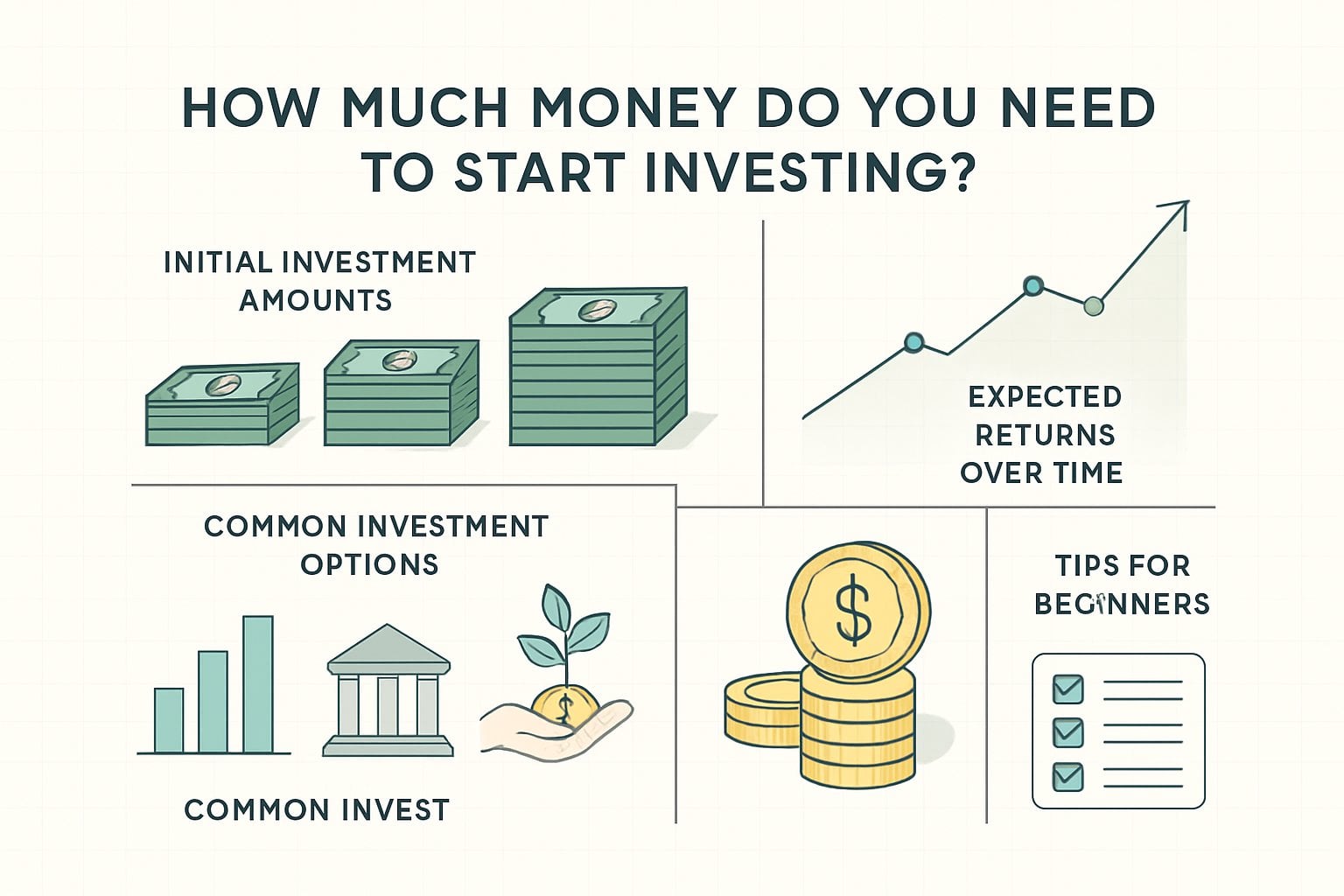
Before you put money into the market, check your financial foundation. Pay off high-interest debt, build an emergency fund, and figure out how to invest monthly without making life stressful.
Once you’re set, you can use tools like Stock Rover to compare investments and track your progress toward your goals.
You’ll get more confident as you see how different accounts—like IRAs or regular brokerage accounts—fit your needs. Small, steady investments really can add up over time, if you stick with it and don’t panic at every market wobble.
Savings / Investing Goal Calculator
Calculate how much you need to save each month to reach a financial goal, how long it may take, and how investment returns can accelerate the journey.
Inputs
Results
Formula Used
Advanced Financial Goal Calculator for Saving and Investing
Key Takeaways
- You can start investing with just a few bucks using fractional shares.
- Make sure your finances are solid and pick accounts that work for you.
- Use research tools to build and tweak your investment plan.
How Much Money Do You Really Need to Start Investing?
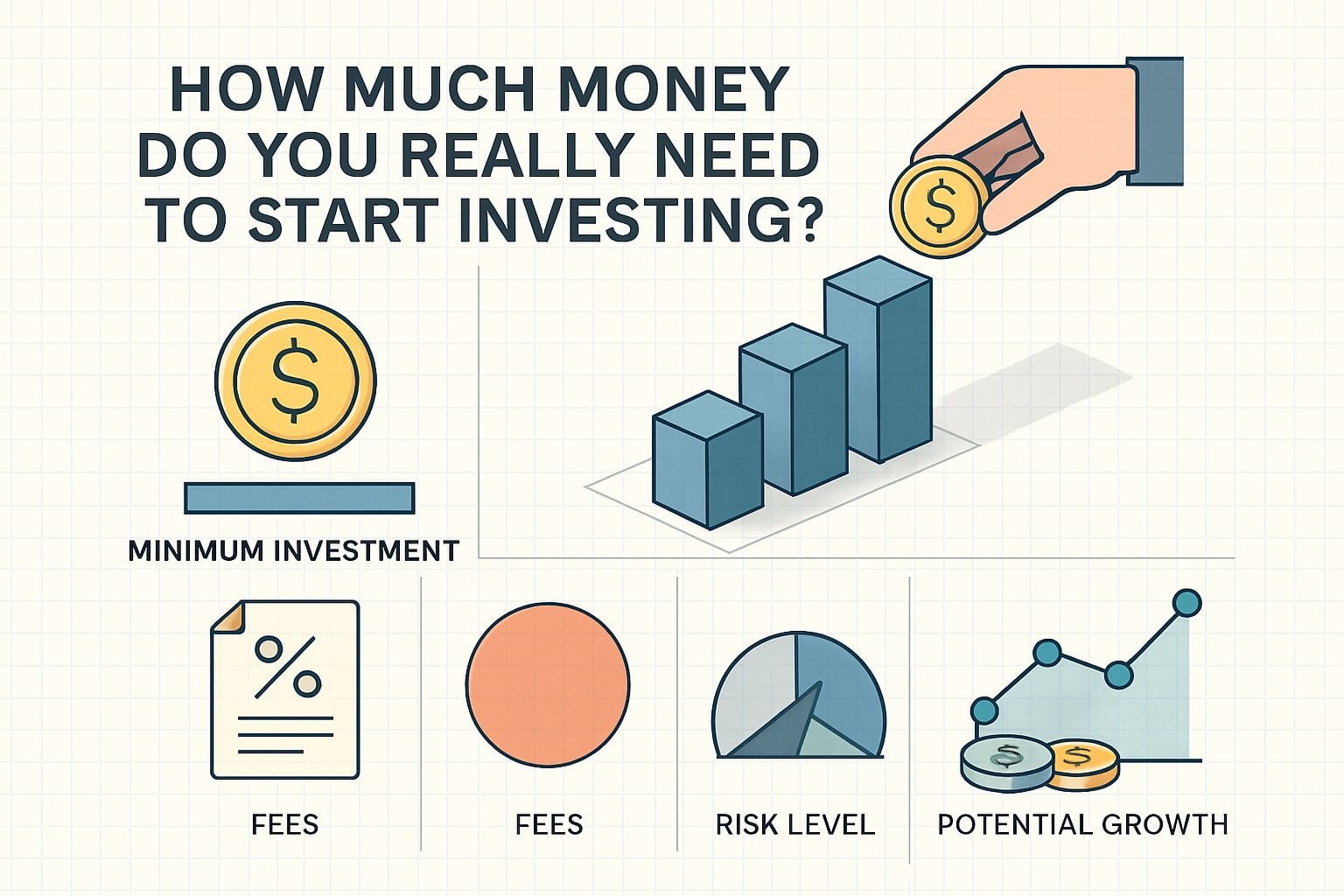
You can get started investing with way less than most people think. Many platforms let you buy fractional shares, automate small deposits, and focus on building habits instead of waiting to hit some big number. Consistency really does matter more than starting with a lump sum.
Minimum Amounts for Popular Investments
What you need to invest depends on what you’re buying and where. Stocks can cost as little as a dollar or two, thanks to online brokers that don’t require minimum balances.
ETFs often have no minimum if you use a brokerage account, but mutual funds might ask for $500–$3,000 to get started.
Some robo-advisors let you begin with $10–$100 and automatically spread your money across diversified ETFs. For example, you could put $50 a month into a balanced ETF portfolio instead of waiting to save up a big chunk.
| Investment Type | Typical Minimum | Example Platform |
|---|---|---|
| Stocks | $1–$100 | Fidelity, Robinhood |
| ETFs | $0–$100 | Vanguard, Schwab |
| Mutual Funds | $500–$3,000 | T. Rowe Price |
| Robo-Advisors | $10–$100 | Stash, Betterment |
Check out tools like Stock Rover to compare costs and performance before you commit. That way, you can match your budget to actual options instead of guessing.
Fractional Shares and Micro-Investing
Fractional shares let you buy just a piece of a stock or ETF. If a company’s share costs $300, you can throw in $10 and own 1/30 of it. This opens the door to investing and diversifying early, even if you don’t have much to start with.
Apps like Stash and Fidelity Spire make micro-investing easy by rounding up your spare change and putting it straight into investments. Honestly, it’s a painless way to get exposure to the markets without moving big sums.
Fractional investing also lets you experiment across different sectors or strategies before you go bigger. You can use TradingView charts to see how your little slices perform over time. Start tiny, watch what happens, and add more as you get comfortable.
The Importance of Starting Early
Starting early beats starting big—every time. Even small amounts can compound into real money if you give it years to grow. For example, putting in $50 a month at a 7% return for 30 years gets you to about $61,000. That’s not pocket change.
Investing early also forces you to learn. You’ll see how the market moves, what it’s like to get dividends, and how it feels when things get bumpy. These lessons are worth a lot when you start putting in more money later.
If you wait until you “have enough,” you might lose more to lost time than to market risk. Start with what you can handle now, automate your contributions, and check your progress once a year. You can always tweak your strategy using tools like TrendSpider as you go.
Preparing Your Finances Before You Invest
You’ll want to shore up your finances before you start investing. Build up an emergency fund, pay off expensive debts, and figure out what you can invest without making life stressful. That way, you can invest with a clear head—not out of desperation.
Building an Emergency Fund
Set up an emergency fund before you dive in. Try to save three to six months of living expenses in an account you can access quickly. If you lose your job or face a medical bill, you won’t have to sell investments at a bad time.
Start wherever you can. Automate transfers—maybe $25–$50 a week—from your checking account. Over time, this really adds up.
Keep your emergency fund in a high-yield savings account or money market fund—definitely not stocks or crypto, since those can drop when you least expect them.
Here’s a simple way to track your progress:
| Expense Category | Monthly Cost | 3-Month Target | 6-Month Target |
|---|---|---|---|
| Housing & Utilities | $1,200 | $3,600 | $7,200 |
| Food & Essentials | $600 | $1,800 | $3,600 |
| Transportation | $400 | $1,200 | $2,400 |
| Total | $2,200 | $6,600 | $13,200 |
Check in once a year and adjust for inflation or any big life changes before you start increasing your investments.
Paying Down High-Interest Debt
Knock out high-interest debt—especially credit cards—before you get too aggressive with investing. If your interest rate is over 8–10%, you’re probably losing more to debt than you’d gain from the market.
List your debts, interest rates, and minimum payments. Use the avalanche method (highest rate first) or the snowball method (smallest balance first)—just pick one that keeps you motivated.
If you’re still carrying debt, only invest enough to get your employer’s retirement match. That match is basically free money and can make up for the debt drag a bit.
Once you wipe out high-interest balances, you can put those old debt payments into index funds or retirement accounts and actually get ahead.
Setting a Realistic Investment Budget
Figure out how much to invest by looking at your income, expenses, and risk tolerance. Many people aim for 15–20% of take-home pay, but your situation might call for more or less.
Start with small, automatic contributions. With fractional shares, you can literally invest $1 at a time—so just focus on building the habit.
Keep your short-term savings separate from your investments. If you’ll need the money within three years, stick with cash or bonds, not stocks.
You can use TradingView to test how your planned contributions might perform in different market conditions.
Check your budget every quarter. If your income or expenses change, tweak your contributions. This keeps your plan realistic and prevents overextending yourself.
Choosing the Right Investment Accounts

Your account choice affects how your money grows and how much you keep after taxes. Each account type comes with its own rules for contributions, withdrawals, and any employer perks, so it’s worth knowing the basics.
401(k) and 403(b) Plans
A 401(k) (for the private sector) or 403(b) (for nonprofits and schools) lets you invest pre-tax money right from your paycheck. Most employers match 3% to 6% of your salary—don’t leave that on the table.
For 2025, you can put in up to $23,000 if you’re under 50, or $30,500 if you’re 50 or older. Your investments grow tax-deferred until you withdraw in retirement. Take money out before age 59½, and you’ll usually owe taxes plus a 10% penalty.
If your employer matches, always contribute enough to get the full match. Then, look at your plan’s investment menu—usually target-date funds, index funds, and bond funds. Compare their performance and fees on a platform like Stock Rover before choosing.
IRA, Roth IRA, SIMPLE IRA, and SEP IRA
An IRA gives you tax perks even if your job doesn’t offer a retirement plan. With a traditional IRA, you get a tax break up front; with a Roth IRA, you pay taxes now but withdraw tax-free later. For 2025, you can put in up to $7,000 (or $8,000 if you’re 50+).
If you’re self-employed or run a small business, a SIMPLE IRA or SEP IRA lets you save more. A SEP IRA allows up to 25% of compensation or $69,000 in 2025, whichever is less. SIMPLE IRAs let you contribute $16,000 plus a $3,500 catch-up if you’re 50+.
Pick based on your current tax bracket and what you expect in retirement. Use Roth accounts if you think taxes will go up for you later; stick with traditional if you need the deduction now.
Taxable Brokerage Accounts
A taxable brokerage account has no limits on how much you can add or when you can take money out. You can buy stocks, ETFs, mutual funds, or bonds and sell whenever you want. Just remember—you’ll owe capital gains tax on profits and dividend tax on payouts.
This kind of account works well for goals outside retirement, like saving for a house or extra income. You can set up automatic contributions and reinvest dividends.
If you’re into active trading, use TrendSpider for charts and technical analysis. For stock research, Seeking Alpha is a go-to. Keep good records of your cost basis and holding periods to handle taxes smoothly.
Comparing Investment Options
Every investment type comes with its own costs, risks, and level of control. You can pick between owning stocks directly, using pooled funds, or letting a robo-advisor handle things, depending on how hands-on you want to be.
Stocks and Stock Market Funds
Buying individual stocks gives you a piece of a company and direct exposure to its ups and downs. You can start with just $1 using fractional shares at most brokers. Stocks offer serious growth potential, but they’re also volatile in the short run.
For broader exposure, stock market index funds track benchmarks like the S&P 500. These funds cut down company-specific risk and don’t need constant attention. Expense ratios are usually under 0.10%, so they’re cheap to own long-term.
Use Stock Rover to screen for companies with strong earnings or low debt before you buy. If you’re more active, TrendSpider can help you spot technical patterns on charts.
When you invest in stocks or stock market funds, decide if you want to build a custom portfolio or stick with a diversified index strategy. Start small, reinvest dividends, and review your holdings at least once a year.
Mutual Funds and ETFs
Mutual funds gather money from a bunch of investors and use it to buy a mix of assets. They’re a solid choice if you want professional management and don’t want to fuss with picking investments yourself.
But let’s be honest—fees can sting. You’ll usually pay 0.50% to 1.00% each year, and you can only trade at the fund’s closing price once per day. More on mutual fund fees.
Exchange-traded funds (ETFs), on the other hand, trade like stocks throughout the day. That means you can buy or sell whenever the market’s open. Fees are usually lower than those of mutual funds, and you’ll find plenty of ETFs tracking indexes, though some use active management for specific strategies.
If you’re investing smaller amounts on a regular basis, ETFs often save you money in the long run. Check if your broker offers commission-free ETFs—trading costs can sneak up on you. Always look at the expense ratio, tracking error, and liquidity before you jump in.
Mutual funds work well for retirement or long-term accounts if you want something simple. ETFs are better if you like having more control over when and what you buy or sell.
Robo-Advisors and Automated Platforms
Robo-advisors use algorithms to build and manage a portfolio that matches your goals and risk tolerance. They’ll pick ETFs or index funds for you based on your answers to a few questions. You can usually start with just $0–$500, and annual management fees average 0.25%–0.40%.
These platforms take care of rebalancing and reinvesting your dividends automatically. No need to pick individual stocks or keep up with daily market moves. If you want a hands-off, automated experience, robo-advisors are a great fit.
Some robo-advisors even connect with tools like TradingView so you can visualize your portfolio’s performance. It’s a nice perk if you want a quick snapshot without digging through reports.
Before you choose, compare the fees, account minimums, and whether they offer tax-loss harvesting. Go with a robo-advisor if you’re after a simple, data-driven way to stay invested and don’t want to sweat the details every day.
Employer-Sponsored Plans
Employer-sponsored plans—think 401(k) or 403(b)—let you invest straight from your paycheck. A lot of employers will match part of your contribution, usually 3%–6% of your salary, which is basically free money.
Most of these plans offer a handful of mutual funds or target-date funds. Fees depend on the plan, but bigger companies often negotiate for lower expense ratios. You can tweak your contribution or switch funds whenever you want.
If you switch jobs, you can roll over your balance into an IRA and keep your tax advantages. Always put in at least enough to get the full employer match before looking at other options.
Employer plans come with tax-deferred or Roth choices, so you can pick whether you want the tax break now or later. Check your investment options every year to make sure they still fit your goals.
Building a Practical Investment Strategy
A practical investment strategy helps you figure out how much to invest, where to put your money, and how to manage risk as your life changes. You’ll want to set clear objectives, spread your money across different assets, harness compound growth, and adjust your contributions as your income or priorities shift.
Setting Investment Goals
Set specific, measurable, and time-bound goals before you start. Are you saving for retirement, a house, or maybe college? Each goal shapes your time horizon and how much risk you can take.
Short-term goals (under five years) usually call for safer spots like high-yield savings or short-term bonds. For long-term goals like retirement, you can lean into stocks or diversified funds since you’ve got time to ride out the bumps.
Here’s a quick checklist:
- Purpose: What’s the money for?
- Timeline: When will you need it?
- Risk tolerance: How much volatility can you live with?
Write down your answers. They’ll help you stick to your plan when the market gets choppy.
Diversification for Risk Management
Diversification means putting your money into different asset classes—stocks, bonds, and cash equivalents—so you’re not betting everything on one thing. If one area tanks, others might hold up.
Try a basic allocation like this:
| Investor Type | Stocks | Bonds | Cash |
|---|---|---|---|
| Conservative | 40% | 50% | 10% |
| Balanced | 60% | 35% | 5% |
| Growth | 80% | 15% | 5% |
You can go further by mixing in international stocks, emerging markets, or different sectors like tech or healthcare.
Tools such as Stock Rover let you see how diversified you really are by showing correlations between your holdings. Rebalance your portfolio once or twice a year to keep your target mix on track.
Understanding Compound Growth
Compound growth happens when your returns start earning their own returns. The earlier you start, the stronger it gets.
For example, if you invest $200 per month at a 7% annual return for 30 years, you’ll end up with about $243,000—even though you only put in $72,000. That’s the power of time, not just timing.
To get the most from compounding:
- Reinvest dividends automatically.
- Keep withdrawals to a minimum.
- Watch out for fees—they eat into growth.
You can use TradingView to spot performance trends and see how reinvested returns add up over decades. Even small, steady contributions can really add up if you stick with it.
Adjusting Contributions Over Time
Your finances aren’t static, so your investments shouldn’t be either. Bump up your contributions when you get a raise or pay off debt.
Try increasing your investment rate by 1–2% of your income each year until you hit your target—usually around 15% for retirement.
Check your budget every year. If your goals or the market shift, tweak your allocations instead of stopping altogether.
Automate your transfers to help you stay on course and avoid knee-jerk decisions. Set up alerts or dashboards in tools like TradingView, so you know when it’s time to rebalance.
FAQ
What is the minimum amount of money required to begin investing?
You can start with as little as $5 to $100 if you use platforms that offer fractional shares. Most online brokers and apps don’t require account minimums, so you can grab a slice of a stock or fund without needing hundreds.
Can you start investing with a budget of $100 as a beginner?
Absolutely. With $100, you can open a brokerage account and buy fractional shares of ETFs or big-name stocks.
Use that money to get a feel for markets—don’t stress about making fast gains. Stock Rover can help you compare funds and see performance metrics, which is handy before you commit more cash.
What are the first steps to investing for students with limited funds?
Pay off any high-interest debt first and get an emergency fund in place. Then open a Roth IRA or a low-cost brokerage account with no minimums.
Set up small, automatic investments—$10 or $20 a month builds the habit. Plenty of student-friendly apps let you invest spare change, so you can start even if you’re tight on cash.
At what age is it advisable to start investing?
You can start investing once you have income and you’re old enough to open an account, usually age 18. Parents can also open custodial accounts for kids under 18.
The earlier you start, the more time your money has to grow. Usually, time in the market beats trying to time the market.
What are the key considerations for investing a small amount, like $20?
If you’ve got $20 to invest, focus on platforms that offer low or zero trading fees and let you buy fractional shares. High minimums or commissions can wipe out your gains, so steer clear of those.
Whenever you earn dividends or profits, put them back into your account. As your income grows, try to bump up your contributions. Honestly, think of this as a way to get comfortable with investing before you commit larger amounts.