
Real Estate Investment Trusts, or REITs, offer investors an accessible way to participate in the real estate market without buying, financing, or managing physical property. Through a REIT, you can invest in professionally managed portfolios of income-generating real estate such as office buildings, shopping centers, apartment complexes, warehouses, hotels, and even mortgage assets.

Because REITs trade on major stock exchanges, they provide liquidity and flexibility similar to stocks and ETFs. At the same time, REITs are legally required to distribute at least 90% of their taxable income to shareholders, making them appealing to income-focused investors seeking regular dividend payments.
This lesson explains what REITs are, how they work, the main types of REITs, the benefits and risks, and how you can use them within a diversified investment portfolio. If you understand the basics of ETFs and indexed investing from earlier lessons, REITs will feel like a natural extension of the same concepts—except with a focus specifically on real estate assets.
Savings / Investing Goal Calculator
Calculate how much you need to save each month to reach a financial goal, how long it may take, and how investment returns can accelerate the journey.
Inputs
Results
Formula Used
Advanced Financial Goal Calculator for Saving and Investing
What Is a REIT?
A Real Estate Investment Trust (REIT) is a company that owns, operates, or finances income-producing real estate. Think of a REIT as a mutual fund for property: investors pool money, and the REIT uses that capital to acquire buildings, land, mortgages, or property-backed securities.
REITs can be publicly traded, publicly registered but non-traded, or private. In this course, we focus on publicly traded REITs—those you can buy on a stock exchange—because they provide liquidity, transparency, and pricing throughout the trading day.
Why REITs Are Attractive to Investors
- High dividends – REITs must distribute at least 90% of their taxable income, resulting in above-average dividend yields.
- Diversification – REITs allow investors to add real estate exposure without owning property directly.
- Professional management – Experts handle real estate selection, leasing, and maintenance.
- Liquidity – Traded REITs can be bought and sold on exchanges like stocks.
- Lower barrier to entry – You gain real estate exposure without saving hundreds of thousands of dollars for a deposit.
How REITs Work
REITs operate using a straightforward model: they acquire or finance real estate, lease it to tenants, collect rental or interest income, and distribute the majority of those profits to shareholders as dividends.
- Investors purchase shares of the REIT.
- The REIT pools this capital and acquires property or mortgage assets.
- Tenants pay rent, or borrowers pay interest.
- The REIT covers operating costs and distributes income to shareholders.
- Shareholders may also benefit from long-term property appreciation.
This structure gives investors exposure to the income and growth potential of real estate, without the responsibilities of maintaining buildings, managing tenants, or handling mortgages.
Types of REITs
REITs vary based on the types of assets they hold. Each category behaves differently, carries different risks, and fits different investment goals. Understanding these distinctions will help you choose REITs that align with your strategy.
1. Equity REITs (Property Ownership)
Equity REITs own and operate income-producing properties. These are the most common types of REIT, and they generate income primarily through rent. Examples include:
- Commercial property – office towers, shopping centers, event venues, hotels, warehouses
- Residential property – apartment buildings and multifamily housing
- Specialty real estate – data centers, self-storage facilities, hospitals, telecommunications towers
2. Mortgage REITs (mREITs)
Mortgage REITs do not own physical buildings. Instead, they provide financing by purchasing mortgages or mortgage-backed securities. They earn income through interest payments.
Because mREITs rely heavily on borrowing (leverage) to generate higher yields, they are more sensitive to interest rate risk and market volatility.
3. Hybrid REITs
Hybrid REITs combine equity and mortgage strategies, holding both physical properties and mortgage assets. This provides diversification within the REIT structure itself.
Benefits of REIT Investing
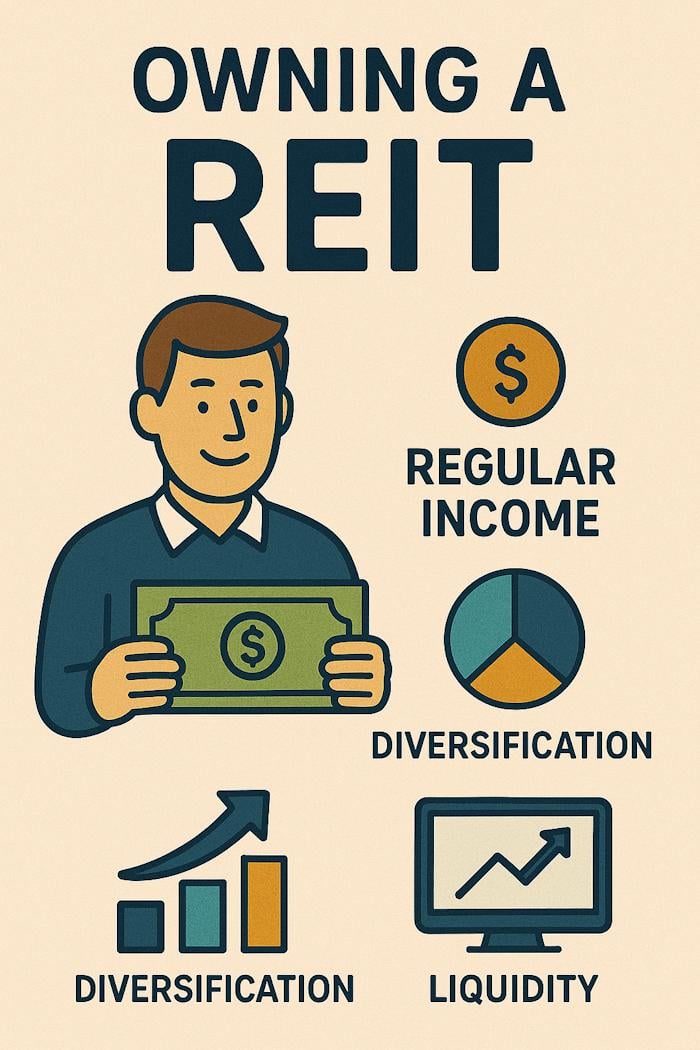
REITs can strengthen a portfolio by providing income and diversification. They are especially attractive to investors seeking real estate exposure without direct property ownership.
- High dividend income – Due to the 90% distribution rule.
- Inflation hedge – Rental income often rises along with inflation.
- Portfolio diversification – REITs behave differently from stocks or bonds.
- Low capital requirement – Buy real estate exposure with a single share.
- Easy to trade – REITs are bought and sold like stocks throughout the day.
Risks of REIT Investing
While REITs offer compelling advantages, they also carry meaningful risks that every investor should consider.
- Leverage risk – Many REITs borrow significant capital; property declines or rising interest rates can amplify losses.
- Sector concentration – A REIT focused on a single property type (e.g., hotels) may be subject to cyclical downturns.
- Taxation – Although REITs are not taxed at the entity level if they distribute 90% their income, dividends are typically taxed as ordinary income to shareholders.
- Interest rate sensitivity – Higher interest rates can pressure REIT valuations, especially mortgage REITs.
- Market volatility – Publicly traded REITs fluctuate in price like stocks.
Before investing in REITs, consider how these risks align with your overall investment plan, risk tolerance, and income needs.
How to Invest in REITs
There are several easy ways to add REIT exposure to your portfolio:
- Buy shares of individual REITs on a stock exchange.
- Invest through REIT ETFs, which provide diversification across many REITs.
- Use REIT-focused mutual funds if your broker offers them.
- Consider retirement accounts to minimize taxation on REIT dividends.
For a deeper understanding of how pooled investments work, see our lesson on investing in mutual funds and ETFs.
Are REITs a Good Investment?
REITs may be a strong fit for income-seeking investors and those looking to diversify into real estate. Historically, many REITs have delivered competitive total returns driven by both income and property appreciation.
However, investors should evaluate:
- Your income needs
- Your risk tolerance
- Your time horizon
- How REITs complement your existing portfolio
Because dividends are taxed at ordinary-income rates, many investors hold REITs in tax-advantaged accounts when possible.
Next Steps in the Course
The next lesson explores alternative investments, including hedge funds and private equity. Understanding these vehicles will help you see where REITs fit relative to other non-traditional assets and how they contribute to a diversified portfolio.
Lesson Review Questions
1. What is a REIT, and how does it generate income for investors?
A REIT is a company that owns or finances income-producing real estate. It generates income by collecting rent or interest, then distributes at least 90% of taxable income to shareholders as dividends.
2. What is the main difference between equity REITs and mortgage REITs?
Equity REITs own and operate physical properties, earning rent. Mortgage REITs provide financing and earn interest on mortgages and mortgage-backed securities.
3. Why are REITs often considered attractive for income-focused investors?
By law, REITs must distribute at least 90% of taxable income to shareholders, resulting in high and regular dividend payments.
4. What risks make REITs vulnerable during economic downturns?
High leverage, declining property values, rising interest rates, and sector-specific downturns can all reduce REIT profitability and share prices.
5. What are the primary ways investors can gain exposure to REITs?
Investors can buy individual REITs, invest in REIT ETFs, use REIT mutual funds, or hold REITs in retirement accounts for tax efficiency.