
Precious metals have played a central role in global economics for thousands of years. Long before stock markets, central banks, or digital currencies existed, gold and silver were used as money, stores of value, and symbols of wealth.
Today, they remain essential components of global financial markets because they offer something rare: an asset with no counterparty risk and a long history of maintaining purchasing power.
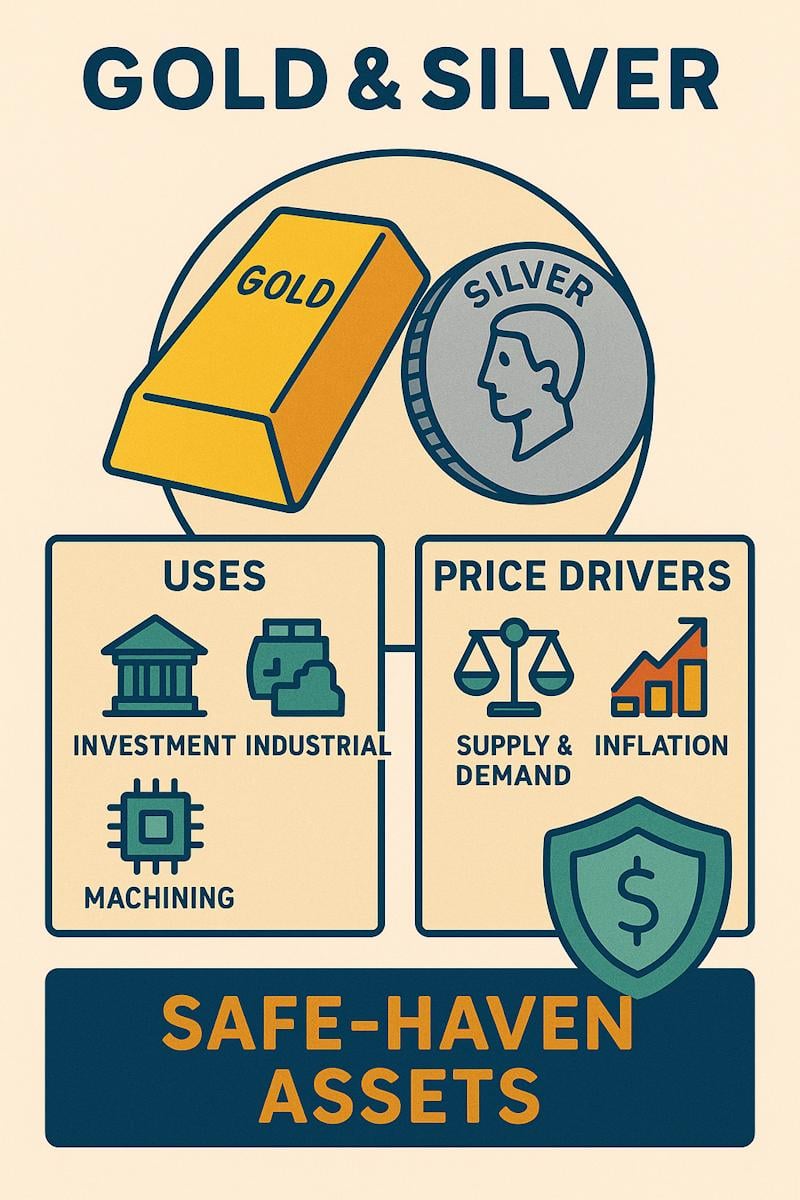
Modern investors use precious metals to diversify portfolios, hedge against inflation, protect against financial instability, and store value in uncertain times. While gold and silver do not generate income, they often perform well when traditional markets struggle. This makes them valuable tools in risk-managed investing.
This lesson explains why precious metals matter, how gold and silver differ, how prices are determined, and the various ways investors can gain exposure—from physical bullion to ETFs and mining stocks.
Why Precious Metals Matter in Investing
Gold and silver play roles that few other assets can replicate. They provide portfolio stability, hedge against inflation, and act as insurance during economic turmoil. These benefits explain why institutional investors, central banks, and individuals hold precious metals as part of long-term wealth strategies.
Key Benefits of Precious Metals
- Inflation hedge: Gold and silver often rise when the cost of living increases.
- Safe-haven asset: During geopolitical or financial crises, precious metals tend to outperform risk assets.
- Diversification: Their price movements differ from stocks and bonds, improving portfolio stability.
- No counterparty risk: Gold and silver are physical assets—unlike stocks, they do not rely on the success of a company.
- Universal value: Precious metals are globally recognized, and demand persists across cultures and nations.
For these reasons, gold in particular is often considered a core component of long-term defensive investing.
Understanding Gold: The World’s Oldest Store of Value
Gold has served as currency, jewelry, and a wealth reserve for thousands of years. Today, it remains one of the most actively traded safe-haven assets worldwide. Central banks collectively hold over 35,000 tonnes of gold, underscoring its importance in global finance.
Why Gold Holds Value
- Scarcity: Gold is difficult and costly to mine.
- Durability: Gold does not corrode or tarnish.
- Universal acceptance: Gold is trusted around the world.
- Historical performance: Gold maintains purchasing power over centuries.
- Financial safe haven: Investors turn to gold during uncertainty.
Gold’s price is influenced by currency movements, interest rates, geopolitical tensions, and overall market sentiment. When investors fear inflation or instability, demand for gold generally increases.
Understanding Silver: A Dual-Purpose Precious Metal
Unlike gold, which is primarily a store of value, silver has both monetary and industrial uses. It is essential for electronics, solar panels, batteries, medical devices, and various manufacturing processes.
This dual role makes silver more volatile than gold. When industrial demand rises, prices may climb rapidly. During economic slowdowns, prices may fall sharply.
Key Characteristics of Silver
- More affordable: Silver costs much less per ounce than gold.
- Higher volatility: Greater price swings create both opportunity and risk.
- Industrial demand: Half of all silver production goes to manufacturing.
- Potential upside: Economic growth can increase silver demand dramatically.
Because of these traits, silver often behaves like a hybrid between a precious metal and an industrial commodity.
How Precious Metal Prices Are Determined
Gold and silver prices are driven by global economic conditions, supply and demand, mining output, and financial market behavior.
Major Price Drivers
- Inflation expectations: Investors buy metals when currency purchasing power is weakening.
- Interest rates: Higher rates may reduce gold demand; lower rates make gold more attractive.
- U.S. dollar strength: Precious metals usually move inversely to the dollar.
- Geopolitical tensions: Wars, sanctions, and instability increase safe-haven demand.
- Industrial demand (mainly for silver): Technology and manufacturing impact silver prices.
- Mining supply: Limited supply supports long-term scarcity value.
Gold typically behaves as a strategic, defensive asset, while silver often reacts more sensitively to economic cycles.

Ways to Invest in Precious Metals
Investors can access gold and silver through several vehicles, each offering different levels of liquidity, cost, risk, and convenience.
1. Physical Bullion (Coins and Bars)
Buying physical gold or silver is the most traditional method. Investors own the metal directly.
- Advantages: No counterparty risk, tangible asset, long-term wealth store.
- Disadvantages: Requires secure storage, higher premiums, and is less liquid than ETFs.
Common formats include 1 oz coins (e.g., American Gold Eagle, Silver Maple Leaf) and investment-grade bullion bars.
2. Gold & Silver ETFs
Precious metal ETFs track the price of gold or silver without requiring investors to store anything. They are highly liquid and easy to trade.
- Advantages: Low fees, high liquidity, ideal for active portfolios.
- Disadvantages: You do not own physical metal; subject to fund management.
For example, a gold ETF may physically store bullion in a vault, giving investors price exposure without delivery.
3. Mining Stocks
Mining companies extract gold and silver. Their earnings often rise when metal prices increase, giving mining stocks leverage to metal prices.
- Pros: Potential for high returns, dividends, and growth opportunities.
- Cons: Business risks unrelated to metal prices (management, costs, debt).
Mining stocks can outperform physical metals in bull markets but fall sharply in downturns.
4. Precious Metal Mutual Funds & ETFs
These funds include multiple mining companies or diversified metal holdings, reducing individual company risk.
5. Futures Contracts
Gold and silver futures allow high-leverage exposure but are risky and unsuitable for beginners. Futures require margin, fast decision-making, and understanding of contract settlement.
To learn how futures work, review our lesson on futures contract mechanics.
Risks of Investing in Precious Metals
Despite their benefits, precious metals come with risks investors must understand:
- No income generation: Unlike stocks or bonds, metals do not pay dividends or interest.
- Price volatility: Silver, especially, can swing sharply.
- Storage and insurance costs: Required for physical metal.
- Market sentiment-driven: Prices may rise or fall based on investor psychology.
- Opportunity cost: During strong bull markets in equities, metals may underperform.
Investors typically use metals as part of a diversified long-term strategy, not as stand-alone high-growth investments.
How Much Gold or Silver Should You Own?
There is no universal answer, but many financial planners recommend allocating 2–10% of a portfolio to precious metals depending on risk tolerance and economic outlook.
Investors focused on inflation hedging may favor gold, while those who believe in industrial growth may allocate more to silver.
Lesson Review Questions
1. Why are gold and silver considered safe-haven assets?
They maintain value during economic or geopolitical stress, offering protection when risk assets fall.
2. What makes silver more volatile than gold?
Silver’s industrial demand exposes it to economic cycles, causing sharper price swings compared to gold.
3. What are the main ways to invest in precious metals?
Physical bullion, ETFs, mining stocks, mutual funds, and futures contracts.
4. Why don’t precious metals generate income?
Gold and silver are commodities, not businesses—they do not produce earnings, dividends, or interest.
5. When do precious metals tend to perform well?
During inflation, economic uncertainty, currency weakness, and geopolitical instability.
Excellent article. As a precious metals investor, I like this article. It is very informative and helpful for new beginners who want to invest in precious metals; your article is good.