
The foreign exchange market, known as Forex or FX, is the largest and most liquid financial market in the world. More than $7 trillion is traded every day as governments, corporations, banks, and investors buy and sell global currencies. The Forex market never sleeps—operating 24 hours per day, five days per week—and plays a critical role in international trade, travel, monetary policy, and economic stability.
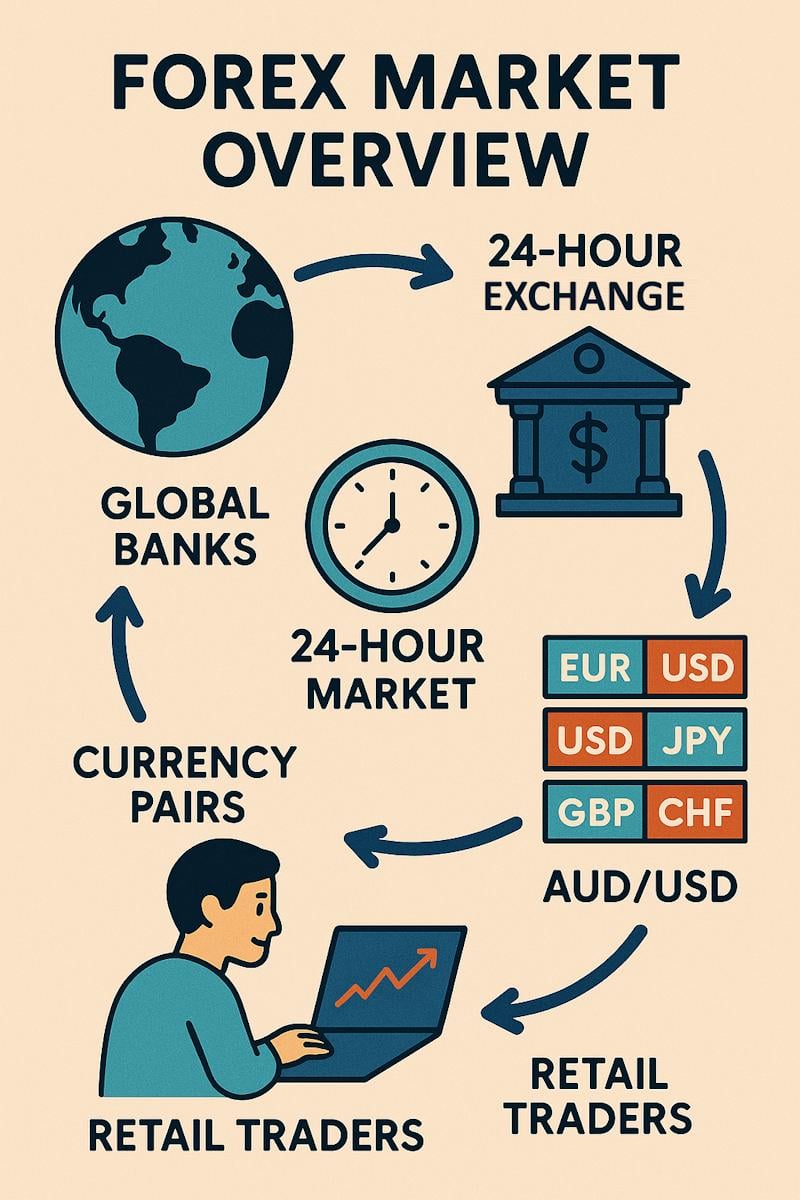
For individual investors, Forex trading offers the potential to profit from fluctuations in exchange rates such as EUR/USD, USD/JPY, or GBP/CHF. However, Forex is also one of the riskiest markets due to extreme leverage, rapid price movements, and a history of unregulated brokers targeting beginners. Understanding both the mechanics and risks is essential before considering any currency exposure.
This lesson explains how the Forex market works, why currencies move, how pairs are quoted, how leverage magnifies both losses and gains, and the major risks investors should avoid. We also explore practical ways to invest in currencies responsibly without resorting to speculative day trading.
What Is the Forex Market?
Forex is a decentralized global marketplace where currencies are exchanged. Unlike stock markets, there is no central exchange. Instead, banks, governments, corporations, and traders interact electronically through networks known as the interbank market.
Who participates in the Forex market?
- Central banks – control currency supply and interest rates
- Commercial banks – execute global payments and trading
- Corporations – hedge currency exposure from international operations
- Institutional investors – manage currency risks in global portfolios
- Retail traders – individuals trading through online Forex brokers
Retail trading is only a tiny fraction of total global currency volume, but it is the area where individual investors often take on excessive risk due to high leverage and fast-moving markets.
How Currency Pairs Work
Forex prices are always quoted in pairs because traders buy one currency while selling another. A pair is written as:
BASE / QUOTE = PRICE
For example:
EUR/USD = 1.10
means that 1 euro (base currency) costs 1.10 U.S. dollars (quote currency).
Major Currency Pairs
- EUR/USD – Euro / U.S. Dollar
- USD/JPY – U.S. Dollar / Japanese Yen
- GBP/USD – British Pound / U.S. Dollar
- USD/CHF – U.S. Dollar / Swiss Franc
- AUD/USD – Australian Dollar / U.USollar
- USD/CAD – U.USollar / Canadian Dollar
These “major pairs” are the most liquid and generally have the lowest transaction costs.
Why Do Currency Prices Move?
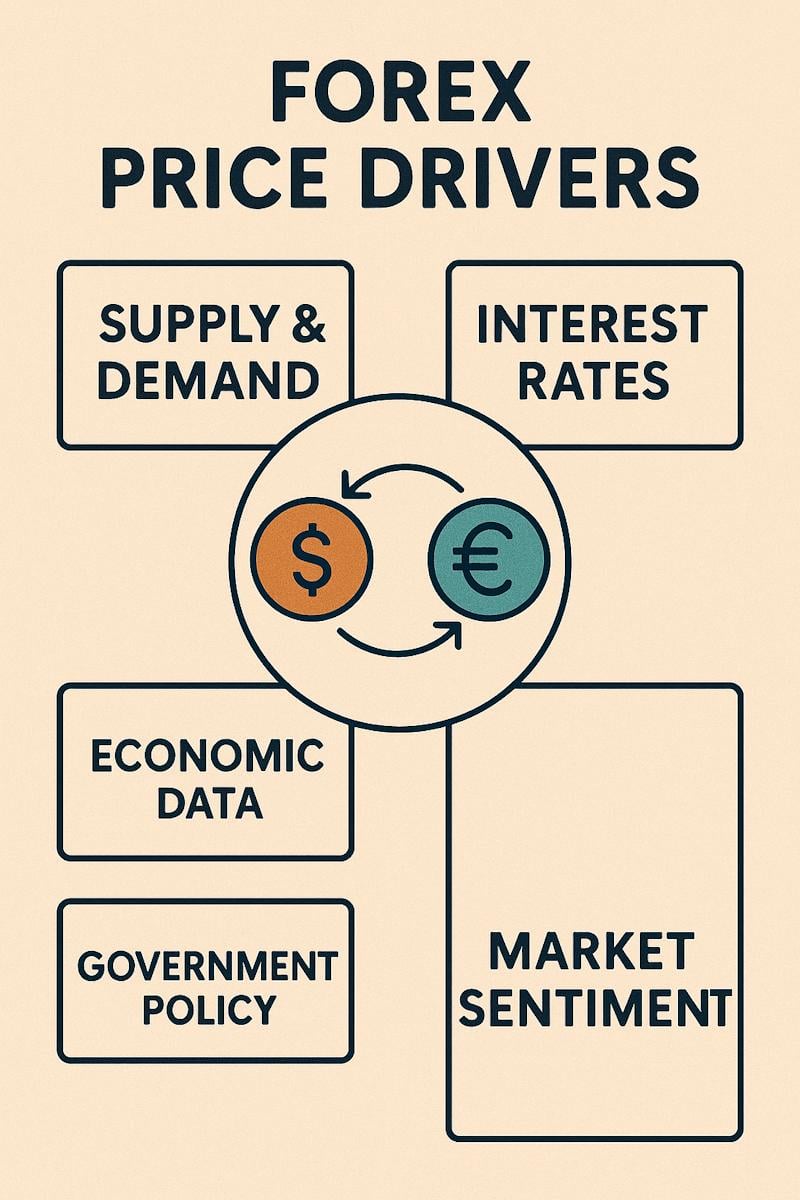
Exchange rates fluctuate based on a variety of economic, political, and financial factors. Currencies reflect the relative strength of national economies.
Key Drivers of Forex Prices
- Interest rates: Higher rates attract foreign capital, strengthening a currency.
- Inflation: High inflation reduces purchasing power, weakening a currency.
- Economic growth: Strong GDP numbers increase investor confidence.
- Political stability: Uncertainty often causes currency depreciation.
- Trade balances: Countries exporting more than they import may see stronger currencies.
- Central bank policy: Monetary tightening strengthens currencies; easing weakens them.
Because so many factors influence Forex prices, predicting short-term movements is extremely difficult—even for professionals.
How Forex Trading Works
Unlike stocks, Forex trades occur in standardized units called “lots.” These are:
- Standard lot: 100,000 units of currency
- Mini lot: 10,000 units
- Micro lot: 1,000 units
Retail brokers allow traders to control these lots using margin and leverage.
What Is Leverage?
Leverage allows traders to control large positions with small deposits. Brokers often advertise leverage of 30:1, 50:1, or even 200:1 in lightly regulated regions.
For example:
With 50:1 leverage, a $1,000 deposit controls $50,000 of currency.
Leverage amplifies both gains and losses. A 2% move against you can wipe out an entire account.
Margin Calls
If the market moves against your position, your broker may issue a margin call. You must deposit more funds, or the broker will close your trade automatically.
This mechanism protects the broker, not the trader.
The Extreme Risks of Forex Trading
Forex trading carries far higher risk than most traditional investments. Many new traders are attracted by leverage and 24-hour markets, but underestimate the difficulty and danger involved.
Why Forex Is Risky for Most Beginners
- High leverage magnifies losses and can eliminate accounts rapidly.
- Fast price movements make stop-loss orders difficult to execute during volatility.
- Emotional decision-making increases the odds of overtrading.
- Scam brokers in unregulated jurisdictions often manipulate prices or refuse withdrawals.
- Lack of transparency—Forex has no central exchange.
- High competition—retail traders compete against banks and hedge funds.
Studies from regulators show most retail Forex traders lose money. Forex trading should never be approached casually or purely for speculation.
How to Avoid Forex Scams
- Use brokers regulated by strong authorities (e.g., FCA, CFTC, ASIC, BaFin).
- Avoid brokers offering leverage above 30:1.
- Beware of guaranteed returns or “copy trading” schemes.
- Never send funds to offshore or unlicensed platforms.
- Research broker reviews and regulatory actions.
Education and regulation are your first lines of defense.
Ways to Invest in Currencies Without Forex Trading
You do not need to trade leveraged Forex contracts to gain exposure to currency movements. Several safer alternatives exist for long-term investors.
1. Currency ETFs
These ETFs track the relative performance of currencies such as the euro, yen, or British pound. They allow investors to diversify internationally without leverage risk.
2. International Stock Funds
Investing in foreign equity funds provides indirect currency exposure because returns are influenced by exchange rates.
3. Foreign Government Bond Funds
These funds generate income while providing exposure to foreign currencies.
4. Multi-Currency Savings or Brokerage Accounts
Some banks allow customers to hold deposits in multiple currencies, capturing long-term currency appreciation without trading.
These methods avoid leveraged speculation while still offering meaningful currency exposure.
Trading Forex Practical Example
The foreign exchange market enables the exchange of one currency for another. Therefore, they are traded in pairs.
Today’s most traded pair is the USD/EUR or the EUR/USD.
Forex Example 1
USD/EUR
In the currency pair above, the first listed currency is the USD; this is known as the base currency, and the value of the base currency is always 1. The EUR, the second currency, is the counter currency.
Forex Example 2
USD/EUR 0.79
In this example, 1 USUSollar can buy 0.79 of a Euro.
Forex Example 3
EUR/USD 1.25
In this example, 1 Euro can buy 1.25 US dollars
Forex Example 4
Day 1 – EUR/USD 1.25
Day 10 – EUR/USD 1.30
On day one, the quote for EUR/Dollar means you can buy 1.25 dollars per euro. By day ten, you could buy 1.3 dollars for each euro. The base currency (Euro) has strengthened against the counter currency (Dollar).
So, if you had purchased euros using dollars on day one and then exchanged the euros back to dollars, you would have realized a profit of 0.05 cents per euro owned. This would equal a gain of 4%.
A key advantage of investing in foreign exchange is that foreign exchange markets are highly liquid and competitive; this means low spreads (the difference between the Bid and Ask price).
A disadvantage is that the price fluctuations are tiny, so retail investors usually use a lot of leverage to make a reasonable profit.
Leverage is when you borrow money to add to your capital to invest. This helps to magnify the gains but also increases the risk exponentially.
If you have $10 to invest and borrow $90, you will have $100. With this capital, you invest and make a 10% profit. Now, your total equity is $110. When you pay back the lender the $90, you are left with $20. This means you have made a 100% profit as you started with $10 and ended with $20.
I would have lost all my money if I had made a 10% loss instead of a 10% gain on my investment. Eventually, this happens to most inexperienced retail investors; they lose all their money.
When Should Investors Consider Currency Exposure?
Most long-term investors gain enough currency exposure through internationally diversified stock or bond funds. However, additional currency exposure may be appropriate when:
- Seeking diversification away from a weakening home currency
- Investing in foreign markets or multinational companies
- Hedging international business or travel expenses
- Protecting against inflation and monetary instability
Is Forex trading legitimate?
Forex trading is a legitimate investment activity, but it has risks. If you’re uncomfortable with the risks, you may want to consider another type of investment.
The biggest problem with trading forex is the high leverage, and the companies offering forex trading can be unregulated. Check with your local financial regulator to establish the company’s legitimacy.
Is Forex trading a scam?
There is no one-size-fits-all answer to this question, as it depends on the individual broker or company. However, forex trading is a legitimate investment activity, and many reputable brokers offer it. However, there are also some scams, so it’s important to research before choosing a broker.
Currency investing is complex and should generally be a small portion of a well-diversified portfolio.
Lesson Review Questions
1. What is the Forex market?
A global marketplace where currencies are exchanged across banks, governments, institutions, and retail traders.
2. Why do currency prices move?
Due to interest rates, inflation, economic growth, political stability, trade balances, and central bank policy.
3. What makes Forex trading so risky?
High leverage, fast price movements, lack of regulation, scam brokers, and competition against professional institutions.
4. What are some safer alternatives to Forex trading?
Currency ETFs, international stock funds, foreign bond funds, and multi-currency bank accounts.
5. Why are currency pairs always quoted as pairs?
Because buying one currency automatically involves selling another, creating a paired exchange rate.