
The stock market rewards patience, research, and discipline. Unfortunately, it also attracts scammers who prey on greed, fear of missing out, and a lack of knowledge. Understanding how stock market scams work is one of the most effective forms of risk management you can practice.
This lesson explains the most common stock market scams, including pump-and-dump schemes, short-and-distort campaigns, Ponzi schemes, and insider trading. You will see how these scams operate, why they are so convincing, and the warning signs that help you avoid them. By the end, you will have a practical checklist to protect yourself and keep your capital working in legitimate investments instead.
Why Stock Market Scams Are So Common
Financial markets are a perfect hunting ground for fraudsters because money, emotion, and uncertainty mix together. When prices move quickly, people naturally want to believe that there is an easy “inside track” to fast profits. Scammers exploit this by offering:
- Unrealistic returns with little or no risk.
- Urgency – “limited spots,” “act today,” “before the news hits.”
- Secrecy or “exclusive access” you are told not to share.
- Complex jargon that sounds professional but hides simple fraud.
- Unregulated platforms or offshore accounts that are hard to trace.
Your first line of defense is mindset. Legitimate investing is rarely urgent or secret. If an opportunity is pitched as guaranteed, effortless, or private, assume it is dangerous until proven otherwise.
Pump-and-Dump Scams & Penny Stock Newsletters
One of the most common stock market scams is the pump-and-dump. It usually targets small, thinly traded “microcap” or OTC and pink sheet stocks that are easy to manipulate.
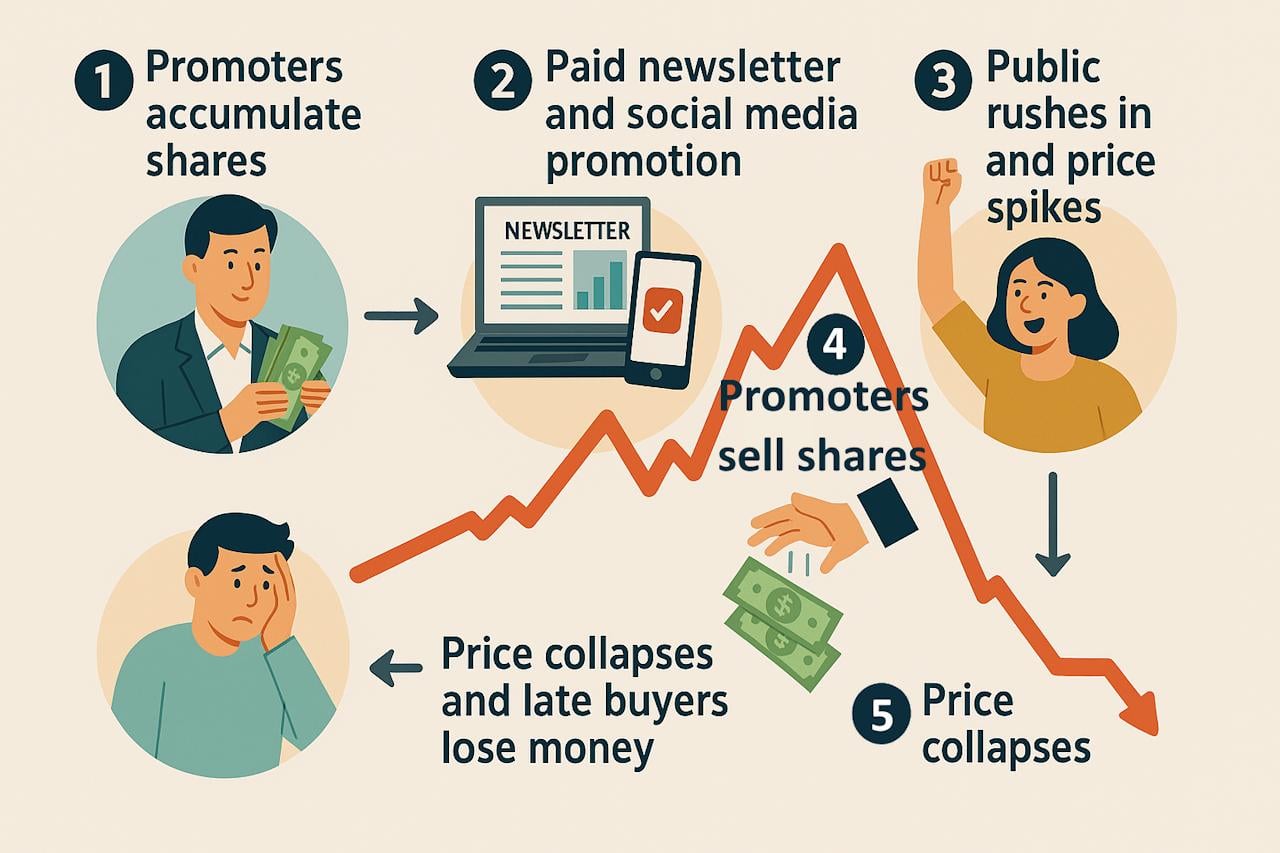
How a Pump-and-Dump Works
- Step 1 – Accumulate: Fraudsters quietly buy a large position in a low-volume stock at a very low price.
- Step 2 – Promote: They “pump” the stock by blasting out emails, social media posts, or paid newsletters promising huge, quick gains.
- Step 3 – Buying frenzy: New investors, lured by the hype and charts showing a rising price, rush in and push the stock even higher.
- Step 4 – Dump: The promoters sell (“dump”) their shares into the buying wave at inflated prices.
- Step 5 – Collapse: Once the promotion stops, demand dries up. The price crashes back down, and late buyers are left with large losses.
Because these scams usually involve small, illiquid stocks, you may not be able to exit quickly even if you see the price turning. The basic rule: if your only reason for buying is a promotional message, you are likely the exit liquidity for someone else.
How “Hot Stock” Newsletters Really Make Money
Many penny stock and “hot stock” newsletters disclose, often in small print, that they are paid to promote certain companies, sometimes in shares instead of cash. That creates a direct conflict of interest:
- The company issues free or discounted shares to the newsletter publisher.
- The newsletter features the company as a “top pick” with eye-catching claims.
- Subscribers buy the stock, pushing up the price and trading volume.
- The publisher sells the free or cheap shares into the demand.
- When the buying pressure stops, the price sinks back, often below the starting level.
The fine print often says the publisher “may sell shares while the recommendation is being distributed” or that the service is “for entertainment only.” Legally, that protects the promoter; practically, it leaves subscribers unprotected.
Any time you see a recommendation for a tiny stock together with claims of 100%, 500%, or 1,000% short-term gains, treat it as a red flag. For serious long-term investors, your time and capital are far better spent on high-quality companies and diversified funds than on penny stock promotions.
Short-and-Distort: The Evil Twin of Pump-and-Dump
Short-and-distort scams are the mirror image of pump-and-dump. Instead of hyping a stock to sell at a higher price, the fraudsters short-sell first and then try to crash the stock with negative hype.
In a legitimate short sale, a trader borrows shares, sells them, and hopes to buy them back cheaper later. In a short-and-distort scam, the trader goes further and actively spreads misleading or false negative information to push the price down.
Red Flags for Short-and-Distort Campaigns
- A sudden wave of anonymous posts or emails making extreme claims about a company’s fraud or imminent bankruptcy.
- Links to “research reports” or websites with no clear author, credentials, or regulatory disclosures.
- Recycled or exaggerated news is framed as a brand-new catastrophe.
- Sharp price drops on heavy volume shortly after the negative campaign begins.
This does not mean every critical article or short thesis is a scam. Short-sellers sometimes uncover real fraud, as happened in several historic accounting scandals. The key is whether the criticism is supported by verifiable facts and comes from identifiable, regulated professionals, or whether it is anonymous, emotional, and timed to a sharp price move.
If you own a stock that suddenly comes under attack, avoid panic. Go back to your investment thesis, read the company’s filings, and consult reliable sources. If the criticism is vague and impossible to verify, it may be part of a manipulation campaign rather than a genuine warning.
Other Common Stock Market and Investment Scams
While pump-and-dump and short-and-distort scams focus on listed stocks, many other frauds target investors more broadly. It is crucial to recognize these patterns, especially when they intersect with stock trading, forex, or crypto platforms.
- Ponzi schemes: “Returns” are paid to earlier investors using money from new investors, not from real profits. The scheme collapses when new money dries up.
- Pyramid and referral schemes: You are rewarded mainly for recruiting other participants, not for selling a real product or service.
- Unlicensed “account managers” or signal sellers: Strangers on social media offer to trade your brokerage account or sell guaranteed winning signals.
- Fake online trading platforms: A professional-looking website shows big profits on a dashboard but blocks withdrawals or demands extra fees before you can “cash out.”
- Insider trading rings: People claim to have confidential information about upcoming mergers, earnings surprises, or regulatory decisions. Trading on real inside information is illegal; trading on fake “inside” tips is simply reckless.
- Romance or “relationship” investment scams: A person builds a personal relationship online, then slowly steers conversations toward a “sure thing” investment opportunity.
These scams often mix together. For example, a romance scammer may direct victims to deposit money with an unregulated crypto or CFD platform that shows fake gains and then quietly disappears.
A Practical Checklist to Avoid Investment Scams
You do not need to memorize every type of scam. Instead, train yourself to notice recurring warning signs and develop habits that keep you safe. Combine this lesson with your earlier work on managing financial risk to build a robust defense.

10 Common Red Flags
- Promise of high or guaranteed returns with little or no risk.
- Pressure to act immediately or “before the opportunity closes.”
- Unsolicited contact by phone, email, direct message, or text.
- Requests to send money to personal accounts or unfamiliar payment services.
- Avoidance of regulated brokers in favor of obscure or offshore platforms.
- Lack of clear information about the company’s financials, products, or management.
- Complicated explanations that never quite answer your questions.
- Emphasis on recruiting others or earning referral bonuses instead of investing.
- Instructions to keep the offer secret or not talk to family, friends, or your bank.
- Inconsistent, changing stories when you ask for documentation.
5 Habits That Keep You Safer
- Verify registration: Check that brokers and investment professionals are registered with the appropriate regulator in your country.
- Use reputable platforms: Stick to well-known brokers and exchanges with clear fee schedules and customer support.
- Do your own research: Cross-check any tip against company filings, multiple news sources, and independent analysis.
- Slow down: Never invest money on the same day you first hear about an opportunity.
- Set a personal rule: If something sounds too good to be true, you walk away and instead focus on your long-term plan using solid stock market investing principles.
Real-World Scandals and What They Teach Us
Large, well-known companies have also been at the center of major market scandals. Studying them helps you understand how fraud can grow inside respected institutions and why independent thinking matters.
Enron: Accounting Tricks and Hidden Debt
Enron was once celebrated as an innovative energy company. Behind the scenes, it used complex off-balance-sheet entities and aggressive accounting to hide huge debts and exaggerate profits. When the truth emerged in 2001, Enron collapsed into bankruptcy, wiping out shareholders’ and employees’ retirement savings. The lesson: even “blue chip” names can be hiding risk if their business model is overly complex and earnings seem too smooth and consistent.
WorldCom: Inflated Profits
WorldCom, a large telecommunications company, boosted its reported earnings by classifying routine expenses as long-term investments. This accounting fraud artificially inflated profit figures for years. When internal auditors uncovered the scheme, the company collapsed, and executives went to prison. The lesson: watch out for companies that consistently beat expectations in troubled industries without clear operational reasons.
Tyco: Corporate Looting
At Tyco International, senior executives treated the company almost like a personal bank account, approving extravagant bonuses, hidden perks, and questionable acquisitions. Once exposed, the scandal led to criminal convictions and major governance reforms. The lesson: poor corporate governance and weak boards can allow even large companies to be abused from the inside.
Bernard Madoff: The Classic Ponzi Scheme
Bernard Madoff ran one of the largest Ponzi schemes in history. For years, he reported steady, positive returns that seemed to defy market volatility. In reality, there were no real investments behind the statements; earlier investors were paid with money from new ones. When withdrawals surged during the 2008 financial crisis, the scheme collapsed. The lesson: long-term returns that are smooth, high, and “never down” are a major red flag, no matter how respected the manager appears.
How This Lesson Fits into the Course
You have now seen how stock market scams manipulate prices, exploit emotions, and hide behind complexity. By learning to recognize red flags and building disciplined habits, you significantly reduce the chance of becoming a victim.
In earlier lessons, you focused on clarifying your goals, understanding market booms and crashes, and managing risk. This lesson adds a layer of defense against fraud and manipulation so that your long-term plan is not derailed by bad actors.
Next, you will explore investing in Mutual Funds and ETFs. These pooled investments are powerful tools for diversification, but they also come with their own fee structures and risks. Understanding those trade-offs will help you build a portfolio that is both resilient and aligned with your objectives.
Lesson Review Questions
1. What is the core difference between a pump-and-dump and a legitimate stock recommendation?
In a pump-and-dump, promoters secretly own large positions and deliberately spread exaggerated or false claims to inflate the price so they can sell into the buying frenzy. Their profit comes from dumping shares on others. In a legitimate recommendation, conflicts of interest are fully disclosed, claims are backed by evidence, and the goal is long-term analysis, not a quick exit at your expense.
2. How does a short-and-distort scam try to profit from negative information?
In a short-and-distort, scammers first take short positions in a stock and then attempt to push the price down by spreading misleading or false negative stories. If they succeed in causing panic selling, they can buy back the shares at a much lower price, closing their short positions for a profit while long-term investors suffer losses.
3. Which warning signs should make you walk away from an investment immediately?
Major red flags include guaranteed or unusually high returns, pressure to invest right now, requests to send money to unfamiliar accounts, secrecy about the opportunity, and difficulty verifying the promoter’s registration or the company’s financial information. Any combination of these signs is enough reason to walk away and focus on regulated, transparent investments instead.
4. What lessons do scandals like Enron or Madoff teach a long-term investor?
These scandals show that even famous companies or respected managers can hide serious problems. Complex, hard-to-understand business models, smooth “too good to be true” performance, and weak corporate governance all increase risk. A long-term investor should demand clear financial reporting, diversified holdings, realistic expectations, and independent verification instead of relying on reputation alone.
5. How can you use this lesson together with risk management to build a safer investment plan?
You can combine scam awareness with risk management by avoiding high-risk promotions entirely, diversifying across quality assets, using only regulated brokers, and setting clear rules for research, position sizing, and exits. This reduces both normal market risk and fraud risk, helping you stay invested in legitimate opportunities for the long term.