
MetaTrader (MT4/MT5) is a broker-distributed trading terminal that dominates global FX/CFD workflows and remains a default for algorithmic trading via Expert Advisors (EAs).
In this lab audit, MetaTrader scores well on execution ecosystem depth and automation potential. Still, it underperforms in native-market scanning breadth and built-in pattern depth relative to research-first scanners or AI-native platforms.
The key takeaway is simple: MetaTrader is strongest when you treat it as a fast execution + automation shell—and you pair it with external research/scanning inputs (or broker plugins) to feed ideas into EAs and alerts.
Composite Lab Performance Test Score
MetaTrader’s CLPS of A 4.19 lands essentially at the dataset median (4.21)—a “strong overall” result driven by execution + automation infrastructure, not by research UX polish. Multiple best-in-dataset style capabilities prop up the score:
| Test | Tier | Score | Median |
|---|---|---|---|
| Lab Test Composite Score (CLPS) | A | 4.19 | 4.21 |
| Composite Lab Performance Score (CLPS) Overall Test Winners | TrendSpider 4.72 | Trade Ideas 4.52 |
Broker Connectivity & Ecosystem Depth (5.0), Community Utility (5.0), and custom indicator coding (5.0)—which is exactly what you expect from a broker-distributed terminal built around Expert Advisors (EAs) and the MQL ecosystem.
Where CLPS doesn’t inflate is the “discovery stack”: scanning depth/speed is weak (0.88) and native pattern depth is limited (my audit notes: it often relies on add-ons like Autochartist). In other words: MetaTrader is a powerhouse for execution + automation, but not a modern all-in-one research workstation.
The Composite Lab Performance Score (CLPS) is the single “headline” benchmark in my Lab Test framework. It summarizes overall platform performance across the full rubric, including the 5× Superpower boost for the tool’s strongest verified capabilities.
Benchmarks (High / Median / Low):
- Best (High): AAA 4.75
- Median: A 4.21
- Worst (Low): C 2.93
Benchmarked Lab Scores
| Test | Tier | Score | Average (Median) |
|---|---|---|---|
| Lab Test Composite Score (CLPS) | A | 4.19 | 4.21 |
| Pricing Index | AAA | 5.00 | 4.29 |
| Value Score | C | 2.48 | 2.82 |
| Speed & Ease of Use | A | 4.00 | 4.50 |
| Chart Analysis Depth Index | C | 2.72 | 3.17 |
| Chart Pattern Depth & Accuracy | C | 2.55 | 2.73 |
| Scanning Performance | C | 0.88 | 3.38 |
| Backtesting Performance | B | 3.00 | 3.38 |
| Trading Bot & Auto-Trading Reliability | B | 3.50 | 2.50 |
| AI & Algo Index | C | 2.00 | 2.00 |
| Alert Speed | B | 3.67 | 3.67 |
| Trade Signal Quality | C | 0.00 | 0.00 |
| Broker Connectivity & Ecosystem Depth | AAA | 5.00 | 2.00 |
| Portfolio Tool Performance | C | 2.90 | 2.80 |
| Financial News Speed & Depth | B | 3.00 | 2.80 |
| Community Utility Index (CUI) | AAA | 5.00 | 3.25 |
| Support Infrastructure & SLA Audit | C | 1.00 | 3.75 |
Reasons to Consider MetaTrader
- You want automation that can actually execute. MetaTrader is built around Expert Advisors (EAs) and scored 3.50 for Trading Bot & Auto-Trading Reliability, with Strategy/Bot Sophistication = 2.0 and Automation Path = 1.5 (EA-driven workflow).
- You need deep broker connectivity. It’s a clear ecosystem winner: Broker Connectivity & Ecosystem Depth = 5.00, with Live Trading = 5, Broker Integration = 5, and broad Asset & Data Coverage = 5 (broker/infrastructure dependent, but the ecosystem depth is real).
- You care about speed and multi-chart responsiveness. Speed & Ease of Use = 4.00, with Multi-Chart Latency = 50ms and Multimonitor Chart Speed = 4.5—a strong “terminal performance” profile.
- You want custom indicators and coded strategies. Charting “style variety” is limited, but Custom Indicator Coding = 5.0 and Flexible Coding Backtesting = 5.0—this is a developer’s trading workstation, not a visual-social charting network.
- You want the largest automation community. Active Community Size = 5.0 and Quality of Community Contribution = 5.0.
Reasons to Avoid MetaTrader
- You rely on scanning as your main edge. Scanning Performance = 0.88 is a structural weakness: Scanner Performance = 2500ms, Criteria Count = 60, and Criteria Points = 0.75. If you want fast multi-factor discovery across large universes, you’ll need an external scanner.
- You want a modern “research platform” experience. Value is modest (Value Score = 2.48) because MetaTrader is not designed as a full research stack. It’s an execution + automation shell.
- You want deep built-in chart pattern tooling. Pattern depth is shallow (Pattern Recognition Depth ≈ 0.86, Total Patterns 26). Accuracy is decent (85%, 4.25 points), but the library is not rich unless you add plugins (My audit notes: dependence on Autochartist).
- You need predictable vendor-level support. Support Infrastructure & SLA = 1.0: My audit notes explicitly state that retail support is broker-dependent and that there is no unified MetaTrader developer SLA.
- You want “AI-native” decisioning. AI Layer = 0 and AI & Algo Index = 2.0 (algo depth, yes, but no inherent AI reasoning layer). Any AI is typically external tooling integrated into your workflow—not a default platform capability.
Verdict
MetaTrader is best understood as a high-performance execution and automation terminal—not a scanning-first research platform. Your lab scores make that unambiguous:
- Strengths: ecosystem depth (5.0), automation reliability (3.5), speed/multi-chart responsiveness (50ms latency; 4.0 speed index), and an unmatched EA/indicator community (CUI 5.0).
- Tradeoffs: weak scanning (0.88), limited native pattern depth (2.55 overall; shallow pattern library), and broker-dependent support (1.0).
If your edge is automation + execution, MetaTrader is a strong “core terminal.” If your edge is idea discovery (scanning), research depth, and platform-level support guarantees, use MetaTrader as the execution layer behind a dedicated scanner/research stack.

In Context
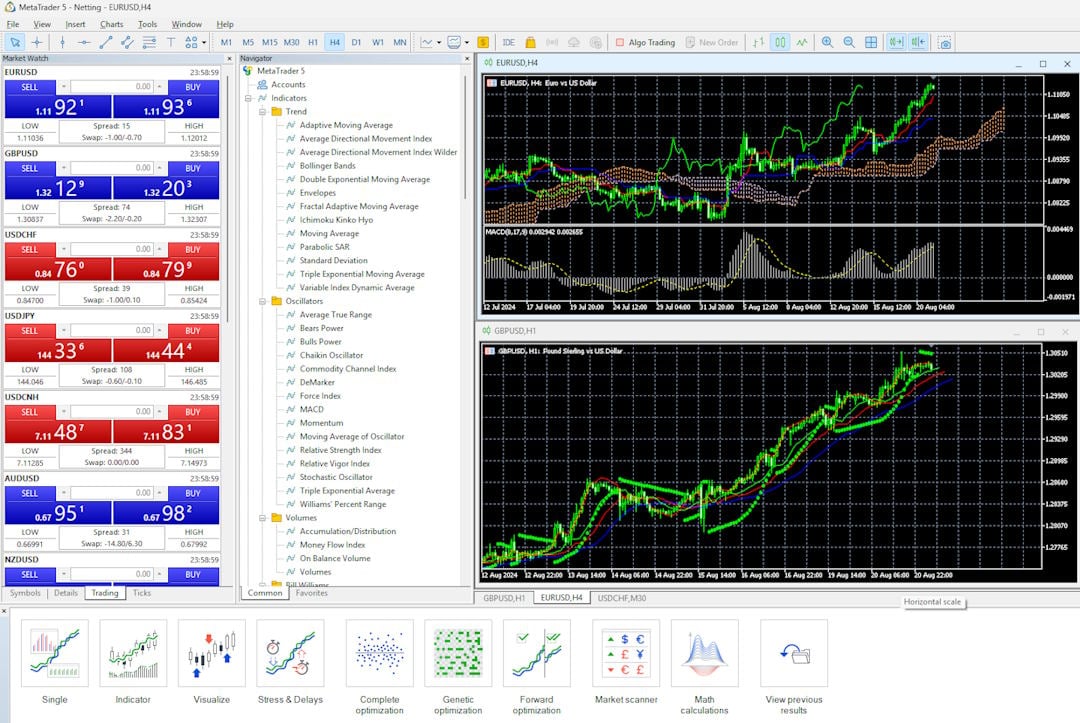
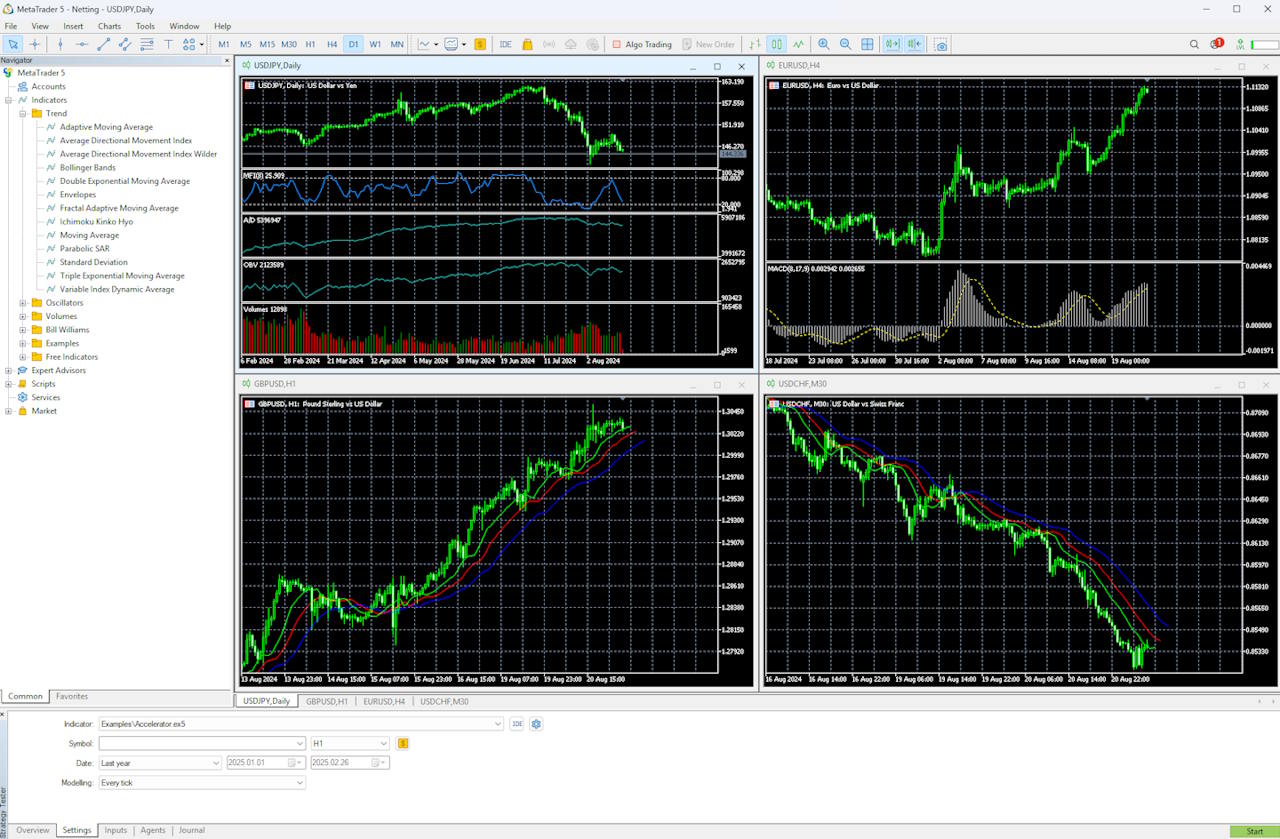
MetaTrader’s “shape” differs from that of most retail research platforms. It’s primarily a broker-delivered terminal optimized for order placement, charts, automation hooks, and add-ons—not a unified research stack. That explains why the lab scores show elite ecosystem depth and strong automation potential, while scanning and native “idea generation” lag.
For many traders, that is ideal: you source setups elsewhere, then use MT4/MT5 as the execution and automation layer, where EAs manage rules, risk, and speed.
MetaTrader Software Features
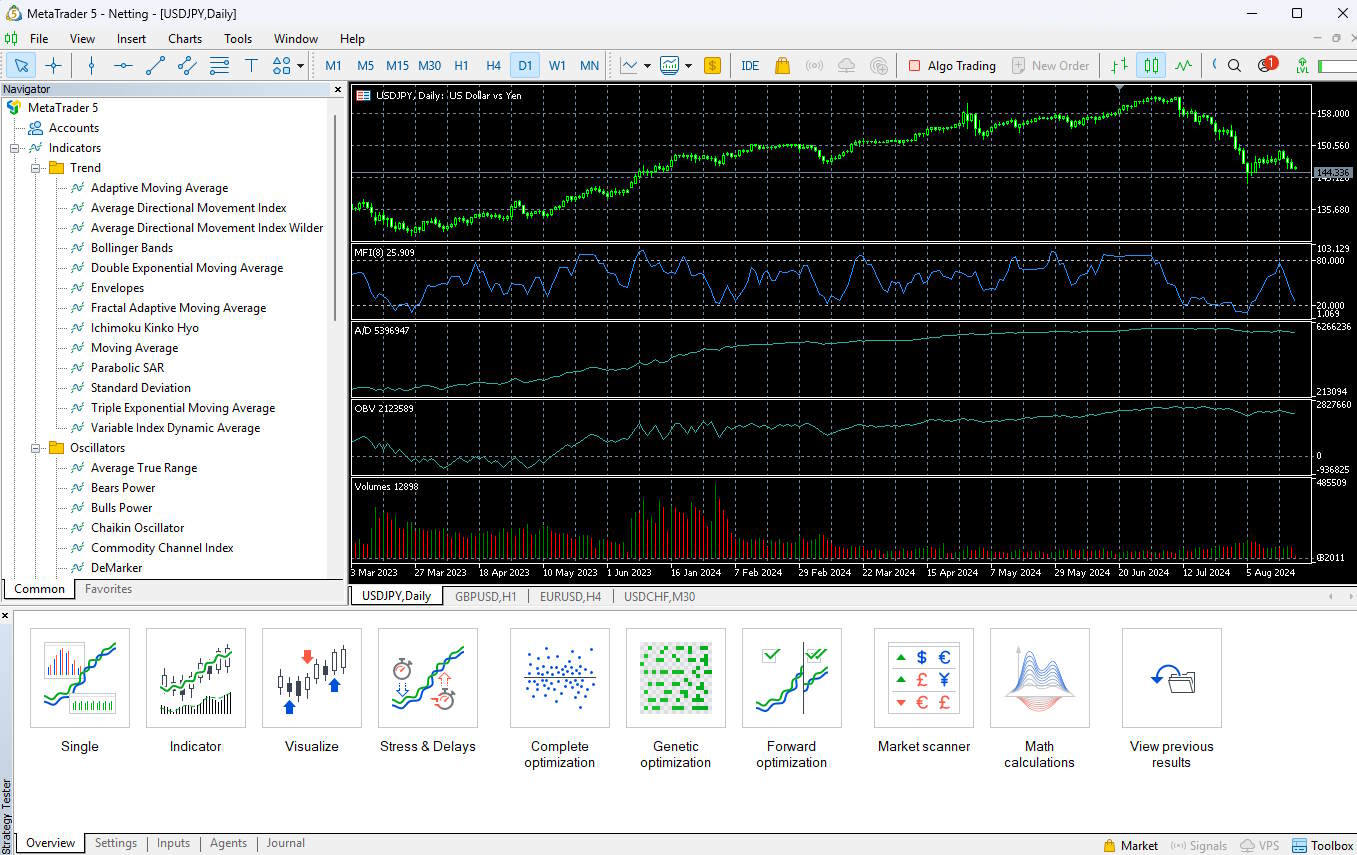
MetaTrader 5 centers on algorithmic trading and extensibility: traders can build Expert Advisors, indicators, and scripts using the MQL5 environment and distribute or purchase them via the MetaTrader Market. It also supports strategy testing/reporting workflows (including test reports and optimization outputs) that align with our audited backtesting score.
For copy workflows, the MQL5 Signals service enables follow/copy behavior directly through the ecosystem. Advanced users can even integrate ML models through ONNX in MQL5 programs—powerful, but developer-level rather than a consumer “AI copilot.”
Pricing Index
My audit notes: MetaTrader is free but requires a brokerage account and is broker-distributed; therefore, pricing is excluded from direct platform-subscription comparisons.
| Measure | MetaTrader | Median | High | Low |
|---|---|---|---|---|
| Cost-per-day | $0 | 2.74 | 9.99 | 0.74 |
| $ per feature | $0 | 5.95 | 23.37 | 1.94 |
| Effective Monthly Cost (EMC) | $0 | 83.32 | 303.87 | 22.50 |
MetaTrader doesn’t price like a typical SaaS trading tool. Your broker usually provides the terminal, and the real “cost” is embedded in the brokerage relationship: spreads/commissions, data quality, execution model, and any broker add-ons.
That’s why pricing is excluded here—comparing a broker-delivered terminal to subscription research platforms creates false conclusions. The practical decision is: pick the broker you trust, then treat MetaTrader as the execution/automation interface sitting on top of that broker infrastructure.
Value Score
MetaTrader’s value is highly situational: if your goal is execution + automation, it can be excellent.
| Measure | MetaTrader | Median | High | Low |
|---|---|---|---|---|
| Value Score | 2.48 | 2.82 | 4.37 | 1.70 |
| Value Rank | 1.75 | 2.50 | 5.00 | 1.00 |
| Feature Quality | 2.79 | 2.97 | 4.16 | 2.00 |
| Feature Breadth (count) | 12 | 12 | 17 | 9 |
| Feature Depth | 2.00 | 3.00 | 4.75 | 1.00 |
| Device Support Depth | 2.00 | 2.00 | 5.00 | 1.00 |
| Value Score Test Winners | TrendSpider 4.20 | Trade Ideas 4.05 |
If your goal is a fully integrated research suite, it can feel thin without external tooling. The lab score reflects that split: breadth is decent (core trading, charting, scripting), but “depth” depends on how far you go into EAs, plugins, and broker integrations.
In other words: MetaTrader’s value comes from being an extensible shell—powerful in expert hands, less compelling as a standalone research platform.
Speed & Ease of Use
MetaTrader feels “fast” because it’s a lightweight native terminal designed for high-frequency user actions: quick chart loads, rapid symbol switching, and multi-chart workflows. This is evident in the latency results and multimonitor performance.
| Measure | MetaTrader | Median | High | Low |
|---|---|---|---|---|
| Speed & Use Index | 4.00 | 4.50 | 5.00 | 3.30 |
| Time to Chart Speed (sec) | 2.10 | 4.70 | 17.03 | 1.60 |
| Time to Chart Performance | 4.50 | 4.50 | 5.00 | 3.00 |
| Multi-Chart Latency (ms) | 50 | 209 | 667 | 10 |
| Multimonitor Chart Speed | 4.50 | 3.50 | 5.00 | 0.00 |
| 3-Click Rule Test (clicks) | 5 | 3 | 6 | 2 |
| 3-Click Ease of Use | 3.00 | 3.00 | 5.00 | 2.00 |
| Speed & Ease of Use Test Winners | Stock Rover 5.00 | Seeking Alpha 5.00 | TrendSpider 4.67 |
The tradeoff is usability depth: workflows are optimized for experienced trading behaviors rather than guided discovery. For new users, it can feel dense; for FX-first traders, it’s extremely efficient.
Net: strong operational speed, average ease-of-use for beginners, and excellent “muscle memory” once configured.
Chart Analysis Depth Index
| Measure | MetaTrader | Median | High | Low |
|---|---|---|---|---|
| Chart Analysis Depth Index | 2.72 | 3.17 | 5.00 | 0.50 |
| Chart Types (count) | 3 | 10 | 38 | 1 |
| Chart Depth | 0.90 | 3.00 | 5.00 | 0.30 |
| Indicators (count) | 90 | 116 | 400 | 0 |
| Indicator Depth | 2.25 | 2.90 | 5.00 | 0.00 |
| Custom Indicator Coding | 5.00 | 0.00 | 5.00 | 0.00 |
My audit notes: Global standard for FX; uses MQL4/MQL5 languages.
MetaTrader’s charting depth is less about the number of native chart styles and more about extensibility. Out of the box, chart variety is limited, but indicator availability is solid and—critically—custom coding is first-class. That’s why this category lands mid-pack: basic visuals aren’t the point; programmable indicators and EAs are.
If you want dozens of chart “types” and rich visual layouts, other platforms win. If you want programmable signals/visual studies tied to automated execution logic, MetaTrader’s MQL environment becomes the differentiator.
Chart Pattern Depth & Accuracy
| Measure | MetaTrader | Median | High | Low |
|---|---|---|---|---|
| Pattern Efficacy & Accuracy | 2.55 | 2.73 | 4.88 | 0.00 |
| Total Patterns (count) | 26 | 57.5 | 226 | 0 |
| Pattern Depth | 0.86 | 1.90 | 5.00 | 0.00 |
| Candle Patterns (count) | 10 | 22.5 | 172 | 0 |
| Price/Trend Patterns (count) | 16 | 24 | 54 | 0 |
| Accuracy (%) | 85 | 89.5 | 95 | 0 |
| Accuracy Points | 4.25 | 4.48 | 4.75 | 0.00 |
| Chart Pattern Recognition & Accuracy Test Winners | TrendSpider 4.88 | Trade Ideas 4.62 |
My audit notes: Native patterns are basic; they rely on the Autochartist plugin.
MetaTrader can be accurate for the patterns it supports, but its native pattern library is shallow; it is not a pattern-recognition platform by design. Traders who depend on pattern automation typically extend MT4/MT5 using broker plugins (e.g., Autochartist) or EAs that implement pattern logic directly.
That explains the profile: a respectable accuracy score and a shallow depth score. For most serious users, MetaTrader is where pattern signals are consumed and executed, not where pattern discovery is generated at scale.
Scanning Performance
This is MetaTrader’s weakest area of “idea generation” in the lab. It’s not built to scan an equity universe like the S&P 500 with deep multi-factor criteria; it’s built to trade what your broker delivers, quickly, with automation.
| Measure | MetaTrader | Median | High | Low |
|---|---|---|---|---|
| Scanning Latency & Depth | 0.88 | 3.38 | 5.00 | 0.80 |
| Scanner Performance (ms) | 2500 | 300 | 2500 | 7 |
| Scanning Speed Points | 1.00 | 4.00 | 5.00 | 1.00 |
| Scanner Auto-Refresh (sec) | — | 1 | 60 | 0 |
| Criteria Count | 60 | 200 | 675 | 30 |
| Criteria Points | 0.75 | 2.50 | 5.00 | 0.38 |
| Custom Code Scanning | — | 5.00 | 5.00 | 0.00 |
| Scanning Performance Test Winners | Stock Rover 5.00 | TrendSpider 4.67 |
Yes, you can create logic in EAs, but that’s not the same as a purpose-built market scanner with hundreds of criteria and rapid iteration. The result: slow scan latency, limited breadth of criteria, and a workflow that pushes scanning upstream into external tools (then routes signals into MT execution).
Backtesting Performance
MetaTrader’s backtesting is strongest when you accept the core design: backtesting is for coded strategies (EAs), not no-code portfolio simulations.
| Measure | MetaTrader | Median | High | Low |
|---|---|---|---|---|
| Quantitative Backtesting Fidelity | 3.00 | 3.38 | 4.90 | 0.00 |
| Backtesting Speed (ms) | 1500 | 302 | 6000 | 7 |
| Backtesting Speed Points | 3.50 | 4.25 | 5.00 | 0.00 |
| No Coding Required | 0.00 | 5.00 | 5.00 | 0.00 |
| Flexible Coding Backtesting | 5.00 | 5.00 | 5.00 | 0.00 |
| Report Quality (%) | 70 | 70 | 100 | 0 |
| Report Quality Points | 3.50 | 2.25 | 5.00 | 0.00 |
| Multi-Stock Basket Backtesting | 0.00 | 5.00 | 5.00 | 0.00 |
| Backtesting Performance Test Winners | Optuma 4.94 | TrendSpider 4.88 | MetaStock 4.81 |
The lab reflects that—excellent flexibility for coders, decent reporting, but no true “zero-code” workflow, and no multi-stock basket backtest suite like dedicated quant platforms. For FX algorithm developers, it’s a productive environment; for equity investors who want portfolio-level factor testing, it’s the wrong tool.
MetaTrader publishes detailed Strategy Tester reporting/testing workflows, consistent with this profile.
Trading Bot & Auto-Trading Reliability
My audit notes: Purpose-built for automated trading via “trading robots”/Expert Advisors, but no platform-wide SLA indicated.
This is where MetaTrader earns its reputation. The platform is explicitly designed for automation (EAs/robots) and supports sophisticated strategy logic, which is why it scores well on bot reliability versus typical retail charting tools.
| Measure | MetaTrader | Median | High | Low |
|---|---|---|---|---|
| Automated Execution & Bot Reliability | 3.50 | 2.50 | 4.50 | 1.50 |
| Automation Path | 1.50 | 1.00 | 2.00 | 1.00 |
| Strategy/Bot Sophistication | 2.00 | 1.50 | 2.00 | 1.00 |
| Operational Assurance | 0.00 | 0.00 | 1.00 | 0.00 |
| Bot & Auto-Trading Reliability Test Winners | TrendSpider 4.50 | Trade Ideas 4.00 | Tickeron 4.00 |
The limiting factor isn’t the coding environment—it’s operational assurance: uptime, execution quality, and incident handling are broker-dependent rather than guaranteed by a single SaaS vendor. Practically: MetaTrader is an automation engine; reliability is ultimately governed by broker infrastructure, hosting, and your EA’s engineering discipline.
AI & Algo Index
My audit notes: Best-in-class automated trading ecosystem (robots/EAs), but “AI reasoning” is not an inherent platform guarantee.
MetaTrader is highly algorithmic but not inherently AI-native. The core strength is deterministic rule execution (EAs), not embedded AI decisioning. That’s why the algorithm depth is solid while the AI layer remains zero in this scoring model.
| Measure | MetaTrader | Median | High | Low |
|---|---|---|---|---|
| AI & Algo Index | 2.00 | 2.00 | 5.00 | 1.00 |
| Algo Depth | 1.50 | 1.50 | 2.00 | 1.00 |
| AI Layer | 0.00 | 0.00 | 2.00 | 0.00 |
| Transparency | 0.50 | 1.00 | 1.00 | 0.00 |
| AI & Algo Index Test Winners | TrendSpider 5.00 | Trade Ideas 4.50 |
Where MetaTrader gets interesting is extensibility: developers can integrate advanced logic (including ML via ONNX in MQL5), but that’s a developer implementation choice, not a default user-facing feature. For most users, MetaTrader is an automation shell—AI depends on the EA/plugin ecosystem you attach to it.
Alert Speed
MetaTrader alerts are good at what they need to do: push terminal-defined conditions into notifications quickly enough for active trading. The lab scores reflect strong latency rating and high concurrency assumptions, but fewer “streams” than platforms that expose webhooks and richer automation plumbing by default.
| Measure | MetaTrader | Median | High | Low |
|---|---|---|---|---|
| Alert Speed Index | 3.67 | 3.67 | 4.67 | 2.33 |
| Concurrent Alerts | 5.00 | 5.00 | 5.00 | 5.00 |
| Concurrent Alert Count | Unlimited | 875 | 2000 | 400 |
| Alert Streams Richness | 2.00 | 2.00 | 5.00 | 1.00 |
| Alert Speed Rating | 4.00 | 3.00 | 5.00 | 1.00 |
| AI & Algo Index Test Winners | TrendSpider 5.00 | Trade Ideas 4.50 |
In practice, serious MetaTrader users often route alerts through EAs and broker infrastructure rather than relying on complex multi-channel alert stacks. If you need webhooks, integrations, and alert-as-API patterns, these are typically addressed through third-party bridges around MT rather than within MT.
Trade Signal Quality
MetaTrader is not a “signal provider” in the same way that research and recommendation platforms are. It’s an execution and automation environment. Signals can exist inside EAs, paid indicators, broker plugins, or copied strategies—but they’re not a standardized, audited, platform-native signal product.
| Measure | MetaTrader | Median | High | Low |
|---|---|---|---|---|
| Signal Alpha & Predictive Efficacy | 0.00 | 0.00 | 5.00 | 0.00 |
| Trade Signal Quality Test Winners | Trade Ideas 5.00 | Seeking Alpha 5.00 | Motley Fool 5.00 |
That’s why the lab score here is zero: there is no consistent, first-party, independently auditable trade-signal engine baked into MetaTrader as a universal feature. MetaTrader is where signals get executed, not where they’re guaranteed.
Broker Connectivity & Ecosystem Depth
This is MetaTrader’s “home turf.” The platform exists to connect traders to brokers on a global scale, so it naturally scores at the ceiling for ecosystem depth. That doesn’t mean every MetaTrader deployment is equal—execution quality, slippage, and data feeds are broker-specific—but the platform’s availability and broker connectivity are unmatched in retail FX workflows.
| Measure | MetaTrader | Median | High | Low |
|---|---|---|---|---|
| Asset & Data Coverage Index | 5.00 | 2.00 | 5.00 | 0.67 |
| Live Trading | 5.00 | 5.00 | 5.00 | 0.00 |
| Brokers Integrated (count) | 1200 | 2 | 1200 | 0 |
| Broker Integration Points | 5.00 | 0.20 | 5.00 | 0.00 |
| Asset & Data Coverage | 5.00 | 2.00 | 5.00 | 2.00 |
| Broker Connectivity & Ecosystem Test Winners | MetaTrader 5.00 | TrendSpider 4.43 |
If your priority is execution access across many brokers and instruments, MetaTrader is a default choice. If your priority is platform-level transparency/SLAs, you’ll need to evaluate the broker layer carefully.
Portfolio Tool Performance
MetaTrader provides solid account/trade reporting—the kinds of metrics active traders care about (performance, drawdown, risk snapshots). But it’s not a portfolio optimizer, dividend analytics suite, or allocation analytics platform.
| Measure | MetaTrader | Median | High | Low |
|---|---|---|---|---|
| Portfolio Health & Risk Analytics | 2.90 | 2.80 | 4.80 | 2.00 |
| Health Check Coverage | 37/80 (46.2%) | 36/80 (45.0%) | 76/80 | 20/80 |
| Portfolio Tool Performance Test Winners | Stock Rover 4.80 | Portfolio 123 4.80 | Seeking Alpha 4.30 |
That’s why the score sits around the median: you get enough reporting to manage a trading account, but not the broader portfolio intelligence expected by long-term investors. If you run multi-asset portfolios, you’ll typically export data to dedicated portfolio tools; MetaTrader is best treated as the execution ledger, not the portfolio brain.
Financial News Speed & Depth
MetaTrader news is not standardized. Some brokers provide fast, integrated news; others provide delayed feeds or minimal headlines. That’s why this category lands mid-range: MetaTrader can be “good enough” for contextual awareness, but it’s rarely the primary news terminal for active equity traders compared with dedicated news products.
| Measure | MetaTrader | Median | High | Low |
|---|---|---|---|---|
| News Speed & Quality Rating | 3.00 | 2.80 | 5.00 | 0.00 |
| Wire Delay (sec) | 30–60 | 60–300 | <1 | Hours/Days |
| Financial News Speed & Depth Test Winners | MetaStock 5.00 | Benzinga Pro 5.00 | Scanz 5.00 |
My audit notes: Highly broker-dependent. Speed varies based on the “News Plugin” your broker provides.
If your strategy is news-driven, you’ll almost always pair MetaTrader with a specialized news source and treat MetaTrader as the execution venue. The platform’s core value is trading and automation—not being a Bloomberg-style wire replacement.
Community Utility Index (CUI)
MetaTrader’s community is not just “users chatting”—it’s a massive global ecosystem of EAs, indicators, scripts, and trading logic. That’s why it scores at the ceiling for both size and contribution quality.
| Measure | MetaTrader | Median | High | Low |
|---|---|---|---|---|
| Community Utility Index | 5.00 | 3.25 | 5.00 | 1.75 |
| Active Community Size | 5.00 | 3.25 | 5.00 | 1.80 |
| Quality of Contribution | 5.00 | 3.50 | 5.00 | 1.50 |
| Community Utility Index Test Winners | MetaTrader 5.00 | Trade Ideas 4.75 |
The real value is leverage: you can adopt battle-tested automation components, modify them, or build proprietary systems on top of widely understood conventions. This is also where MetaTrader surpasses many modern platforms: it has years of accumulated algorithmic IP and a mature marketplace/signals ecosystem that continues to evolve.
Support Infrastructure & SLA Audit
Support is a trade-off in a broker-distributed model. MetaTrader itself isn’t typically the party you contact when something breaks—your broker is. That can be good (a real desk, local language, account-specific help) or terrible (slow responses, limited technical depth), depending on the broker.
| Measure | MetaTrader | Median | High | Low |
|---|---|---|---|---|
| Support SLA Index | 1.00 | 3.75 | 5.00 | 1.00 |
| Support Communication Channels | 1.00 | 3.50 | 5.00 | 1.00 |
| Support Response Times | 1.00 | 4.00 | 5.00 | 1.00 |
| Stated SLA & Tested Outcomes | broker Dependent | — | — | — |
| Support Infrastructure & SLA Audit Winners | TrendSpider 5.00 | TC2000 5.00 | ThinkorSwim 4.75 |
My audit notes: No retail support provided by the developer; users rely on their individual broker’s desk.
From a lab perspective, the platform vendor doesn’t provide a single unified retail SLA, so the score is low. If support and SLA guarantees matter, evaluate MetaTrader through the broker lens: platform stability and broker service quality constitute the combined system.
MetaTrader’s Leading Scores (Superpowers)
- Custom Indicator Coding (5.0)
- Flexible Coding Backtesting (5.0)
- Live Trading (5.0)
- Broker Integration (5.0)
- Asset & Data Coverage (5.0)
- Community Size (5.0)
- Community Contribution Quality (5.0)
- Multimonitor Chart Speed (4.5)
- Time to Chart Performance (4.5)
Weakest Scores
- Scanning Criteria & Depth (0.8)
- Pattern Recognition Depth (0.9)
- Chart Depth (0.9)
- Scanning Speed Points (1.0)
- Support Communication Channels (1.0)
