Archive for Charting
Stock Charts – Investors Guide to Stock Charts
Posted by: | Comments“There is more than one way to skin a cat” goes the old saying, quite why someone would want to skin a cat is beyond me. Like the skinning of cats, there is more than one way to picture the supply and demand situation of the stock market.
Types of Stock Chart
Stock charts come in many shapes and sizes. From the differences in the bars, to the different concepts applied to the chart itself. Here you will find a reference guide to the many types of chart available with an overview of their potential uses.
Line Stock Chart
This is one of the most basic charts, probably giving the least amount of information. The line in the top pane is drawn using the close price for each unit of time. So if this is a daily line chart, the close price for the day is used. If this is a 5 minute chart, then the close price for each 5 minutes of trading is used.
The Good
A very simple view of the price movement. Good to use when comparing many stocks on the same chart.
The Bad
Does not show the Price Open / High / Low for the trading period. The trading range for the day is important in price based decision making
High Low Close Bar Chart (HLC)
Using bars is a step up from the line chart as is allows us to plot additional useful data on the chart. Here we have each bar representing a trading period with the price High, Low and Close represented. Refer to the diagram.
The Good
More information is available, showing the range of the days trading.
The Bad
No opening price is reflected in this chart. The opening price is important as it allows us to immediately see if the price gapped up or down on open, and also where the closing price is in relation to the opening price.
Dow Jones 30 Candlestick Analysis – June 17 2010
Posted by: | CommentsFollowing up on my post yesterday, we had a very flat day on the market. One thing that certainly stood out to me was the chart pattern for the day. The day was extremely uneventful, with the market participants backing away from the higher prices. Volume was lower than the previous day suggesting traders pausing for breath.
What is interesting is to look at the price pattern using Candlestick analysis.
Chart courtesy of Worden Brothers Inc
The Doji is a Candlestick pattern that suggests indecision in the marketplace. The Open and Close prices are very close yet there is a longer distinguishable wick. Above is a 3 month chart of the DJ-30. I have picked out some of the more recent notable signs of indecision, Dojis, Hammers, Spinning Tops and Long Legged Dojis (also known as a Rickshaw Man):
- The first arrow shows price trending up during April 2010.
- Next we see a Doji occur.
- Price then proceeds to move downwards.
- Price moves aggressively downwards and halts at 9875,
- Price begins to recover.
- Then we see a Spinning Top.
- 2 days later the trend changed and move down again.
- Then a Hammer occurs, and the trend changes to short term positive.
- Then at the Start of June we see a Doji
- The following day the price moves down again.
- We then see an Inverted Hammer.
- Price moves up again.
- Then yesterday – June 16th 2010 we see a Long Legged Doji.
As you can see the Doji is a famous and very practical usage of Japanese Candlesticks. So on this basis, we will probably see another sideways move over the next few days, followed by another downturn in the trend.
It is possible that the market may continue this small uptrend, Candlesticks are not 100% correct. But the probability of a short term trend change is there. At least we see this from the last 3 months worth of data.
May the trade be with you.
Chapter 6 – Japanese Candlesticks – Bullish Reversal Patterns
Posted by: | CommentsThis in an excerpt from the forthcoming Liberated Stock Trader Book and Training Course
As we are concerned with spotting changes in price moves we will focus on the Reversal Patterns. This section is the Bullish Reversal Pattern meaning when a price is moving down and you see this sign, the price may change direction and start moving up in the short term. These are the most common patterns not an exhaustive list but it will give you an idea of what is common in all patterns.

The Hammer – this hammer can be either filled or hollow, the Japanese say the price is hammering out a bottom. What is important here is that at the end of a down move, the buyers and sellers test out an extreme low (the long shadow) however by the closing bell the price has returned higher.
The lows were tested but price found no comfort there, there were enough buyers at this level to move price back up.
Inverted Hammer – this hammer shows that at the end of a downward move the stock gaps significantly down there is much movement throughout the day moving back to fill the gap but the price settles lower for the day. This shows significant price action and that buyers are showing strong interest in the stock at these levels.
Bullish Engulfing – here we have a negative spinning top or a short day during a down trend, then followed by a long day of real power the long white body tells you something significant has changed and so has the sentiment, a clear trend reversal.
Bullish Harami – during a downtrend we experience a very negative “Long Day” followed by a short positive day. This indicates the market participants have found a level they are happy with. Candlesticks are most useful when predicting a change in trend, this might be from an “up” to a “down” trend or from a “down” trend to a “sideways” trend. In the case of this Harami, the change in trend may be from downwards to sideways.
Piercing Line – this shows a day of real strength following a very negative day. The White candle gaps down on open but the buyers show real demand throughout the day to retrace more that 50% of the previous day’s losses.
Summary
Each Candlestick pattern has a specific story to tell. If you can understand the story being told you do not need to memorize the name of each pattern and the text book meaning. Re-read this article and try to imagine the story. Combining the action of multiple days will allow you to understand the current psychology of the market participants therefore giving you an insight into tomorrows price action.
Learn Stock Market Trading and Investing with FREE Education and Training on Stock Screening, Stock Charts, Candlesticks, Technical Analysis & Fundamental Analysis and Stock Chart Indicators, Trading Academy Membership is free register here.
Other Chapter excerpts from the Liberated Stock Trader Book & Training Course are here :
Chapter 1 – Essential Stock Market Knowledge – Fundamentals
Chapter 2 – Why do Booms and Busts Occur?
Chapter 3 – Stock Market Cycles – Business & Economic Cycles – Kondratieff to Kuznets
Chapter 4 – Is the Company in great shape – P/E Ratio
Chapter 5 – How to find the best stocks
Chapter 6 – Japanese Candlesticks – Bullish Reversal Patterns
Using the Ichimoku Cloud to forecast the market direction.
Posted by: | CommentsAre you wondering where the market is heading? At this point in time it is worth deciding where you stand. Are you Bullish, Bearish or undecided?
A really excellent tool for helping visualize a what stage the market is in, is the Ichimoku Cloud.
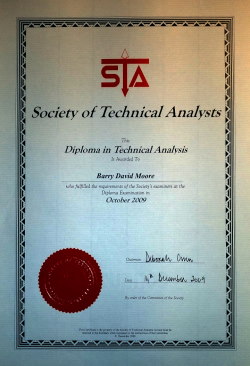
Details of the Ichimoku Cloud Theory can be found on the web. The Society of Technical Analysts have good information on reading and understanding the Ichimoku Charts here.
1. Chart Reading Made Easy. Bar Charts & Candlesticks – Learn Stock Trading
Posted by: | CommentsHow to read a stock chart – Technical Analysis
Welcome back, and welcome to 5th Grade, you are doing well!
This section is all about understanding a basic Chart. Known as “Technical Analysis” Chart reading enables us to visualize a stock not through numbers, but through patterns. It enables us to get to know the stock, see its history, learn its personality and make a value judgment on its future.
We will start with a basic price chart and move on to technical indicators and how to assess their important and meaning in future sessions.
See below a stock chart of INTEL (INTC) what does this tell us? Well an awful lot actually.
What does it tell you?

TeleChart2007 chart courtesy of Worden Brothers, Inc. Read More→
2. Trend Lines, read them or weep! Learn Stock Trading
Posted by: | CommentsIf you cannot draw a Trend-line you should not invest in the stock market!
In this section we will examine how to look at price movement and use it to evaluate the stock.
Price is known as the most important indicator and so it should be, when it boils down to it the most important thing is the price.
Here we can see a chart of Broadcom (BRCM), one of the darlings of the tech bubble; I lost plenty of money on this one through inexperience and greed I have overcome both of these personal flaws since 2001.

TeleChart2007 chart courtesy of Worden Brothers, Inc.
Read More→